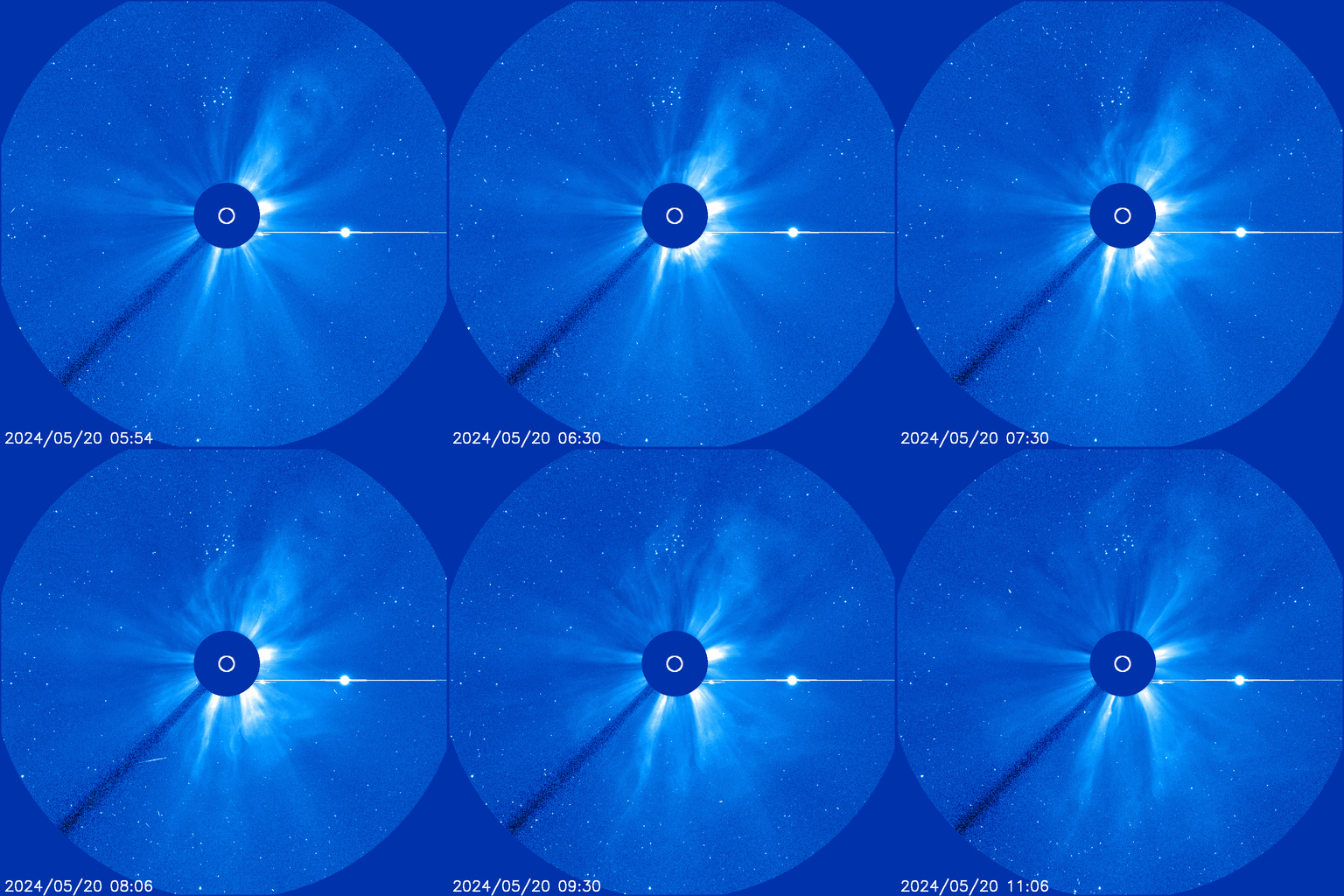
FARSIDE CME TARGETS VENUS: Giant sunspot AR3664 is probably still active on the farside of the sun. We know because yesterday it (or a companion sunspot) hurled a bright full-halo CME into space. According to a NASA model, the storm cloud will make a direct hit on Venus today, potentially stripping away a small amount of that planet's atmosphere. CME impact alerts: SMS Text

MORE AURORAS IN AFRICA: For the first time in more than 30 years, Spaceweather.com has received photos of auroras in Africa. They appeared during the historic geomagnetic storm on May 10, 2024. The latest submissions come from Tivoli Astro Farm in Namibia where Richard Payne photographed the display:
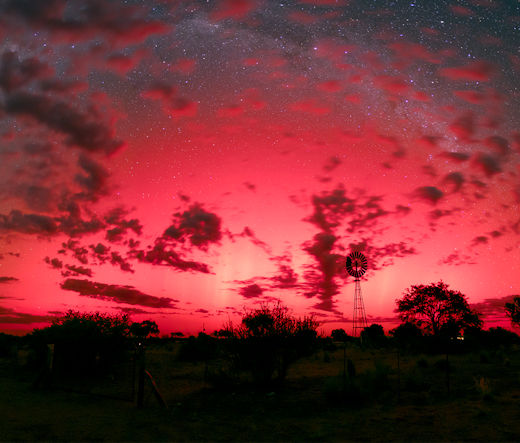
"We could see the auroras with the naked eye," says Payne. "Visually, it was a deep red and very large--about 45 degrees vertical and 135 degrees horizontal." Another guest at the farm, Georg Woeber, also saw the sky turn red. "It was amazing to see this happen from the Tropic of Capricorn (23° S)," says Woeber.
"This is certainly exceptional," says Hisashi Hayakawa, a space weather researcher at Japan’s Nagoya University. "To my knowledge, these are the first auroras in Namibia since 1989."
The lights were also seen from the island of Mauritius east of Madagascar (20.3° S):
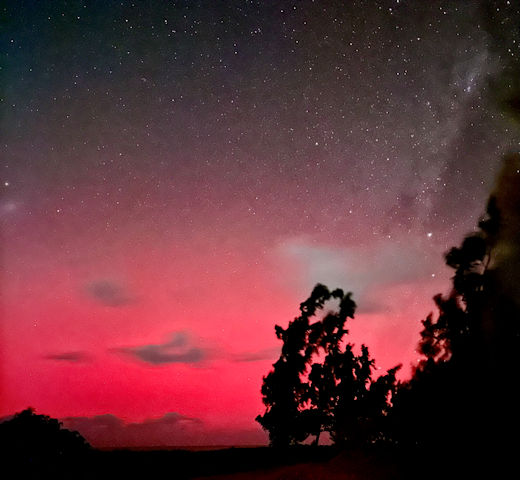
"I couldn't believe my eye!" reports Eric Villars, who was hiking up a mountain near the island's southwest coast. "It was around 04:30 in the morning on the 11th of May. I first saw some pink lights in the sky and thought it was the lights from sunrise--then I realised it was the Southern Lights! I never thought we could see those lights in Mauritius."
The display was also photographed from Namibia's Etosha National Park (18.9° S), from Farm Hakos near Windhoek, Namibia (22.5° S), and from a ship off the coast of Capetown, South Africa (32° S). Taken together, these sightings help confirm that May 10th was a "Great Storm" with one of the most widespread auroral displays of the past 500 years.

Realtime Aurora Photo Gallery
Free: Spaceweather.com Newsletter
18K GOLD TOTAL ECLIPSE PENDANT: This pendant has touched the shadow of the Moon. On April 8, 2024, during a total eclipse of the sun in Texas, the students of Earth to Sky Calculus launched it to the stratosphere onboard a cosmic ray research balloon. Floating more than 118,110 feet high, the locket spent 3 minutes and 45 seconds wrapped in lunar shadow:
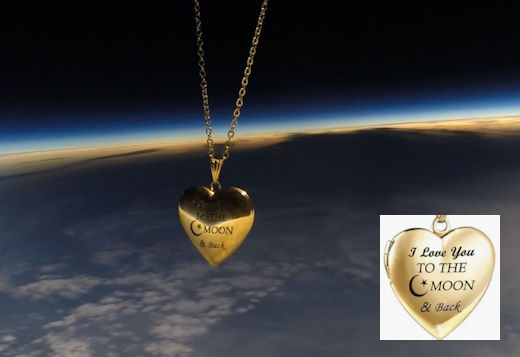
You can have it for $199.95. The 18K gold-plated locket is inscribed with the words "I love you to the Moon and back," and opens to hold a personal photo or other small item. It comes with a greeting card showing the locket in flight and telling the story of its journey to the edge of space during the total eclipse.
Far Out Gifts: Earth to Sky Store
All sales support hands-on STEM education
Realtime Comet Photo Gallery
Free: Spaceweather.com Newsletter
Realtime Space Weather Photo Gallery
Free: Spaceweather.com Newsletter