GEOMAGNETIC STORM WATCH (G1): Minor G1-class geomagnetic storms are possible on May 26th when a CME might graze Earth's magnetic field. The CME was hurled into space on May 23rd (0640 UTC) by an erupting filament of magnetism near the center of the solar disk (S15E05). Solar flare alerts: SMS Text

ROCKS AND SOIL ELECTRIFIED BY THE SUPERSTORM: Across the USA on May 10th and 11th, sky watchers marveled at bright displays of aurora borealis during the biggest geomagnetic storm in decades. Little did they know, something was also happening underfoot.
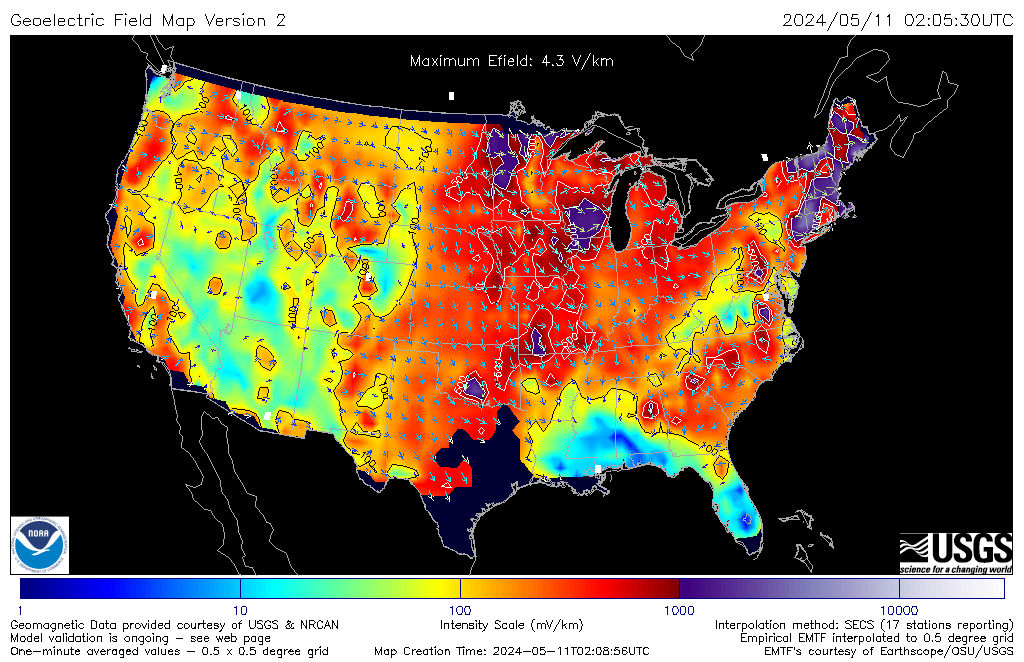
Strong electrical currents were surging through rocks and soil. The biggest voltages along the US eastern seaboard and in the Midwest were as much as 10,000 times normal. A map from NOAA and the US Geological Survey shows some of the 'hot spots' during the early hours of May 11th:
Back in March 1989, voltages only a little stronger than the ones shown above brought down the entire Hydro-Québec power system. The resulting Great Québec Blackout plunged millions of Canadians into darkness.
This time, however, power grids stayed up. "We haven't heard of any serious problems so far," reports Christopher Balch of NOAA's Space Weather Prediction Center.
Balch leads an effort at NOAA to model geoelectric fields during solar storms. The map, above, is a snapshot from a real-time display that takes into account the 3D conductivity of the Earth and ongoing geomagnetic activity. A computer at the Space Weather Prediction Center crunches the data to produce minute-by-minute estimates of electricity in the ground.
"I started working on this in 2011 after a NOAA Space Weather Workshop where representatives from the power industry asked for a geoelectric field model," recalls Balch. "It's a collaboration between NOAA, the US Geological Survey and others; we now have a version that covers much of Canada and the United States"
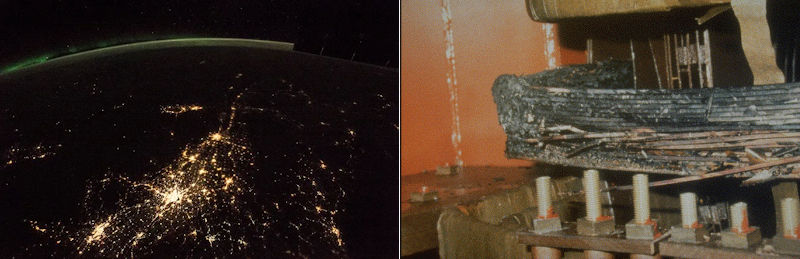
A power blackout (left) and transformer damage (right) during the March 1989 storm.
When researchers talk about geoelectric fields they use units of volts per km (V/km). Earth's crust naturally contains quiet-time fields measuring as little as 0.01 V/km. During geomagnetic storms, these values skyrocket.
"On May 10-11, geoelectric amplitudes exceeded 10 V/km in Virginia and 9 V/km in the upper Midwest," says Jeffrey Love, a key member of the collaboration at the USGS. "These are very high. For comparison, we estimate that geoelectric amplitudes reached almost 22 V/km in Virginia during the March 1989 storm."
This means the May 2024 storm was, electrically speaking, about half as intense as the storm that blacked out Québec 35 years ago. That's too close for comfort. "Although power companies have taken measures to improve the resilience of their systems, no one would welcome another storm as intense as that of March 1989," says Love.
Realtime electric field maps are published 24/7 on the NOAA website. During the next geomagnetic storm, click here to see what's happening underfoot!
Realtime Space Weather Photo Gallery
Free: Spaceweather.com Newsletter
18K GOLD TOTAL ECLIPSE PENDANT: This pendant has touched the shadow of the Moon. On April 8, 2024, during a total eclipse of the sun in Texas, the students of Earth to Sky Calculus launched it to the stratosphere onboard a cosmic ray research balloon. Floating more than 118,110 feet high, the locket spent 3 minutes and 45 seconds wrapped in lunar shadow:
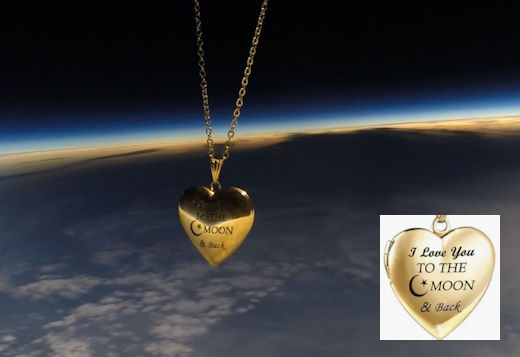
You can have it for $199.95. The 18K gold-plated locket is inscribed with the words "I love you to the Moon and back," and opens to hold a personal photo or other small item. It comes with a greeting card showing the locket in flight and telling the story of its journey to the edge of space during the total eclipse.
Far Out Gifts: Earth to Sky Store
All sales support hands-on STEM education
Realtime Comet Photo Gallery
Free: Spaceweather.com Newsletter
Realtime Aurora Photo Gallery
Free: Spaceweather.com Newsletter