QUIRKY SUNSPOT NAMING TRADITIONS: The most famous sunspot in decades just had its name changed. AR3664, which caused the great May 10th superstorm, has been re-numbered AR3697 following a 2-week trip around the farside of the sun. This is an old tradition in solar physics that started long ago when astronomers had no way to track the continuity of farside sunspots. We will continue to use the old name for clarity. Solar flare alerts: SMS Text
ANOTHER X-FLARE: Old sunspot AR3664 (now AR3697) isn't as big as it used to be, but it is still very active. Today at 1437 UT, it produced an X1.4-class solar flare:
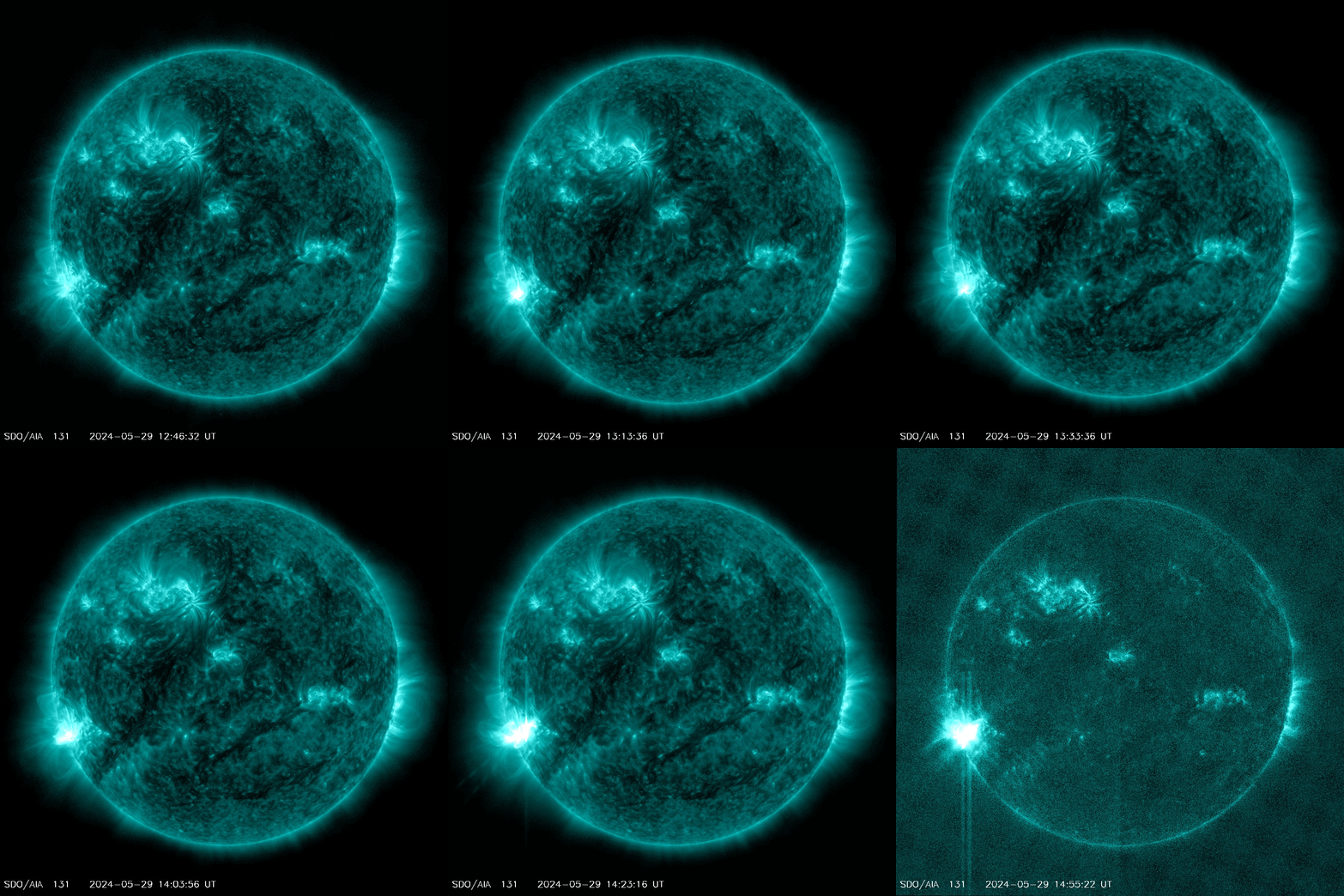
Note: The jiggling of the sun in this movie is not caused by the X-flare. Calibration offsets were underway during the flare. Credit: NASA/Solar Dynamics Observatory.
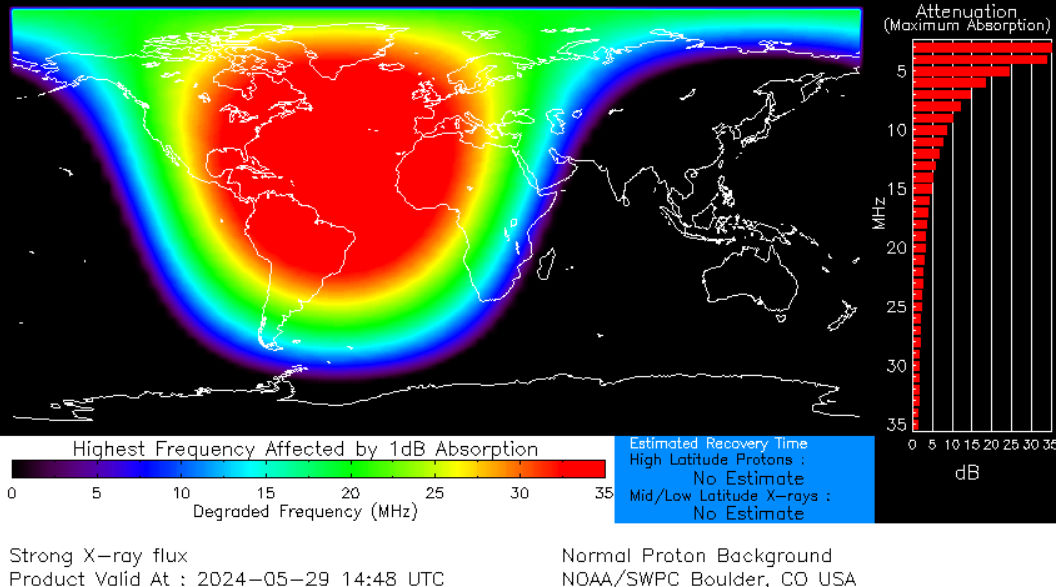
A lengthy pulse of extreme ultraviolet radiation produced a deep shortwave radio blackout over the Americas. Ham radio operators may have noticed loss of signal at all frequencies below 30 MHz for 60 to 90 minutes following the onset of the flare.
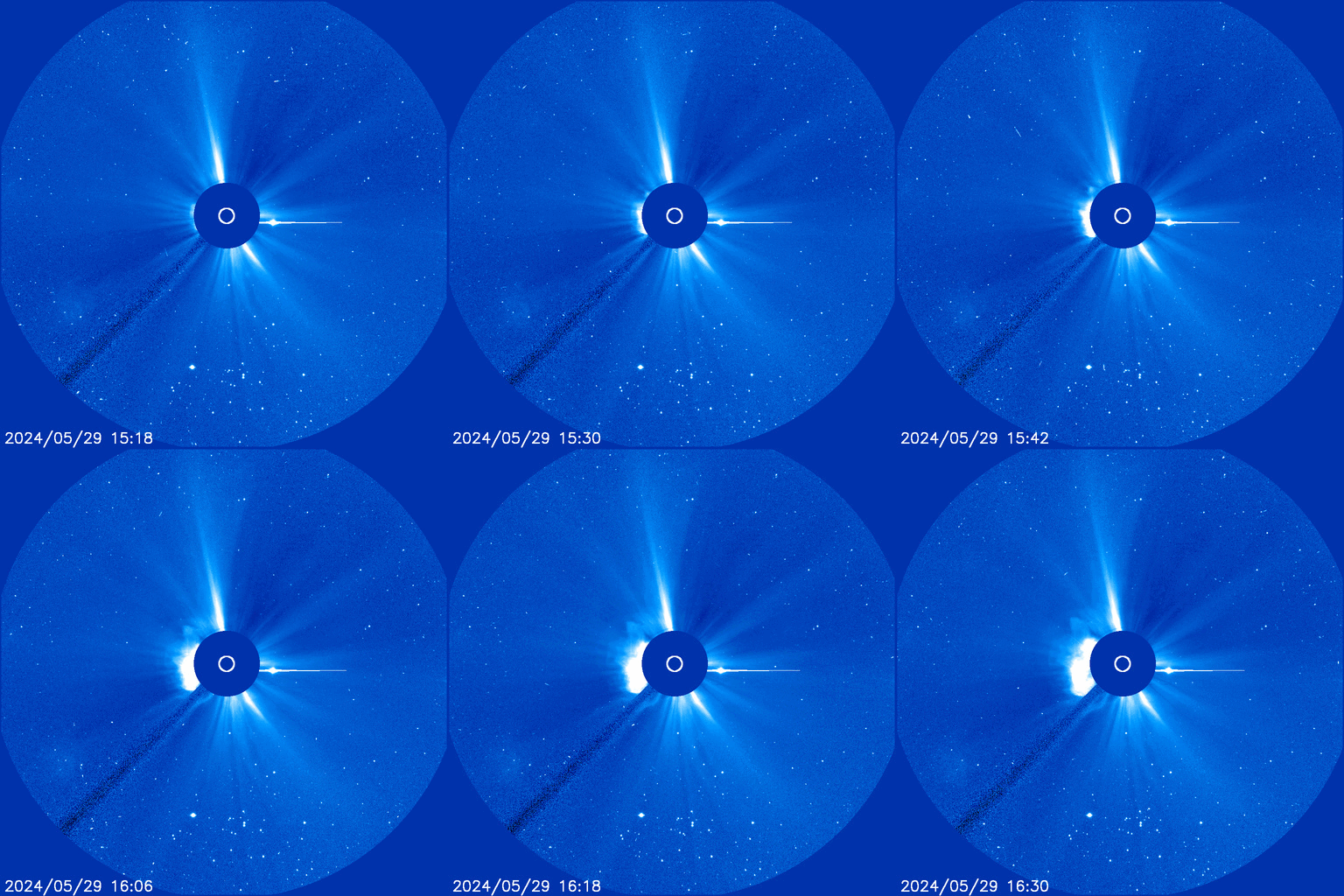
This explosion was remarkable for its duration. The X-class phase alone lasted more than an hour--plenty of time to lift a CME out of the sun's atmosphere. Indeed, SOHO coronagraphs have detected a bright CME emerging from the blast site: movie. We will find out in the hours ahead whether or not the storm cloud has an Earth-directed component. Stay tuned! Solar flare alerts: SMS Text
Realtime Space Weather Photo Gallery
Free: Spaceweather.com Newsletter
THE GREEN GLOW OF SOLAR MAXIMUM: Spoiler alert: These are *not* auroras. On May 28th, a band of green light crossed the Milky Way over rural Colorado. "I photographed the display just before moonrise," reports Aaron Watson of Paonia, CO:
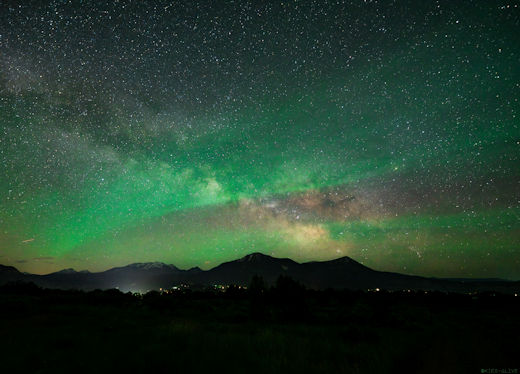
"It was an outburst of bright airglow," says Watson. "The banding was strong and visible to the unaided eye."
Airglow appears on dark nights when oxygen atoms (O) and oxygen molecules (O2) bump together in Earth's upper atmosphere. Collisions between the two species create green photons. This happens every night, but usually the glow is too dim to see with the naked eye.
Solar activity boosts airglow by heating the upper atmosphere. Warmer air causes more collisions and, thus, more green light to emerge. Studies (e.g., 2011, 2015 and 2022) show that airglow is up to 40% brighter when the sun is most active.
May 2024 has been the most active month on the sun in decades. This means *now* is the time to look for airglow. Get away from city lights, wait for the Moon to set, and point your camera at the midnight sky. It might not be as dark as you think.
more images: from Dan Bush of Albany, Missouri
Realtime Space Weather Photo Gallery
Free: Spaceweather.com Newsletter
18K GOLD TOTAL ECLIPSE PENDANT: This pendant has touched the shadow of the Moon. On April 8, 2024, during a total eclipse of the sun in Texas, the students of Earth to Sky Calculus launched it to the stratosphere onboard a cosmic ray research balloon. Floating more than 118,110 feet high, the locket spent 3 minutes and 45 seconds wrapped in lunar shadow:
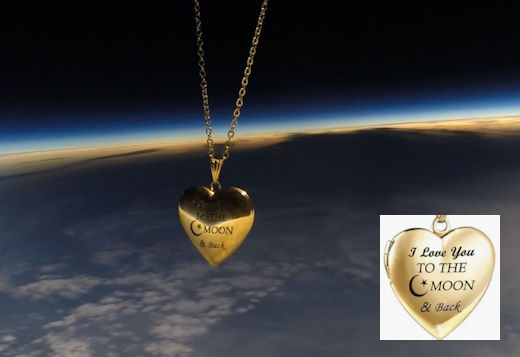
You can have it for $199.95. The 18K gold-plated locket is inscribed with the words "I love you to the Moon and back," and opens to hold a personal photo or other small item. It comes with a greeting card showing the locket in flight and telling the story of its journey to the edge of space during the total eclipse.
Far Out Gifts: Earth to Sky Store
All sales support hands-on STEM education
Realtime Comet Photo Gallery
Free: Spaceweather.com Newsletter
Realtime Aurora Photo Gallery
Free: Spaceweather.com Newsletter