25% CHANCE OF X-FLARES TODAY: Although it has decayed to only a fraction of its former size, sunspot AR3664 (a.k.a. AR3697) still poses a threat for strong Earth-directed solar flares. The active region has a 'beta-gamma-delta' magnetic field, which harbors energy for X-class explosions. NOAA forecasters say there is a 25% chance of X-flares during the next 24 hours. Solar flare alerts: SMS Text
NOCTILUCENT CLOUD SEASON HAS BEGUN: They're back. The northern season for NLCs is underway. The first clouds were detected inside the Arctic Circle on May 25, 2024, by the NOAA 21 satellite. The clouds have since spread, and now observers are seeing from the ground as well:
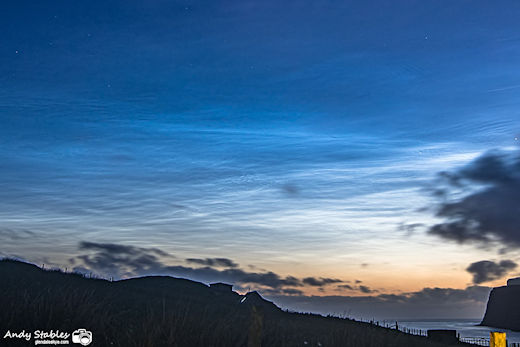
"This was our first display of the season here on the Isle of Skye, Scotland," reports Andy Stables, who photographed the NLCs on June 3rd. "There were some dark tropospheric clouds in the foreground, but we could see a super display of NLCs through the gaps."
NLCs are Earth’s highest clouds. Seeded by meteoroids, they float at the edge of space about 83 km above the ground. NLCs form when summertime wisps of water vapor rise up to the mesosphere, allowing water to crystallize around specks of meteor smoke. In recent years they have spread as far south as Los Angeles and Las Vegas, setting records for low-latitude sightings.
Solar activity is *not* good for noctilucent clouds. Solar flares, sunspots, and generally high levels of solar ultraviolet radiation all conspire to heat Earth's upper atmosphere, stunting the growth of delicate ice crystals at the heart of NLCs. May 2024 saw the biggest outburst of solar activity in decades, so perhaps it's no wonder that the clouds didn't escape the Arctic until June.
To investigate this idea, Lynn Harvey of the University of Colorado Laboratory for Atmospheric and Space Physics plotted temperature data from NASA's Microwave Limb Sounder (MLS), which can sense conditions 83 km high where NLCs form:
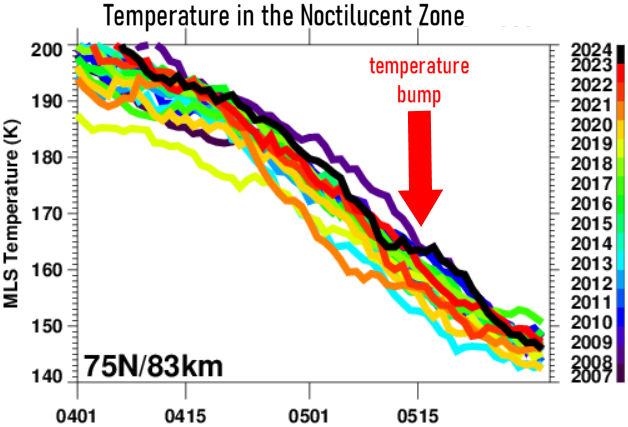
Note the mid-May temperature bump, which coincides with multiple X-class solar flares and the Great Geomagnetic Storm of May 10th. "Those are some of the warmest temperatures since 2007, consistent with a late onset of NLCs," Harvey says.
Although solar activity is high, it may be too soon to conclude that this is a bad year for NLCs. In addition to solar activity, volcanic eruptions (like Tonga) and interhemispheric teleconnections also affect production of the clouds. We simply don't know what will happen next, so stay tuned.
more images: from Alan C Tough of Elgin, Moray, Scotland; from Denis Buczynski of Tarbatness Highland, Scotland
Realtime Noctilucent Cloud Photo Gallery
Free: Spaceweather.com Newsletter
RARE LT. UHURA MUG (COLLECTOR'S ITEM):You can't buy this on Amazon. Only the Earth to Sky Store has the rare Lt. Uhura Coffee Mug. Like the great translator of Star Trek, it has been to space:
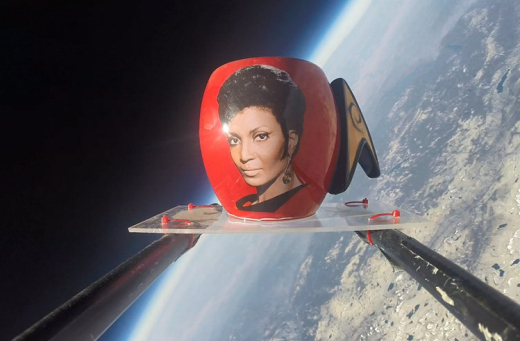
This 16 oz. ceramic mug featuring the face of Nichelle Nichols has flown to the stratosphere onboard an Earth to Sky Calculus cosmic ray balloon. At the apex of the flight, it floated 92,192 feet above the Sierra Nevada mountains of central California.
You can have it for $170.10 (the serial number of the Enterprise divided by 10). It comes with a greeting card showing the mug in flight and telling the story of its journey to the edge of space and back again.
Far Out Gifts: Earth to Sky Store
All sales support hands-on STEM education
Realtime Space Weather Photo Gallery
Free: Spaceweather.com Newsletter
Realtime Comet Photo Gallery
Free: Spaceweather.com Newsletter
Realtime Aurora Photo Gallery
Free: Spaceweather.com Newsletter