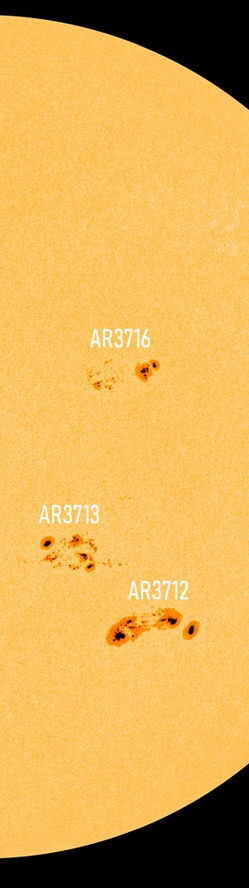
THREE BIG SUNSPOTS: There's a good chance of an Earth-directed solar flare today. Three big sunspots are facing our planet. All three have unstable magnetic fields that pose a threat for M- or X-class explosions. Solar flare alerts: SMS Text
CALIFORNIA STARLINK LAUNCH: Last night in California, SpaceX ended a 10-day drought of rocket launches with a Falcon 9 liftoff from Vandenberg Space Force Station. Carrying 20 Starlink satellites, the ascending rocket was visible as far away as Arizona:
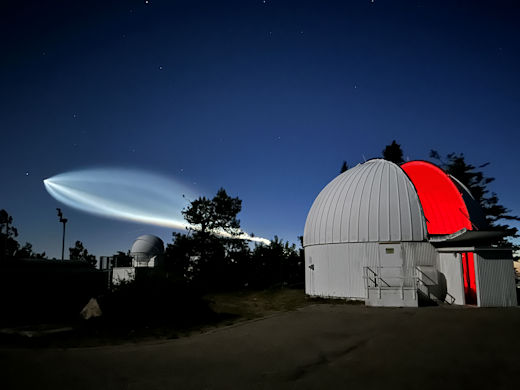
"We had an excellent view of Tuesday evening’s launch from the Mt. Lemmon Observatory (9157 ft) in Arizona," reports Don McCarthy, director of the Beginning Teen Astronomy Camp. "The contrast of the rocket’s plume against the clear, twilight sky was excellent."
Rewind: A "10-day drought?" No so long ago, launching rockets every 10 days would have been considered rapidfire. Now it's a drought. SpaceX has changed the way we think about launch statistics. In 2024 alone, the company has launched 44 Starlink missions, bringing the total number of those internet satellites in orbit to 6,633. The next Falcon 9 launch is scheduled for June 20th from Cape Canaveral. The "drought" is over.
more images: from David Blanchard of Flagstaff, AZ; from Paul D. Maley of New River, Arizona; from Tim Kittell of Carlsbad, CA;
Realtime Space Weather Photo Gallery
Free: Spaceweather.com Newsletter
SUPERSTORM ZAPS THE GLOBAL ELECTRIC CIRCUIT: The geomagnetic superstorm of May 10, 2024, did more than spark some of the best auroras in 500 years. It also electrified our planet.
"Our sensors measured a significant change in atmospheric electricity," reports Prof. Gang Li, a space physicist at the University of Alabama. "Earth's entire global electrical circuit was affected by the storm."
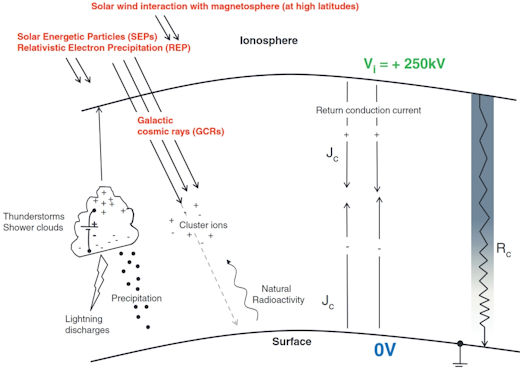
Credit: K. A. Nicoll's 2014 review paper "Space Weather influences on Atmospheric Electricity" [ref]
Yes, Earth has a "global electrical circuit." It is created by thunderstorms, which build up a charge difference between the ground and the ionosphere 50 km overhead. There are about 40,000 thunderstorms per day all over the Earth, and we can think of them as batteries pumping the electricity to the top of the atmosphere. The resulting voltage drop is a staggering 250,000 volts.
On its own, air is not a great conductor of electricity. However, cosmic rays from deep space ionize our atmosphere, creating just enough conductivity for currents to flow in response to those 250,000 volts. The very air you breath is thus electrified.
In April 2024, Li and colleagues published a paper in the journal Space Weather about solar storms and the global electric circuit. They described how CMEs approaching Earth sweep aside cosmic rays, decreasing their intensity. This is called a "Forbush Decrease," named after American physicist Scott Forbush who studied cosmic rays in the early 20th century. During a Forbush Decrease, fewer cosmic rays are available to ionize Earth's atmosphere; this, in turn, changes the conductivity of the entire global electrical circuit. Li's team found that large Forbush Decreases boosted electric fields in the atmosphere.
The CME that hit Earth on May 10, 2024, caused a very large Forbush Decrease. "It was a boon to our research," says Li.
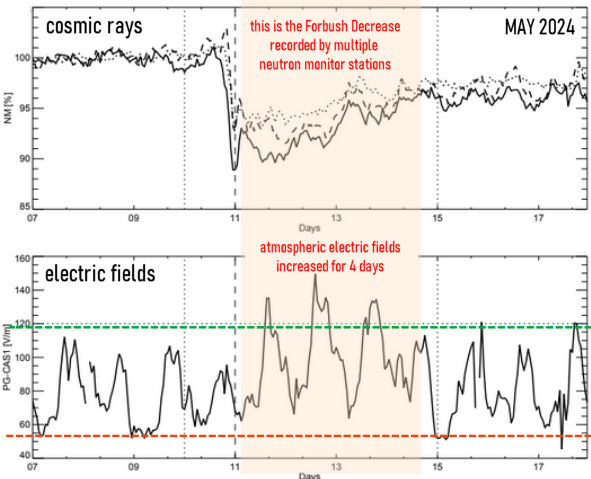
Li and colleagues checked two electric field monitoring stations at the CASLEO observatory in Argentina--a site they often use to monitor the global electrical circuit. During the May 10th superstorm, electric fields jumped 10% to 15%, an increase that lasted for more than four days. "This is in good accord with what we would have predicted based on our paper," he says.
Such changes in atmospheric electricity can affect many things ranging from the probability of rain and lightning to the flight paths of ballooning spiders, which ride electric fields through the air. Indeed, arachnids may have known of this phenomenon all along, but humans are only learning about it now.
Read Li's original research here.Realtime Space Weather Photo Gallery
Free: Spaceweather.com Newsletter
STAR TREK CHRISTMAS ORNAMENT: No Trekkie Christmas tree is complete without The Arena Ornament. This rare Hallmark keepsake depicts the reptilian Gorn poised to deliver a death blow to Capt. James T. Kirk on the planet Cestus III. On June 14, 2024, it flew to the edge of space onboard a cosmic ray research balloon:
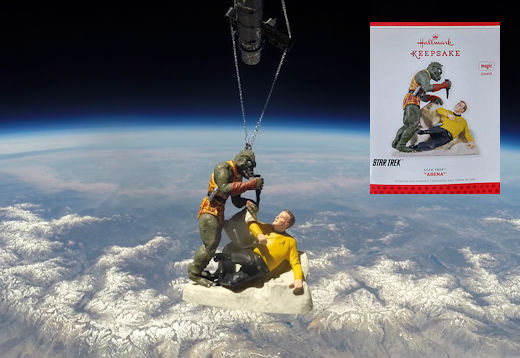
You can have it for $135.95. The ornament depicts a famous scene from The Original Series episode "Arena" first broadcast on January 19, 1967. Decades later, the Gorn have become main villians on the new Star Trek series Strange New Worlds, which we love!
The ornament comes with a Christmas card showing Kirk and the Gorn in flight, and certifying they have traveled to the edge of space and back again.
Far Out Gifts: Earth to Sky Store
All sales support hands-on STEM education
Realtime Comet Photo Gallery
Free: Spaceweather.com Newsletter
Realtime Aurora Photo Gallery
Free: Spaceweather.com Newsletter
Realtime Noctilucent Cloud Photo Gallery
Free: Spaceweather.com Newsletter