THAT POTENT OLD SUNSPOT IS BACK: Old sunspot AR3664, which caused the May 10th superstorm, has returned. This is its 3rd trip across the solar disk. Per tradition, it has been re-numbered 3 times: Originally AR3664, then AR3697, now AR3723. X-flares are possible as it once again turns to face Earth. Solar flare alerts: SMS Text
NOCTILUCENT CLOUDS VS. SOLAR MAX: Europe just experienced a outburst of noctilucent clouds (NLCs) so bright that Danish photographer Ruslan Merzlakovs didn't even have to go outside. "I could photograph them right through my window," he says.

Similar displays were seen from France, Austria, Germany, the Netherlands, England, Poland, Slovakia, and Belgium. It was a widespread display.
2024 is supposed to be a bad year for noctilucent clouds. High solar activity is warming Earth's upper atmosphere and breaking apart water molecules necessary for noctilucent ice. Previous studies have shown that NLCs retreat during years around Solar Max.
But solar activity isn't the only factor. NLCs form when summertime wisps of water vapor rise to the edge of space, frosting specks of meteor debris. Extra moisture pumped into the atmosphere by the undersea eruption of the Tonga volcano could be giving the clouds an edge. Interhemispheric teleconnections influence the temperature and moisture available for NLCs as well.
Earth-orbiting satellites also detected the June 23rd display. Each dot in this map is a cloud of "noctilucent ice" detected by NOAA's Suomi NPP weather satellite:
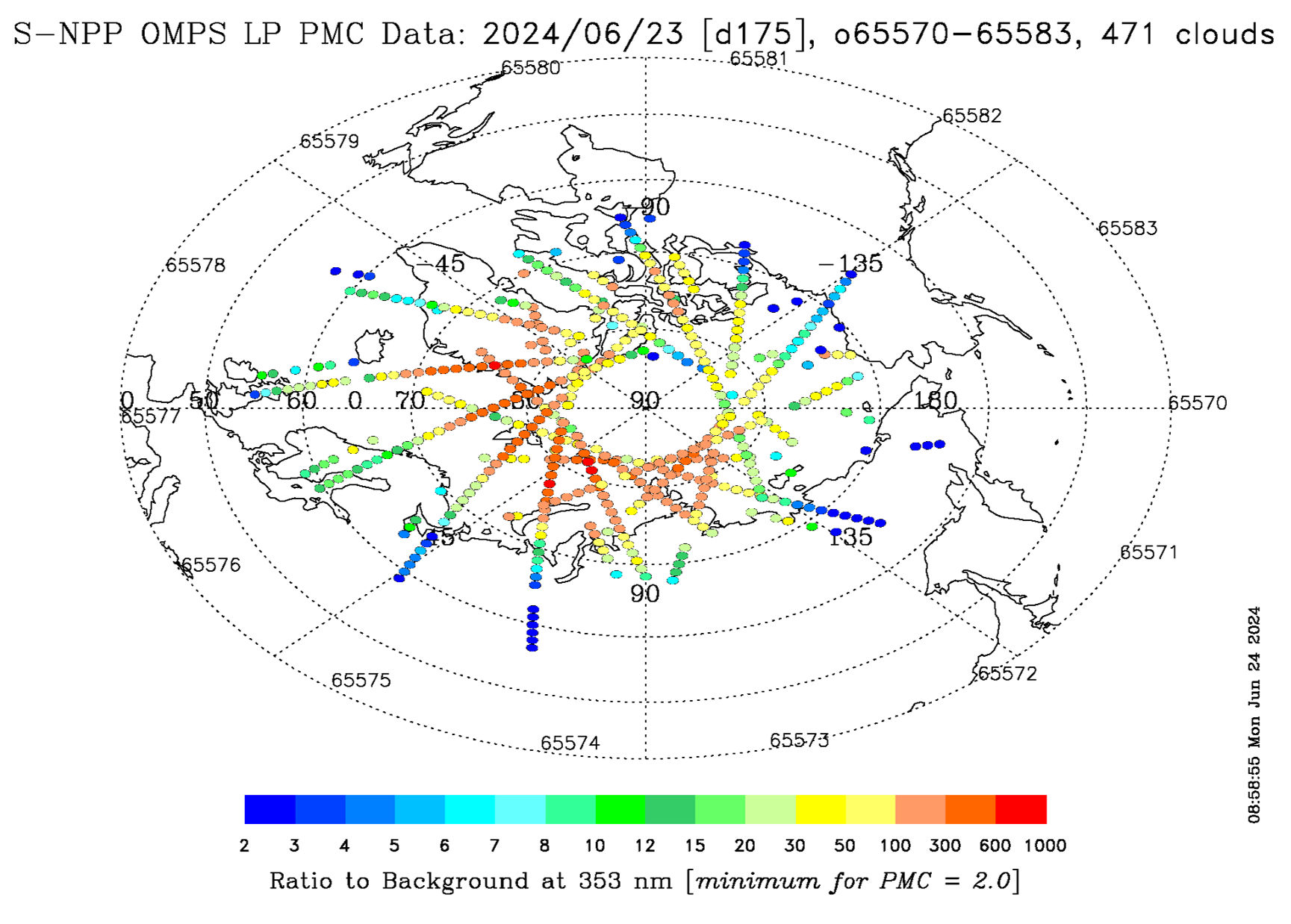
"These data show a nice line of NLCs down to a latitude of ~55° N over the British Isles," says Matthew Deland, Chief Research Scientist at NASA contractor SSAI. Deland works with data from multiple Earth-orbiting satellites, and he provides the maps for our daily NLC reports on Spaceweather.com.
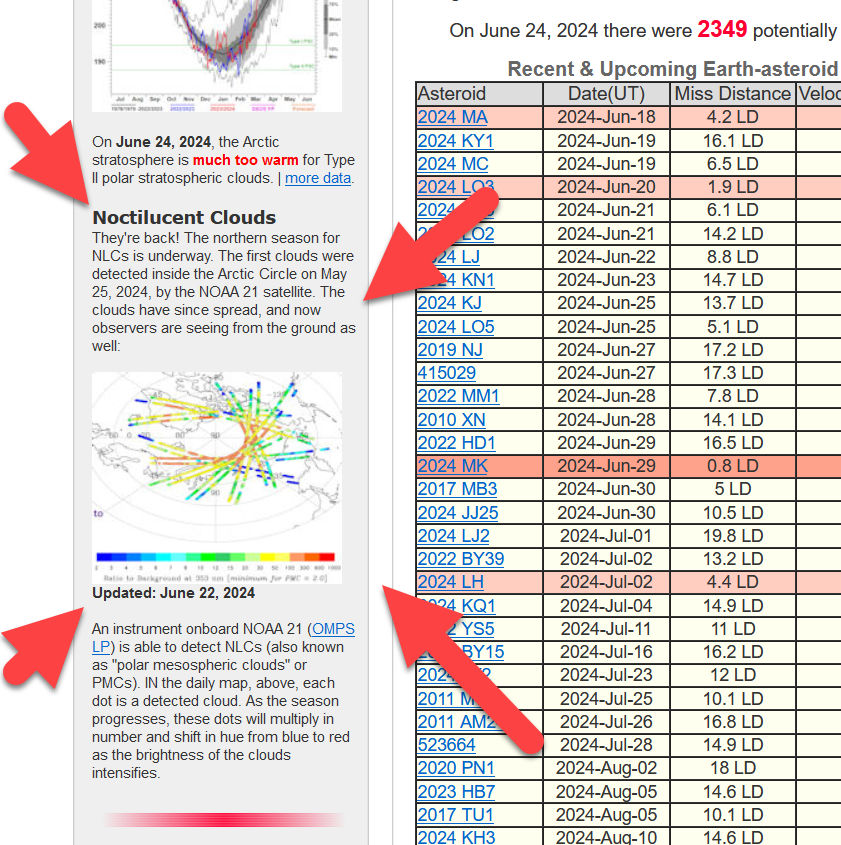
Ground-based observers saw the clouds at even lower latitudes than satellites did--for example, Paris at +48.9° N. This means photographers have an important role to play in tracking their spread. Wherever you live, be alert for electric blue, and if you see an NLC, submit your pictures here.

Realtime Noctilucent Cloud Photo Gallery
Free: Spaceweather.com Newsletter
PREMIUM GEOMAGNETIC BLACK PEARL: On May 10, 2024, a CME slammed into Earth's magnetic field, sparking the biggest geomagnetic storm in 35 years. Moments later, the students of Earth to Sky Calculus launched a cosmic ray balloon directly into the storm. The Geomagnetic Black Pearl went along for the ride:
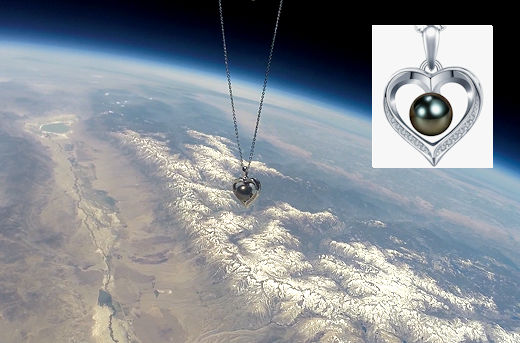
You can have it for $349.95. Measuring 9 mm in diameter, and mounted inside a sterling silver heart, this premium Tahitian pearl floated through the stratosphere for 3 hours while sensors measured the storm's radiation.
Later, when the sun set and the sky grew dark, red and green auroras danced above the Sierra Nevada mountains of California where the balloon was launched. A picture of these auroras is included with the pearl, along with a greeting card showing the pearl in flight.
Far Out Gifts: Earth to Sky Store
All sales support hands-on STEM education
Realtime Comet Photo Gallery
Free: Spaceweather.com Newsletter
Realtime Aurora Photo Gallery
Free: Spaceweather.com Newsletter
Realtime Space Weather Photo Gallery
Free: Spaceweather.com Newsletter