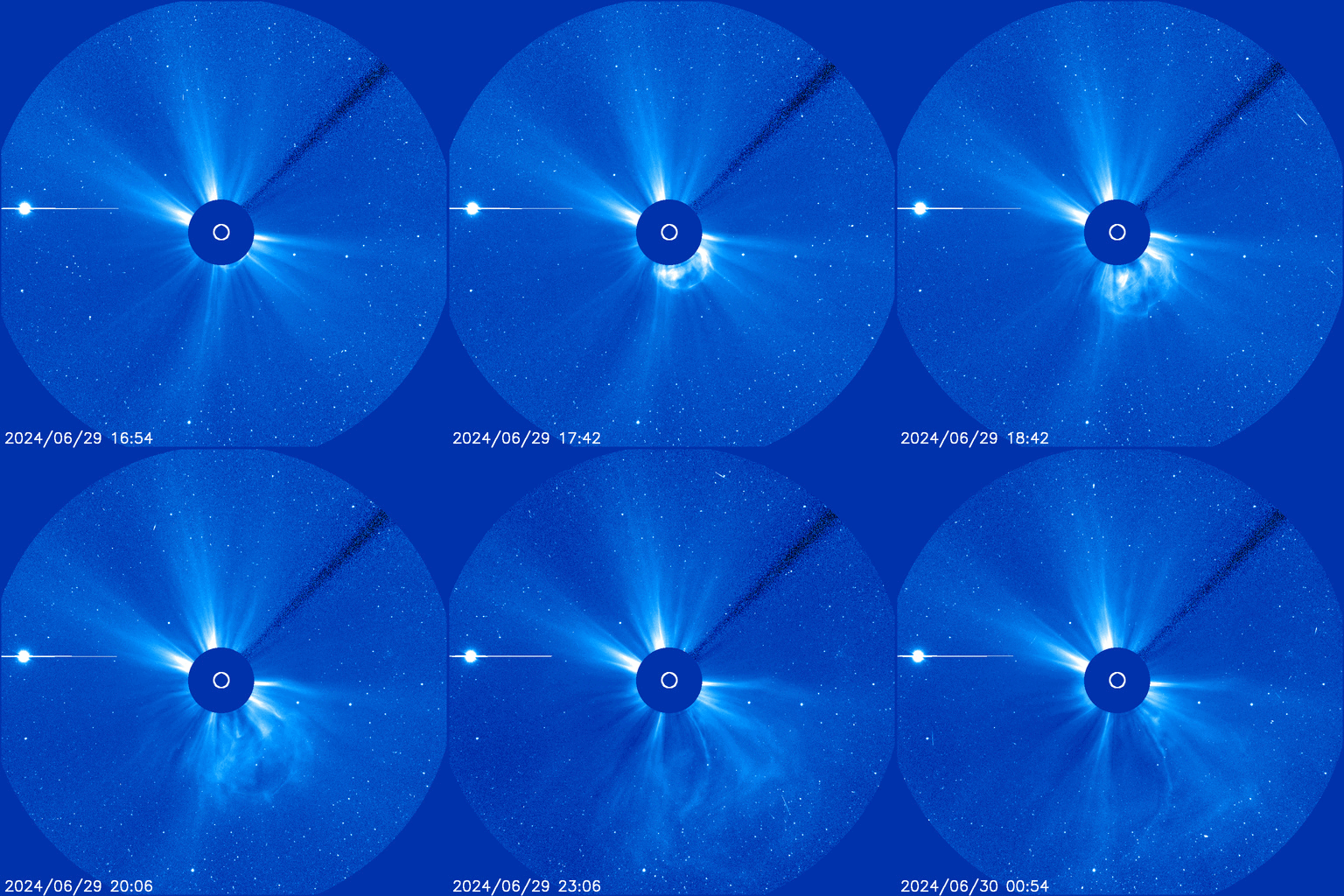
GEOMAGNETIC STORM WATCH (G1): NOAA forecasters say that G1-class geomagnetic storms are possible on July 3rd when this CME is expected to graze Earth's magnetic field. The approaching CME was hurled into space by an erupting magnetic filament in the sun's southern hemisphere. Aurora alerts: SMS Text

GREEN GHOSTS IN A GEOMAGNETIC STORM: This picture may be the first of its kind. On June 27th, photographer Tom Warner of South Dakota caught a bunch of Green Ghosts in a geomagnetic storm:

"This was a huge bucket list item for me," says Warner. "An MCS thunderstorm was moving through the area, so I set up my camera to photograph sprites. The auroras and the Green Ghosts were NOT expected!"
Everyone knows what auroras are. Green Ghosts are still new to many observers. They're the green blobs on top of the red sprites. Experienced observers say they appear in as few as 0.2% of sprite photos.
"Tom Warner's green ghost is very clear--and certainly an unusual sight combined with aurora!" says Oscar van der Velde, an upper atmospheric lightning researcher at the Universitat Politécnica de Catalunya.

Green Ghosts were discovered in May 2019 by Hank Schyma, a Houston Texas-based storm chaser. Initially, researchers thought they might be a form of green airglow activated by sprites when they touched a layer of oxygen 80 to 90 km above Earth's surface. Indeed, Ghost is an acronym: "Green emissions from excited Oxygen in Sprite Tops."
New research casts doubt on that explanation. A paper recently published in Nature Communications reports a Herculean effort to decode the color of Green Ghosts. About a month after Schyma discovered the phenomenon, a team of lightning scientists led by María Passas Varo of the Instituto de Astrofísica de Andalucía began chasing thunderstorms, hoping to catch a Green Ghost in the slit of their spectrograph. It wasn't easy. Green Ghosts appear unpredictably and often last for no more than a fraction of a second. Four years and 2000 spectra later, they managed to capture just one spectrum of a Green Ghost strong enough to study. The results surprised them.
Green Ghosts, it seems, are made of metal.
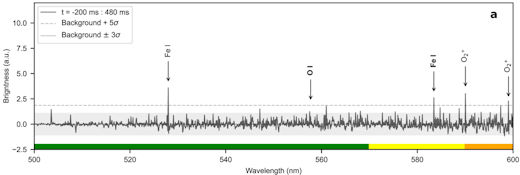 Spectrum of a Green Ghost over the Mediterranean in Sept. 2019. [full caption] [source]

"We identified a mix of spectral lines, including mainly iron, nickel, oxygen and nitrogen, that when combined, produced a green-yellow glow," says van der Velde, a co-author of the study. "There were also traces of sodium and silicon."
This metal-rich stew is more like meteor debris than airglow. Iron atoms deposited by meteors burning up in Earth's atmosphere peak in abundance 85 km high--about right for the tops of the tallest sprites. Green Ghosts might thus be a type of "meteor fluorescence."
Or not. These conclusions are based on just one spectrum, and Green Ghosts may be far more varied than that. Stay tuned for updates as the research continues.
Realtime Space Weather Photo Gallery
Free: Spaceweather.com Newsletter
THIS PENDANT HAS TOUCHED THE SHADOW OF THE MOON: On April 8, 2024, the students of Earth to Sky Calculus launched a cosmic ray research balloon directly into a total eclipse of the sun. This handmade pendant went along for the ride. Floating more than 118,110 feet above the path of totality in Texas, the necklace spent 3 minutes and 45 seconds wrapped in the shadow of the Moon:
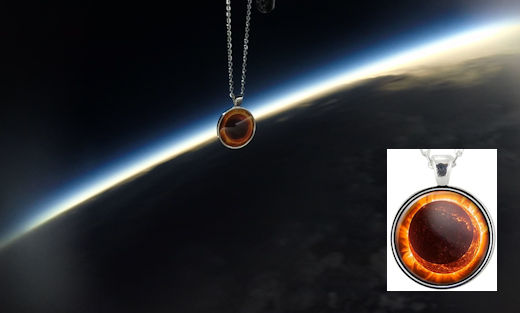
You can have it for $149.95. Created by an artist in Texas where the balloon was launched, the pendant displays a solar eclipse art print sealed under a smooth glass cover. It comes with a greeting card showing the pendant in flight and telling the story of its journey to the edge of space during the total eclipse.
Far Out Gifts: Earth to Sky Store
All sales support hands-on STEM education
Realtime Comet Photo Gallery
Free: Spaceweather.com Newsletter
Realtime Aurora Photo Gallery
Free: Spaceweather.com Newsletter
Realtime Noctilucent Cloud Photo Gallery
Free: Spaceweather.com Newsletter