QUIET WEEKEND: With no CMEs heading for Earth, geomagnetic storms are unlikely for the next three days. Quiet conditions should persist through the holiday weekend and possibly beyond if solar activity remains low. Aurora alerts: SMS Text
WATCH FIREFLY PUNCH A HOLE IN THE IONOSPHERE: When Firefly Aerospace's Alpha rocket launched from Vandenberg Space Force Base in California on July 3rd, astronomer David Blanchard of Flagstaff, Arizona, thought he might be too far away to see. Instead, he had a front row seat as the rocket punched a huge glowing-red hole in the ionosphere:
"I wish I had started the video capture earlier, but I was using a telephoto lens expecting the rocket to be small and far downrange," says Blanchard. "When I realized how large it was, I swapped in a wide angle lens and re-started recording mid-flight."
The lingering red glow in Blanchard's movie is "the hole." Earth's ionosphere is a layer of electrically-conducting gas enveloping our planet more than 100 km high. It plays a key role in shortwave radio communications and GPS positioning. When Alpha burned through the ionosphere, water and carbon dioxide in therocket's exhaust quenched local ionization by as much as 70%. Red light is the afterglow of this process.
Firefly Aerospace isn't the first to do this. Indeed, the phenomenon has been repeatedly observed and studied for decades. However, ionospheric holes are opening more often than ever before--an unintended side effect of record-high launch rates led by SpaceX's almost-weekly Starlink missions.
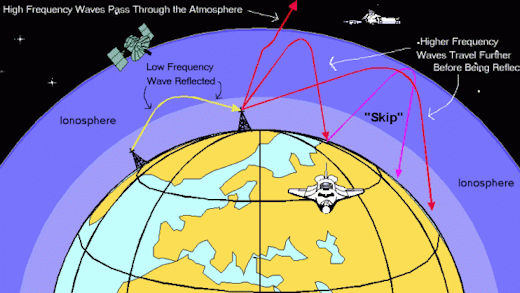
A NOAA diagram of the ionosphere
Ham radio operators may notice ionospheric holes when shortwave signals fail to skip over the horizon, shooting through holes instead of bouncing back to Earth. Sudden GPS errors may also result from the anomalies. So far as we know, these effects are short-lived. The holes close (i.e., "re-ionization occurs") as soon as the sun comes up in the morning.
No harm done? Probably. But with launch rates continuing to climb, we are entering uncharted territory. Observers are encouraged to photograph nighttime launches and check their images for the telltale red glow. There may be much to learn.
Note: Human eyes are notoriously insensitive to the 6300 Å color of ionospheric holes. Cameras have no trouble, though. "Neither my wife nor I could see the red 'rocket aurora' in real time," notes Blanchard. "But it showed up well in the images."
more images: from Paul D. Maley of Scottsdale, Arizona; from Chris Cook of Long Beach, California; from Stephen Sullivan of Malibu, California; from Jeremy Perez north of Flagstaff, Arizona; from Howard Rowe of Chimney Rock National Monument, Colorado
Realtime Space Weather Photo Gallery
Free: Spaceweather.com Newsletter
STERLING SILVER RAINBOW DRAGONFLY (GOLDEN HEART): Are you looking for a far-out gift? Consider a rainbow dragonfly from the edge of space. On June 3rd, this sterling silver pendant hitched a ride onboard an Earth to Sky Calculus cosmic ray research balloon:
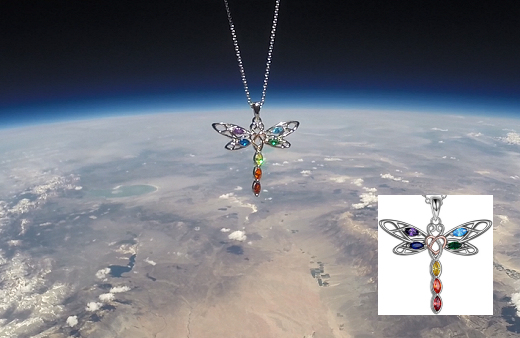
You can have it for $172.95. The dragonfly's heart is a golden Celtic love knot, and its wings are decorated with a spray of rainbow-colored crystals. The students are selling dragonfly pendants to support their cosmic ray ballooning program. Each one comes with a greeting card showing the pendant in flight and telling the story of its trip to the stratosphere and back again.
Far Out Gifts: Earth to Sky Store
All sales support hands-on STEM education
Realtime Comet Photo Gallery
Free: Spaceweather.com Newsletter
Realtime Aurora Photo Gallery
Free: Spaceweather.com Newsletter
Realtime Noctilucent Cloud Photo Gallery
Free: Spaceweather.com Newsletter