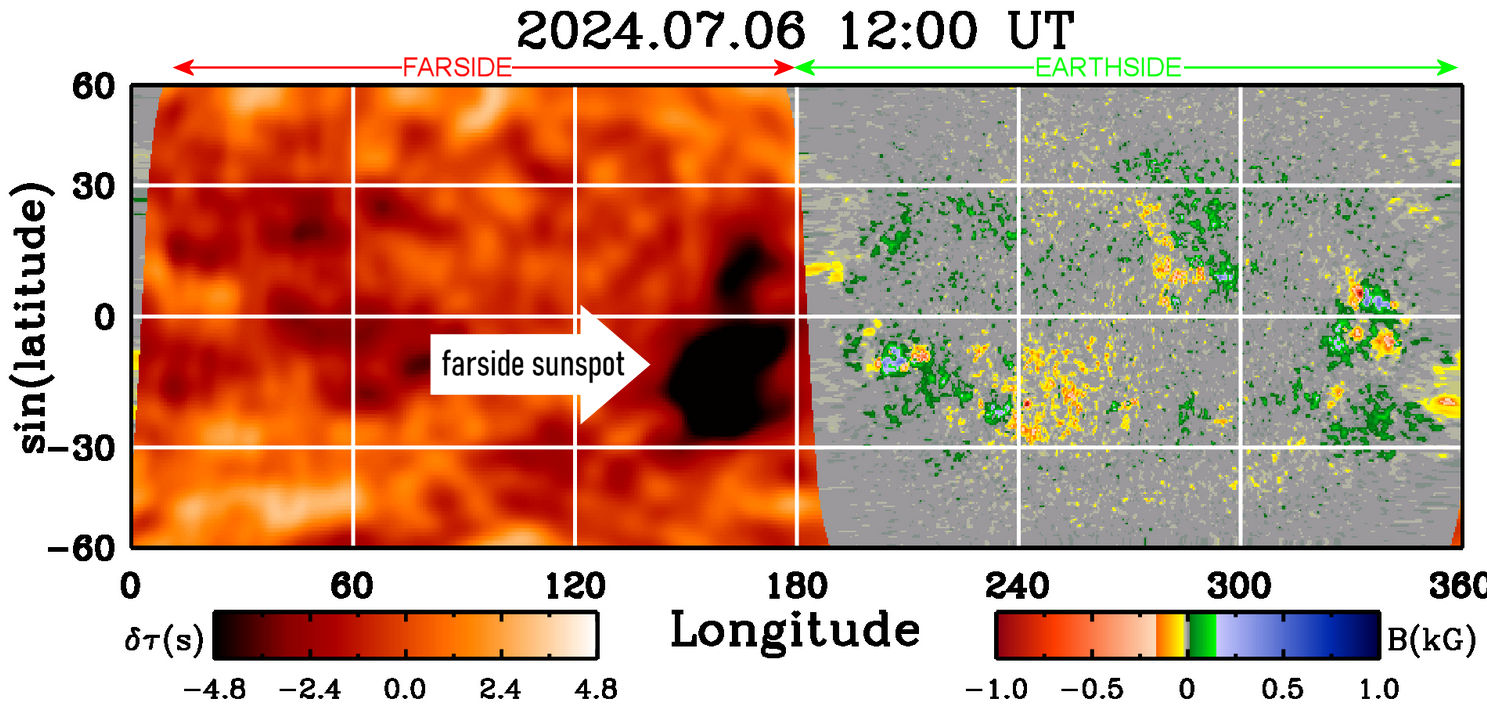
FARSIDE SUNSPOT: A potentially-large sunspot group is hiding just behind the sun's southeastern limb. It's the big dark spot in this helioseismic map of the sun's farside. The active region will rotate onto the Earthside of the sun early this week. Solar flare alerts: SMS Text
WHAT JUST HAPPENED TO COMET OLBERS? A gust of solar wind hit it. Don Bartlett of June Lake, California, photographed 13P/Olbers on the 4th of July and found its tail twisted into a corkscrew shape. "The sun is having fun with this comet," he says.
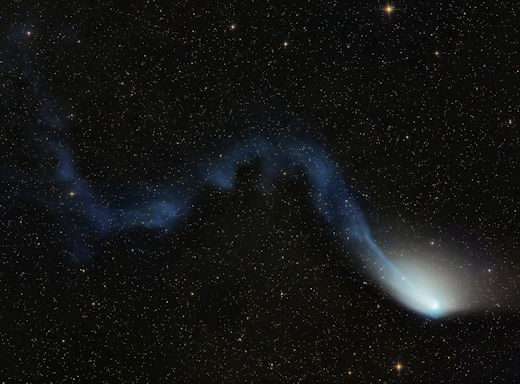
"I've imaged 13P every night since June 22nd, without a hiccup, and this comet changes nightly," says Bartlett.
The reason: Solar activity. Comet Olbers is making its closest approach to the sun in 69 years. Falling inward from the outer solar system, it has arrived just in time for Solar Max. CMEs and other gusts of solar wind are buffeting the comet daily, causing its tail to shape-shift in interesting ways.
48 hours later in Slovakia, astronomer Petr Horálek saw the same curlicues rippling downstream:

"On July 6th, I was lucky to capture its beautiful tail while the comet was moving over cloudy Gerlachovsky Peak, the highest peak of Slovakia located in the High Tatras mountains," says Horálek.
"If you want to see this comet and you are located in the Northern Hemisphere, try your luck in the upcoming days before the Moon becomes too bright again," he advises. "After sunset, the comet may be found low over the northwest horizon beneath the constellation Ursa Major."
The comet is magnitude +6.8, too dim for the naked eye, but an easy target for backyard telescopes. Point your optics here.
more images: from Chris Schur of Payson, Arizona; from Ujvárosi Beáta using a remotely-controlled telescope in Spain; from Jeremy Perez north of Flagstaff, Arizona
Realtime Space Weather Photo Gallery
Free: Spaceweather.com Newsletter
STERLING SILVER RAINBOW DRAGONFLY (GOLDEN HEART): Are you looking for a far-out gift? Consider a rainbow dragonfly from the edge of space. On June 3rd, this sterling silver pendant hitched a ride onboard an Earth to Sky Calculus cosmic ray research balloon:
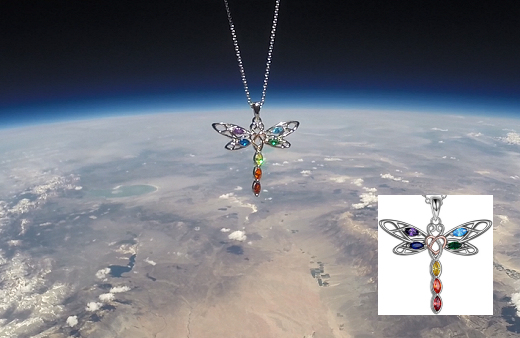
You can have it for $172.95. The dragonfly's heart is a golden Celtic love knot, and its wings are decorated with a spray of rainbow-colored crystals. The students are selling dragonfly pendants to support their cosmic ray ballooning program. Each one comes with a greeting card showing the pendant in flight and telling the story of its trip to the stratosphere and back again.
Far Out Gifts: Earth to Sky Store
All sales support hands-on STEM education
Realtime Comet Photo Gallery
Free: Spaceweather.com Newsletter
Realtime Aurora Photo Gallery
Free: Spaceweather.com Newsletter
Realtime Noctilucent Cloud Photo Gallery
Free: Spaceweather.com Newsletter