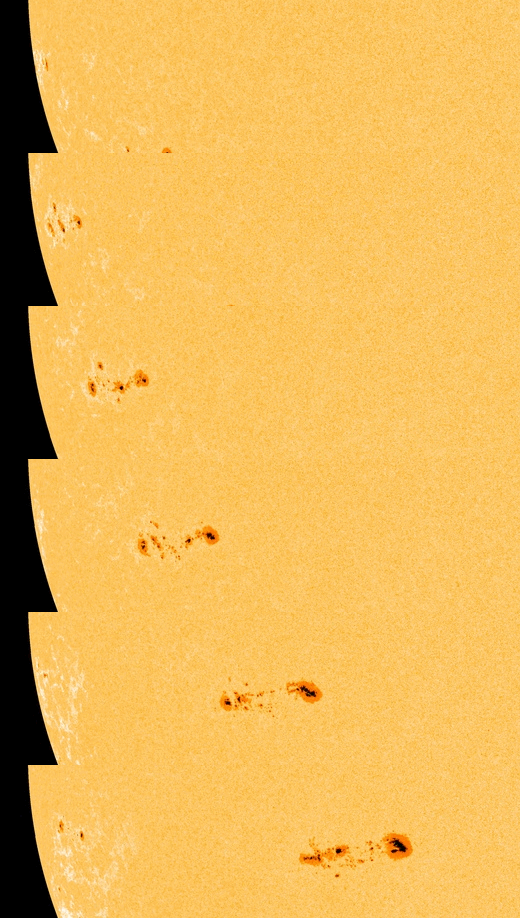
A FAST-GROWING SUNSPOT: Sunspot AR3738 is getting really big. Watch this movie showing how it has grown in the past 5 days. Now almost ten times wider than Earth, the sunspot group is directly facing our planet with a 'beta-gamma' magnetic field that harbors energy for geoeffective solar flares. Solar flare alerts: SMS Text
IS THIS COMET DOOMED? Comet Tsuchinshan-ATLAS (C/2023 A3) is about to fall apart. It's "inevitable," according to a new study by astronomer Zdenek Sekanina. "Evidence suggests that the comet has entered an advanced phase of fragmentation," he writes.
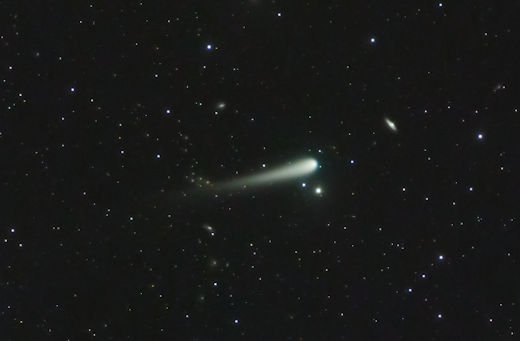
Above: Comet Tsuchinshan-ATLAS photographed by José J. Chambó
If true, this is disappointing news. Discovered in early 2023, the comet appears to be heading for a magnificent close encounter with the sun later this year, perhaps becoming as bright as Venus in October 2024. Instead, it could fall apart before it has a chance to become a naked-eye object.
Sekanina's arguments are threefold: First, the comet has failed to brighten as it approaches the sun. Second, the comet's orbit seems to be affected by a "non-gravitational acceleration." This could happen if, say, inner jets are pushing apart a disintegrating nucleus. Third, the comet's dust tail has an unusually narrow, teardrop shape with a peculiar orientation.
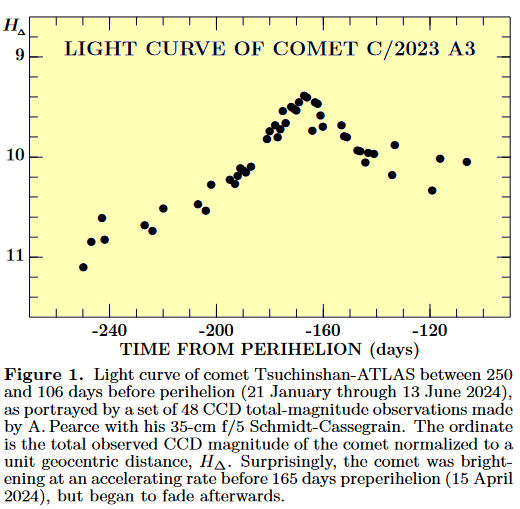
Together, these observations suggest a crumbling comet "in which increasing numbers of fractured refractory solids stay assembled in dark, porous blobs of exotic shape, becoming undetectable as they gradually disperse in space," says Sekanina.
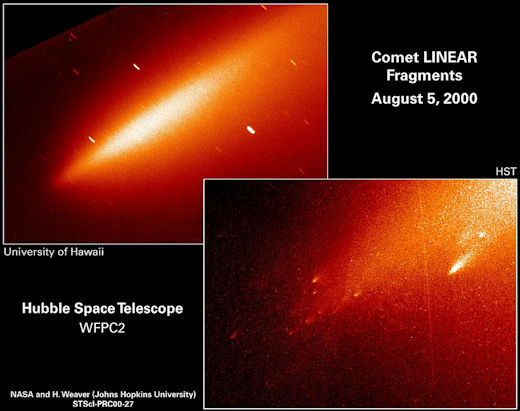
Above: This is what a break-up looks like--Comet LINEAR 24 years ago.
"That is a fascinating paper," says Nick James, director of the Comet Section of the British Astronomical Association. "Sekanina is very well respected in the field, so it carries a lot of weight. To use 'inevitable' in any prediction about a comet may be unwise! But it is definitely a testable theory and another good reason to observe this comet at every opportunity."
In fact, James isn't convinced. In an independent data set, he finds no evidence of non-gravitational accelerations. "This doesn't look like a comet that is fragmenting to me," he says.
We'll soon find out. The comet is brighter than 10th magnitude, well within range of mid-sized backyard telescopes, which means amateur astronomers can monitor the potential break-up. Point your optics here.
Realtime Space Weather Photo Gallery
Free: Spaceweather.com Newsletter
RARE LT. UHURA CHRISTMAS ORNAMENT:You can't buy this on Amazon. The rare Lt. Uhura Christmas Ornament is only available from the Earth to Sky Store. On July 4, 2024, the ornament flew to the stratosphere onboard a cosmic ray research balloon, reaching an altitude of 117,107 feet:
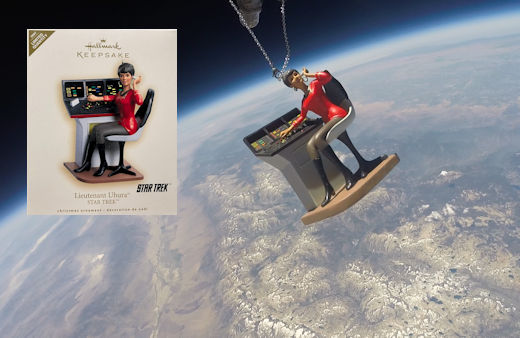
You can have it for $159.95. Sculpted in the likeness of actress Nichelle Nichols, who portrayed Lt. Uhura in the original television series and six Star Trek feature films, the ornamant shows the communications officer on the bridge of the starship Enterprise. It comes with a greeting card showing Uhura in flight, and certifying that she has traveled to the edge of space and back again.
The students of Earth to Sky Calculus are selling space ornaments to support their cosmic ray ballooning program. Don't wait for Christmas--get yours now!
Far Out Gifts: Earth to Sky Store
All sales support hands-on STEM education
Realtime Comet Photo Gallery
Free: Spaceweather.com Newsletter
Realtime Aurora Photo Gallery
Free: Spaceweather.com Newsletter
Realtime Noctilucent Cloud Photo Gallery
Free: Spaceweather.com Newsletter