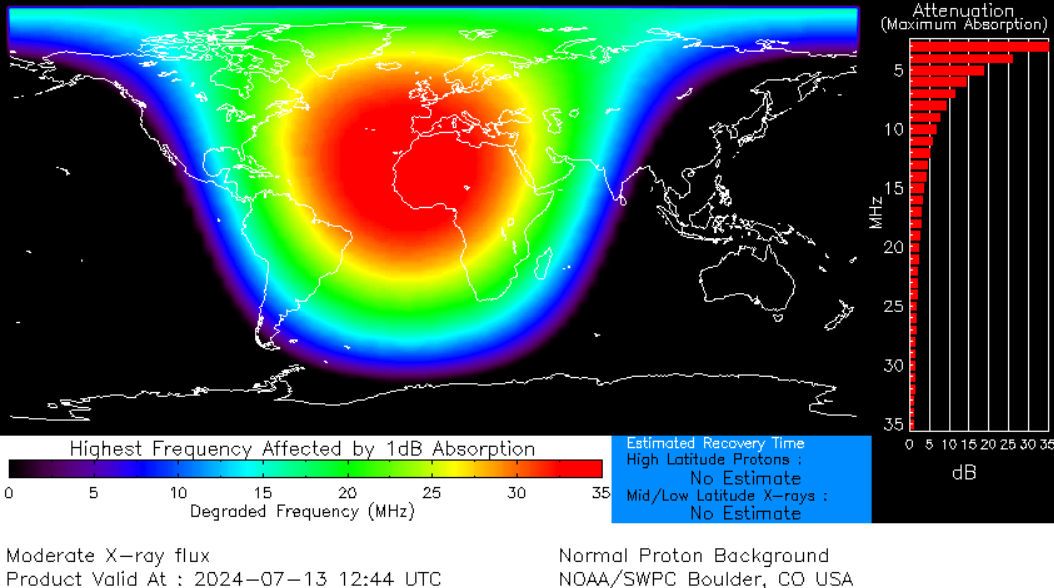
SOLAR FLARE AND RADIO BLACKOUT: Big sunspot AR3738 unleashed an M5.3-class solar flare today, July 13th, at 1242 UT. Radiation from the flare ionized the top of Earth's atmosphere, causing a shortwave radio blackout over Europe and Africa. So far, no CME has been detected emerging from the blast site. Solar flare alerts: SMS Text

HUGE OUTBREAK OF NLCS: European observers are reporting a "huge outbreak" of noctilucent clouds (NLCs) on July 13th. "There were NLCs all around the sky!" says Ujvárosi Beáta of Vácrátót, Hungary:
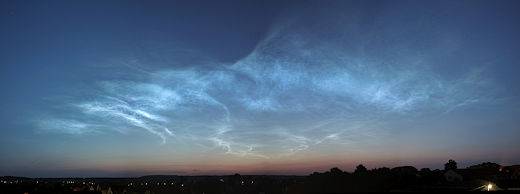
"This is really rare at our latitude (+47N)," says Beáta. "It was a memorable and special display." Similar reports have been received from France, Finland, Latvia, and Norway.
This is the latest example of NLCs defying expectations. Made of frosted meteor smoke near the edge of space, the clouds are supposed to be melted away by high solar activity. Solar Max arrived in 2024, yet observers continue to witness some of the best NLCs in years. Extra water vapor injected into the mesosphere by intensifying space traffic and the Tonga volcano may be counteracting the effect of the active sun.
Realtime Noctilucent Cloud Photo Gallery
Free: Spaceweather.com Newsletter
FIRST SIGHTINGS OF THE EVENING STAR: After months hiding in the sun's glare, Venus is back. Peter Lowenstein saw the Evening Star from Mutare, Zimbabwe on Friday, July 12th:
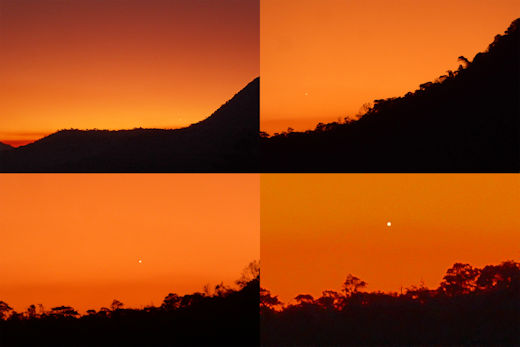
"These pictures, taken between 5.07 and 5.52 pm on Friday, July 12th, show that Venus has separated far enough from the sun to appear in the sunset," says Lowenstein. "These are our first views of Venus after sunset in July 2024."
The view will soon improve. Every night for the rest of 2024, Venus will move farther away from the sun, becoming increasingly visible in the evening sky. When will your first sighting be? Submit your photos here.
more images: from Stephen Biggs of Victoria, BC, Canada
Realtime Space Weather Photo Gallery
Free: Spaceweather.com Newsletter
GLOW-IN-THE-DARK AURORA PENDANT: Are you looking for a far-out gift? Consider the Glow-in-the-Dark Aurora Pendant. On July 8, 2024, it flew to the stratosphere onboard an Earth to Sky Calculus cosmic ray research balloon:
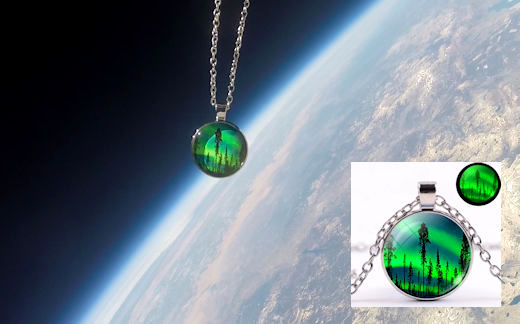
You can have it for $99.95. For 3 hours, the necklace floated 106,444 feet above the Sierra Nevada mountains of central California while radiation sensors inside the balloon's payload gathered data for the students' cosmic ray monitoring project. It comes with a greeting card showing the pendant in flight and explaining the Earth to Sky Calculus radiation experiment.
The students of Earth to Sky Calculus are selling space jewelry to support their cosmic ray ballooning program. Don't wait for Christmas--get yours now!
Far Out Gifts: Earth to Sky Store
All sales support hands-on STEM education
Realtime Comet Photo Gallery
Free: Spaceweather.com Newsletter
Realtime Aurora Photo Gallery
Free: Spaceweather.com Newsletter