20 STARLINK SATELLITES WERE LOST: Jonathan McDowell of Harvard University reports that all 20 Starlink satellites launched on July 11th have re-entered Earth's atmosphere. A failure in SpaceX's Falcon 9 rocket caused the satellites to be deployed lower than usual, too low to escape the drag of the atmosphere below. Right now, our atmosphere is extra-puffed up by high solar activity, so the satellites were doomed despite "warp 9" thuster firings. If you witnessed any of the re-entries, please submit your images here.
VENUS IN FULL: Like the Moon, Venus has phases. There is one phase, however, that astronomers rarely see: Full. The 100% disk of Venus can be devilishly difficult to observe because it only appears when Venus is behind the sun. On July 13th, Patricio Leon photographed the full disk in a blue winter sky over Santiago, Chile:
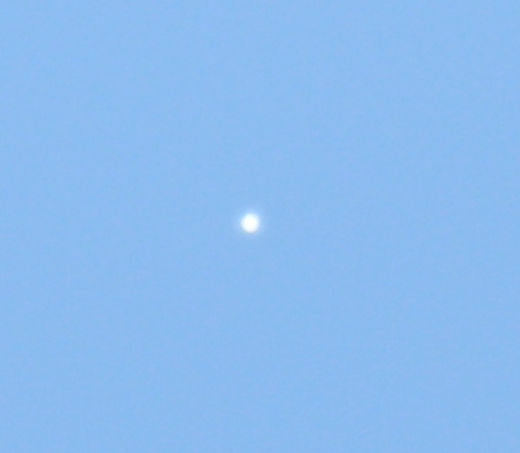
"I located the planet by optical means when it was close to transiting the meridian at noon," says Leon. "In round numbers it presents a 100% phase, measures 10 arcseconds in diameter, and lies 10° east of the sun."
This won't last long. Venus is emerging from the glare of the sun to renew its position as the Evening Star. As the second half of 2024 unfolds, it will shape-shift into a gibbous, half, then crescent easily seen in the twilight sky. If you decide to catch the rare Full Venus, do so now, but be careful! The blinding sun is only 10° away.
Realtime Space Weather Photo Gallery
Free: Spaceweather.com Newsletter
GLOW-IN-THE-DARK AURORA PENDANT: Are you looking for a far-out gift? Consider the Glow-in-the-Dark Aurora Pendant. On July 8, 2024, it flew to the stratosphere onboard an Earth to Sky Calculus cosmic ray research balloon:
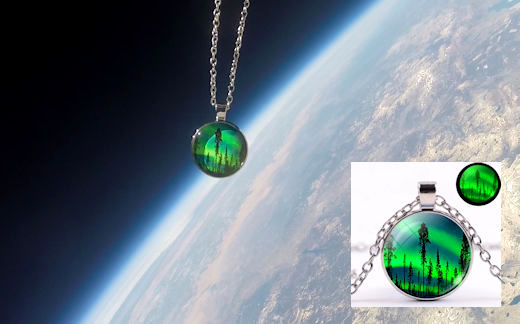
You can have it for $99.95. For 3 hours, the necklace floated 106,444 feet above the Sierra Nevada mountains of central California while radiation sensors inside the balloon's payload gathered data for the students' cosmic ray monitoring project. It comes with a greeting card showing the pendant in flight and explaining the Earth to Sky Calculus radiation experiment.
The students of Earth to Sky Calculus are selling space jewelry to support their cosmic ray ballooning program. Don't wait for Christmas--get yours now!
Far Out Gifts: Earth to Sky Store
All sales support hands-on STEM education
Realtime Comet Photo Gallery
Free: Spaceweather.com Newsletter
Realtime Aurora Photo Gallery
Free: Spaceweather.com Newsletter
Realtime Noctilucent Cloud Photo Gallery
Free: Spaceweather.com Newsletter