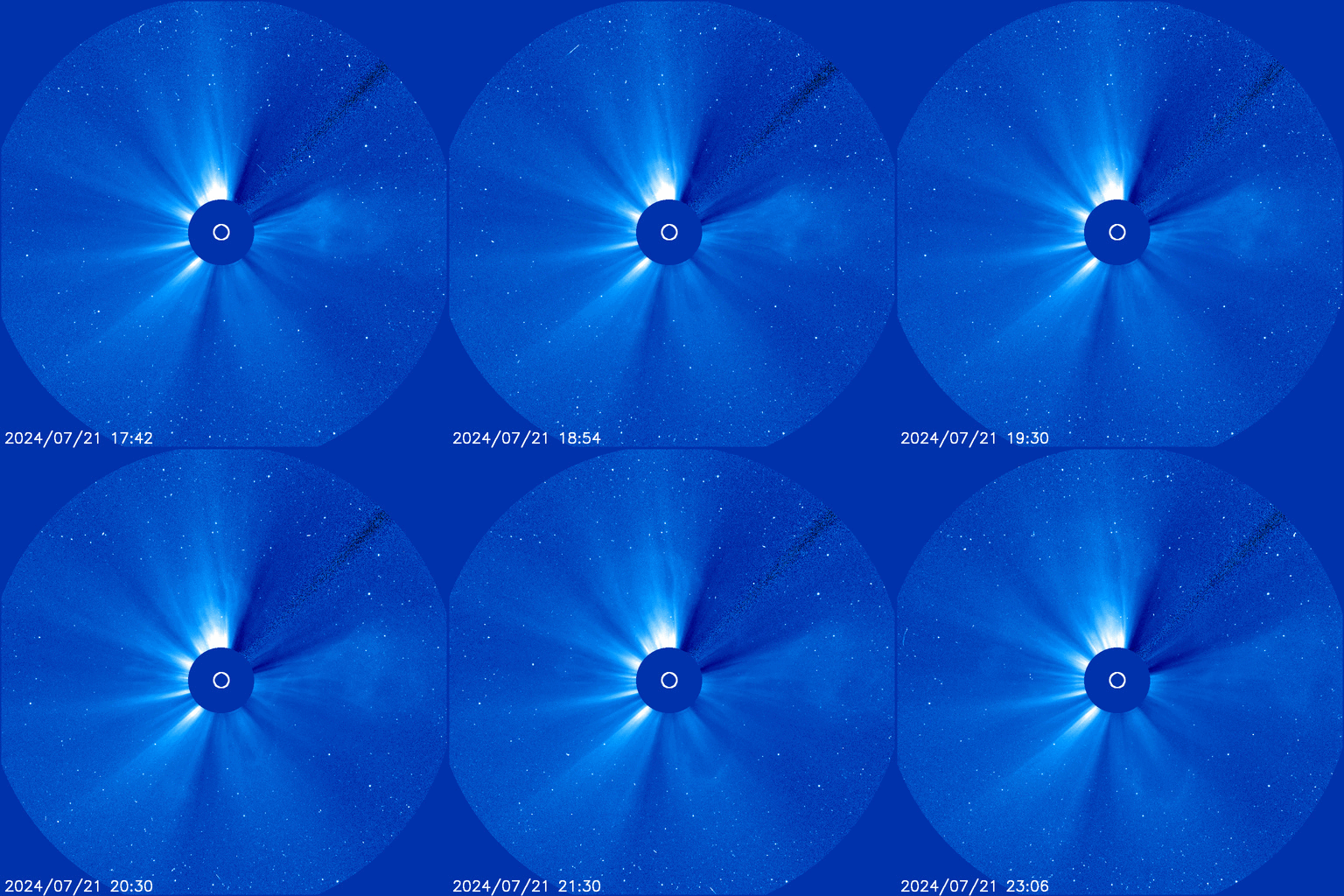
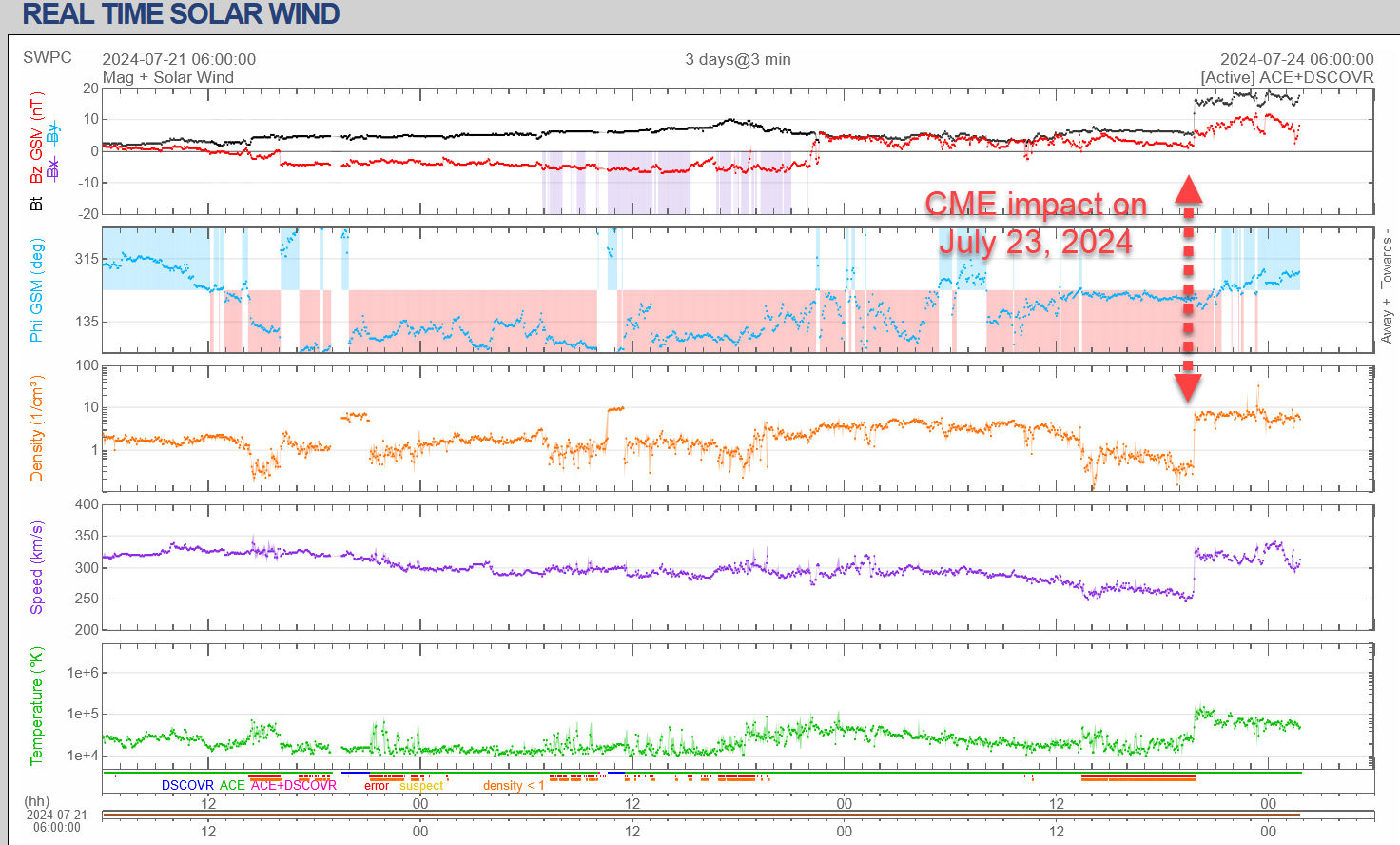
INEFFECTIVE CME IMPACT: Arriving 6 hours earlier than expected, a halo CME hit Earth's magnetic field on July 23rd (2010 UT). Normally, an early CME would strike harder than forecast due to its higher-than-expected speed. In this case, however, the impact was not effective. Magnetic fields within the CME did not connect to Earth's magnetosphere and, thus, no geomagnetic storm occured. CME impact alerts: SMS Text
THE VENUS CLOUD DISCONTINUITY: A towering wall of acid clouds is racing through the atmosphere of Venus. Luigi Morrone photographed it from Agerola, Italy, on July 17th:
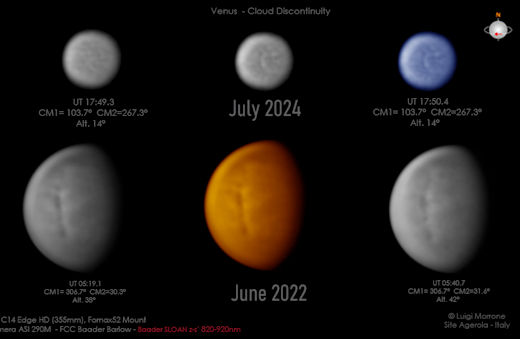
"It's called the Venus Cloud Discontinuity," says Morrone, who is part of an international network of amateur astronomers who have been tracking the massive structure. "This is the first time I've seen it since 2022."
The Venus Cloud Discontinuity is a relatively new discovery, photographed by Japan's Venus orbiter Akatsuki in 2016 and first spotted by JAXA scientist Javier Peralta. The massive structure cuts vertically across Venus's equator, stretching almost 5000 miles from end to end, and circles the planet faster than 200 mph, making one lap every ~5 Earth days.
"This atmospheric disruption is a new meteorological phenomenon, unseen on other planets," says Peralta. "We're still not certain what it is." Numerical simulations suggest that it might be some kind of exotic nonlinear Kelvin wave; the jury's still out.
Whatever it is, the structure might help solve a longstanding mystery: Why does Venus's atmosphere rotate so much faster than the planet itself? The hot, deadly air on Venus spins nearly 60 times faster than its surface, an effect known as "super-rotation." Venus's Cloud Discontinuity could be assisting the spin-up by transporting angular momentum from the deep atmosphere to the cloudtops.
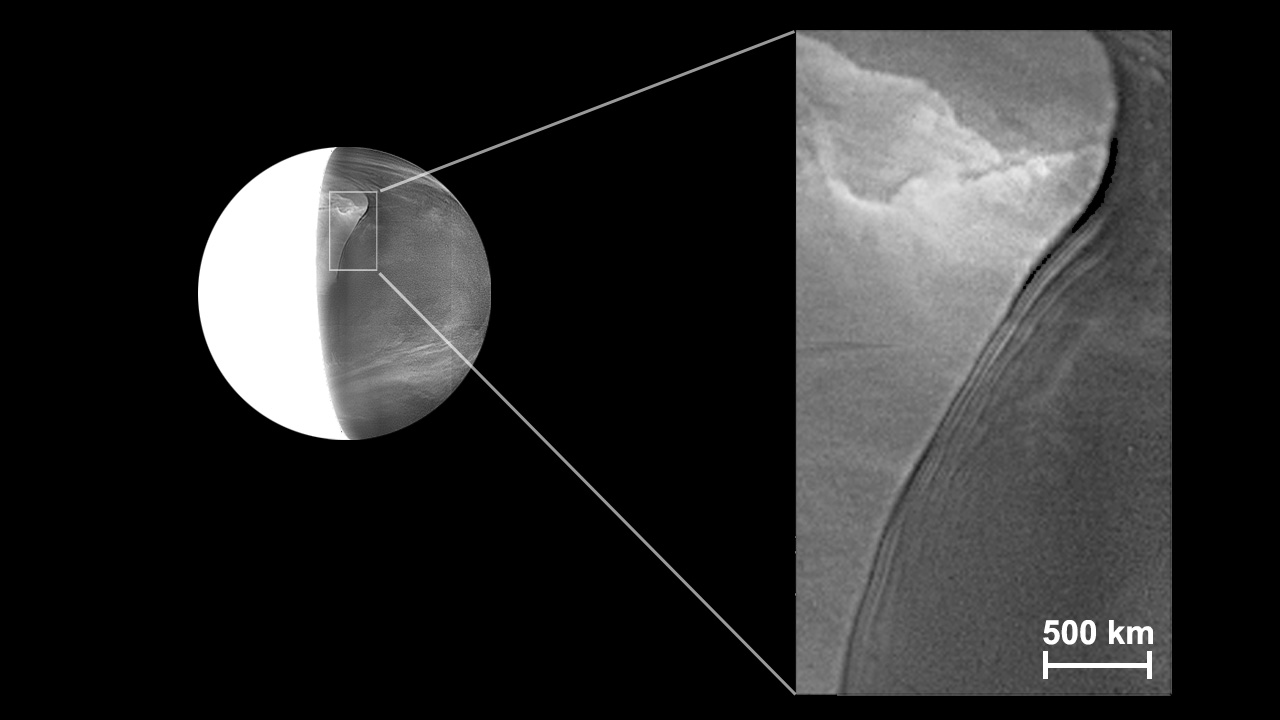
Above: Undulations behind the Cloud Discontinuity on April 15, 2016. Credits: Javier Peralta/JAXA-Akatsuki team. More images.
Amateur observations of the Cloud Discontinuity are crucial. "Unfortunately, we recently lost contact with Akatsuki so images from amateur astronomers are our only source of information," says Peralta. "Because the discontinuity may propagate faster than the superrotating winds of Venus, it is critical that observers from different geographical regions provide images to accurately track its motion and confirm its wave nature."
Observing Venus right now is not easy. The planet is emerging from months in the glare of the sun, and it is still near the twilight horizon at sunset. Nevertheless, it is possible, especially if you use an infrared filter (which is best for seeing the hot Cloud Discontinuity anyway). "I use a Baader SLOAN 820-920nm near-infrared filter on my 14-inch Celestron telescope," notes Morrone.
Would you like to help? Peralta has issued a call for images to contribute to his research.
Realtime Space Weather Photo Gallery
Free: Spaceweather.com Newsletter
REAL MONEY FROM SPACE: On July 16, 1969, the world watched as a Saturn V rocket launched Neil Armstrong, Buzz Aldrin, and Michael Collins to the Moon. Exactly 55 years later, the students of Earth to Sky Calculus launched the US Mint's limited edition Saturn V dollar coin to the stratosphere:
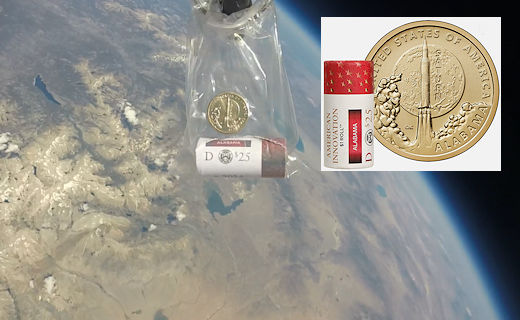
You can have a single coin for $49.95 or an entire unbroken roll for $249.95. No longer available from the US Mint, these rare coins flew 121,665 feet above the Sierra Nevada on July 16, 2024. One side shows the mighty Saturn V rocket blasting off from Cape Canaveral; the other side features the Statue of Liberty in profile.
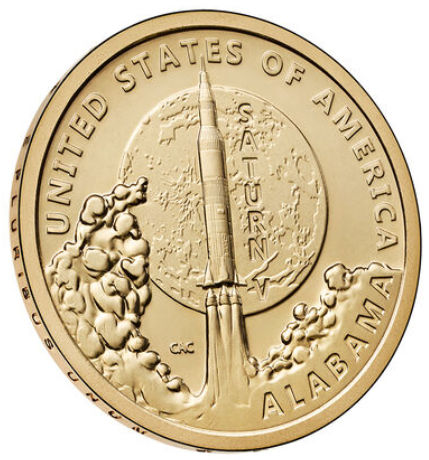

The students are selling space coins to support to support their cosmic ray research program. (Helium is expensive!) Each order comes with a greeting card showing the coins in flight and telling the story of their journey to the stratosphere and back again.
Far Out Gifts: Earth to Sky Store
All sales support hands-on STEM education
Realtime Aurora Photo Gallery
Free: Spaceweather.com Newsletter
Realtime Comet Photo Gallery
Free: Spaceweather.com Newsletter
Realtime Noctilucent Cloud Photo Gallery
Free: Spaceweather.com Newsletter