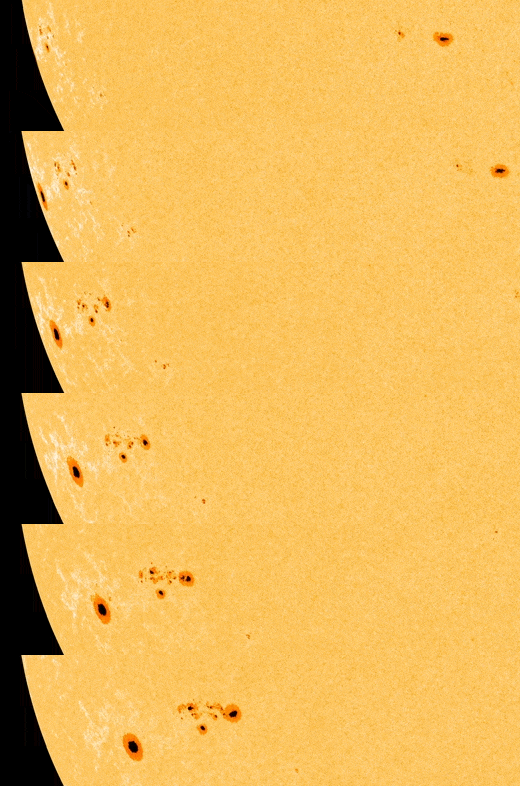
A SUNSPOT OF INTEREST: New sunspot AR3790 is growing rapidly and merits watching as a potential source of strong flares in the days ahead. Already it has a 'beta-gamma' magnetic field that harbors energy for M-class solar flares. Further development could lead to X-class eruptions. Solar flare alerts: SMS Text
AFTERGLOW OF A CME: A CME hit Earth's magnetic field on Aug. 17th, sparking a brief but strong (G3) geomagnetic storm. The timing was bad for sky watchers in Europe and North America, where daylight washed out a widespread aurora display. The fading afterglow, however, was visible after nightfall from Poland:


"This is the third night with aurora this week!" says photographer Marek Nikodem. "This is at latitude +53N."
Frequent mid-latitude auroras are a sign that Solar Maximum has arrived. A severe (G4) storm on August 11-12 sent auroras rippling across North America as far south as Mississippi and Texas. Because Solar Max typically lasts for 2 to 3 years, many more displays can be expected between now and 2026. Aurora alerts: SMS Text

Realtime Aurora Photo Gallery
Free: Spaceweather.com Newsletter
A BLACK DOT ON THE SUN: Sunsets have been a little different since sunspot AR3784 appeared almost two weeks ago. The black cirular active region is making a black dot on the setting sun:

Paulo Régis sends this picture from the seaside near Fortaleza, Brazil. "The sunspot was visible to the naked eye," he says.
Unlike other sunspots, which tend to be spread out in magnetic archipelagos, AR3784 has a centrally-condensed dark core that really pops when the sun is dimmed enough to look at. Emphasis on dimmed. To see this black dot, the glare of the sun must be attenuated by a solar filter, smoke from fires, or the deep haze of a seaside sunset.
AR3784 will be visible on the solar disk for another two to three days. If you're on the beach at sunset, check it out!
more images: from Constantine Emmanouilidi of Rodokipos Halkidiki Greece; from Evan Zucker on Pacific Beach, San Diego, California;
Realtime Space Weather Photo Gallery
Free: Spaceweather.com Newsletter
THIS MOONSTONE HAS TOUCHED SPACE: Are you looking for a romantic gift? Nothing says "I love you" like a moonstone from the edge of space. The students of Earth to Sky Calculus flew this one wrapped in a hand-crafted sterling silver Celtic love knot 35.1 km (115,158 feet) above Earth's surface:
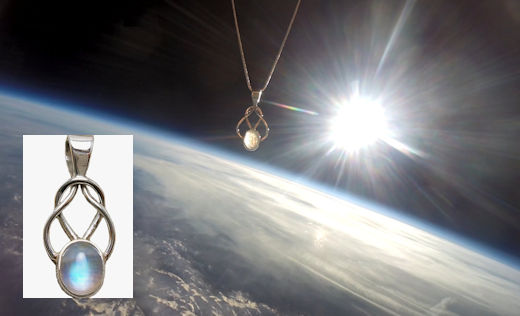
You can have it for $179.95. The students are selling these pendants to support their cosmic ray ballooning program. Each one comes with a greeting card showing the item in flight and telling the story of its journey to the edge of space. All sales support the Earth to Sky Calculus cosmic ray ballooning program and hands-on STEM research.
Far Out Gifts: Earth to Sky Store
All sales support hands-on STEM education
Realtime Aurora Photo Gallery
Free: Spaceweather.com Newsletter
Realtime Comet Photo Gallery
Free: Spaceweather.com Newsletter
Realtime Noctilucent Cloud Photo Gallery
Free: Spaceweather.com Newsletter