LUNAR OCCULTATION OF SATURN: The full Moon is about to swallow Saturn. On Aug. 21st, observers from South America to Europe (animated map) can watch a lunar occultation of the ringed planet. Saturn will dip in and out of the mountainous lunar limb before disappearing for ~45 minutes. Here's what it will look like. This rare event is a great photo-op for amateur astronomers with backyard telescopes. [more]
AURORAS SHOULD NOT BE ORANGE (BUT THEY ARE): During last week's severe (G4-class) geomagnetic storm, Tony Bendele of Pennsylvania saw something rare and a little mysterious. "Orange auroras!" he says. "Yes, Orange. I had never seen this color in auroras before." Note the boxed hue in Bendele's Aug 12th photo:
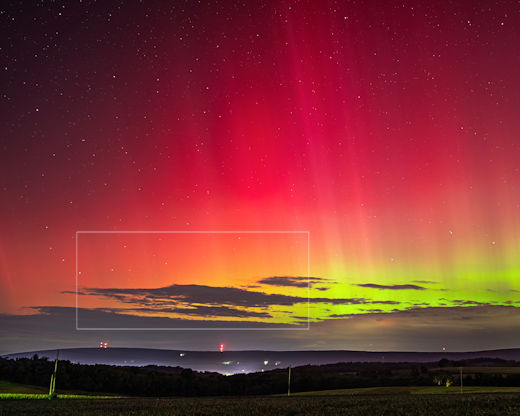
"At first, I thought something was wrong, so I checked this image numerous times. The color orange is really there," he says.
What's so mysterious? There's no element in Earth's atmosphere capable of making bright orange. It's simple chemistry. Every aurora color has a matching atom or molecule. For instance, oxygen atoms produce red and green. Nitrogen molecules give us purple and, sometimes, pink. Theoretically, N2, N2+, and O2+ can produce emissions at orange wavelengths. However, these emissions are very weak compared to other colors produced by the same molecules. Auroras should not be orange.
Yet look at this picture taken during the same storm by Friedrich Deters just North of Minneapolis, Minnesota:
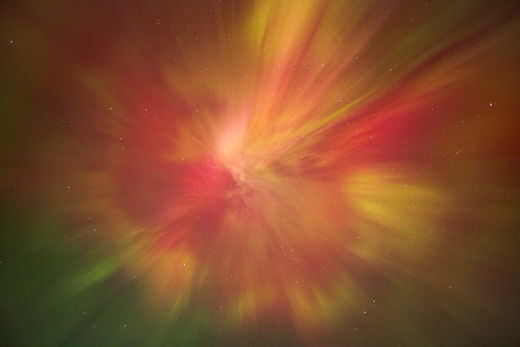
Orange was all over the sky--a phenomenon observed not only by Deters in Minnesota and Bendele by Pennsylvania, but also by many others across North America and Europe.
Aurora physicist Kjellmar Oksavik of the University of Bergen in Norway has given the phenomenon a lot of thought, and he believes he has the answer: "It's not a mystery molecule. It's a mixing of different colors."
During typical geomagnetic storms, red auroras and green auroras are well separated; red on top, green on the bottom. However, when geomagnetic storms become intense, as happened on Aug. 12th, red and green can overlap in a zone 150 km to 200 km high. "The mixture fools the camera and the eye to believe that it is orange. In reality, it is both red and green at the same time," he says.
Mystery solved? Probably. It should be easy to check as Solar Cycle 25 intensifies. Photographers, be alert for orange, and submit your pictures here.
more orange: from Caroline Haldeman near Flagstaff, AZ; from Joel Ryan of Southland, New Zealand; from Noeleen Lowndes near Skagway, AK;
Realtime Space Weather Photo Gallery
Free: Spaceweather.com Newsletter
AMBER BUMBLEBEE SPACE PENDANT: Bumblebees don't usually fly so high. The students of Earth to Sky Calculus launched this one to the stratosphere onboard a cosmic ray research balloon. Here it is floating 115,158 feet above California's Sierra Nevada:
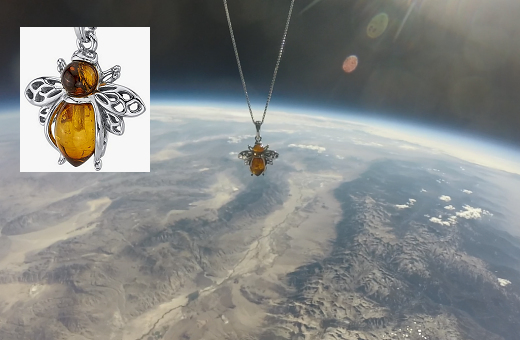
You can have it for $179.95. This bee is made of genuine Baltic Amber with a sterling silver exoskeleton. The rich Cognac-colored pendant measures 3/4 inch and comes with a matching 18-inch sterling silver chain.
The students are selling space pendants to support their cosmic ray ballooning program. Each one comes with a greeting card showing the bumblebee in flight and telling the story of its trip to the stratosphere and back again.
Far Out Gifts: Earth to Sky Store
All sales support hands-on STEM education
Realtime Aurora Photo Gallery
Free: Spaceweather.com Newsletter
Realtime Comet Photo Gallery
Free: Spaceweather.com Newsletter
Realtime Noctilucent Cloud Photo Gallery
Free: Spaceweather.com Newsletter