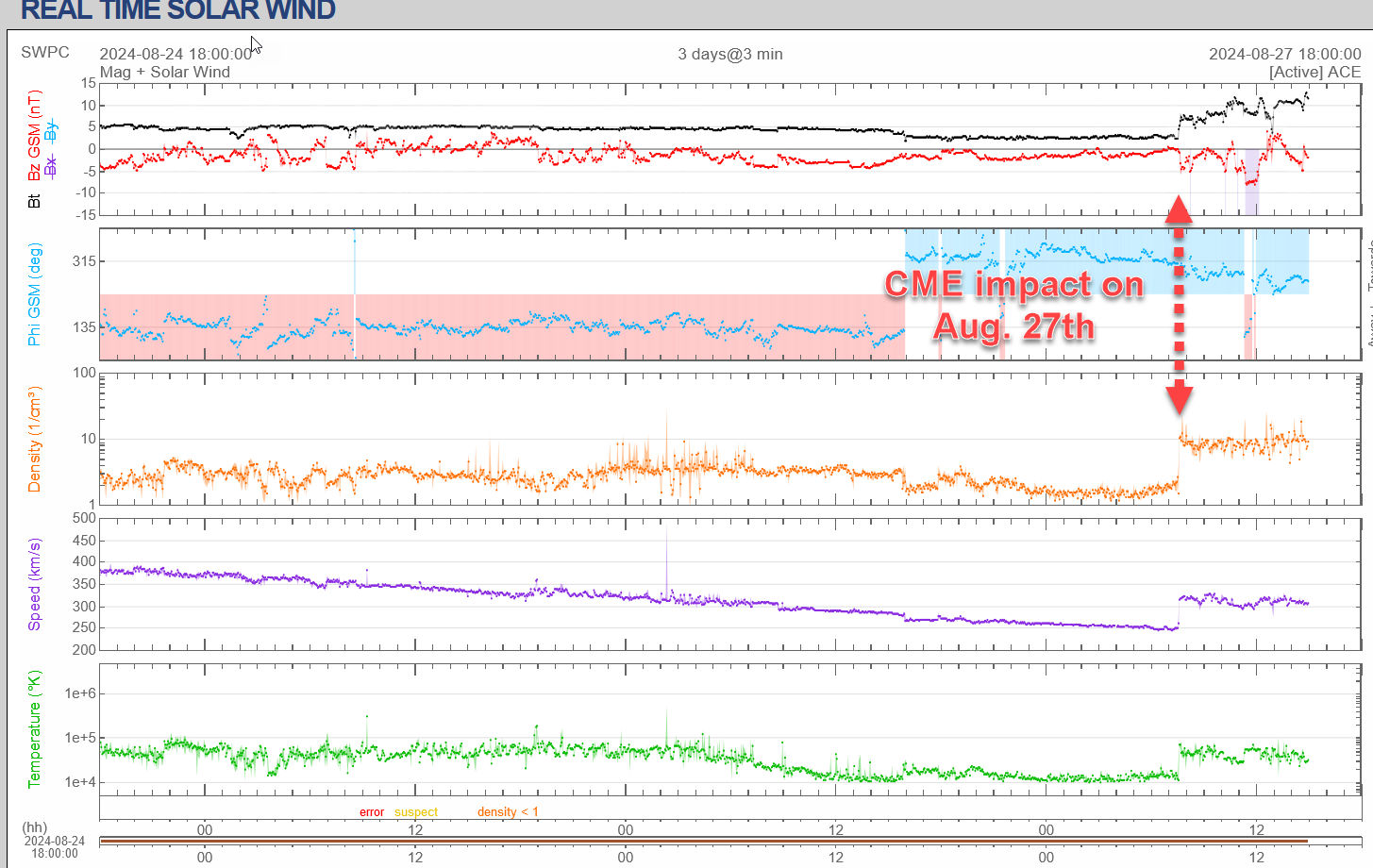
CME IMPACT SPARKS GEOMAGNETIC STORM: Yesterday, Aug. 27th, a CME struck Earth. At first, the CME's impact appeared weak and, indeed, it did not cause an immediate geomagnetic storm. However, during the early hours of Aug. 28th, magnetic fields in the CME's wake linked to Earth's magnetic field, causing storms of category G2. Auroras were photographed in Europe and the USA. CME impact alerts: SMS Text

"This morning, on August 28, 2024, around 1 AM (UTC) faint auroras appeared over the Czech Republic," reports Petr Horálek, who sends this picture from the shore of Seč Lake:

"What a year, so many auroras from central Europe have not been visible since 2001!" he says.
more images: from Oliver Schwenn of Skagen, Danmark; from Jeremy Rogers in the Pawnee National Grasslands of Weld County, Colorado; from Calvin Cannon of Madras, Oregon; from Graeme Whipps of Aberdeenshire, Scotland; from Harlan Thomas of Lake Alberta, Canada;
Realtime Aurora Photo Gallery
Free: Spaceweather.com Newsletter
INCOMING 'DAYLIGHT COMET' IS STILL ALIVE: Amateur astronomers have been wondering how Comet Tsuchinshan-ATLAS (C/2023 A3) is doing. NASA has an answer: "It's still alive." The incoming comet, which could become visible in broad daylight in October, was spotted this month by NASA's STEREO-A spacecraft apparently in good health on the other side of the sun. Click to set the scene in motion:
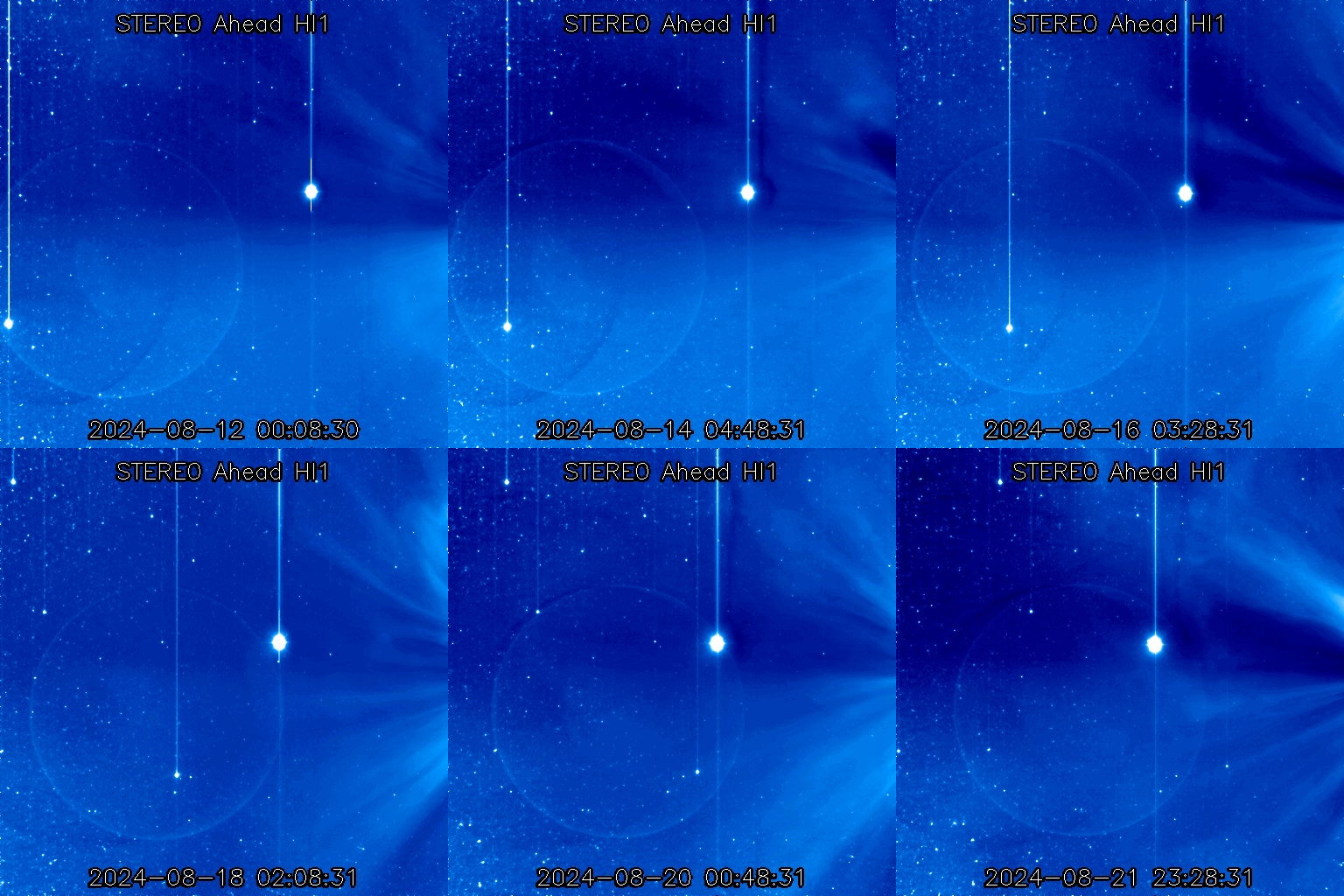
Note: Can't find the comet? It's inside the red ellipse.
Astronomers on Earth have not been able to track the comet for weeks because of the sun's glare. STEREO-A's movie is reassurance that the comet has not broken apart despite predictions to the contrary.
Astronomer Qicheng Zhang of the Lowell Observatory is optimistic about the comet's chances:"It continues to brighten steadily, and is now up to magnitude 7," he says. "It also continues to display a very robust ion tail. There are zero signs that the nucleus is disintegrating."
This is good news for sky watchers. If Tsuchinshan-ATLAS can hold itself together just a little longer, it will become a naked-eye object in late Sept. and October. Zhang predicts "the comet will brighten to magnitude +4 ± 1 at perihelion on Sept. 27th, to a daylight peak of -3 ± 1 near inferior conjunction on Oct. 9th, and subsequently produce a quite possibly 20+ degree dust tail visible under dark skies (Oct ~19) before fading away."
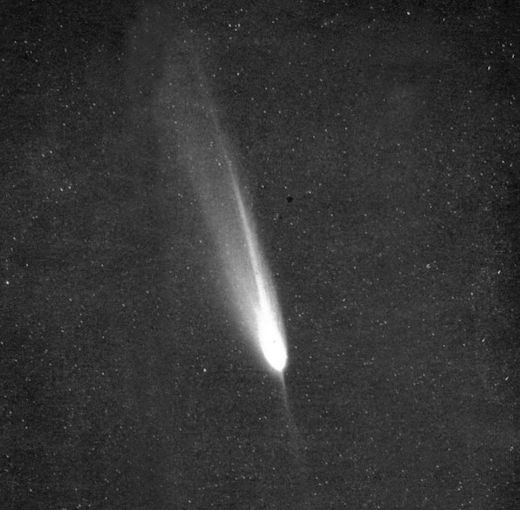
Comet Arend-Roland in 1957 may be "very similar" to Tsuchinshan-ATLAS in 2024
"It reminds me of the very similar Comet Arend-Roland in 1957, whose combined tails extended several tens of degrees for a few days," notes Zhang. "I consider a comparable display to be by far the most likely scenario for mid-October."
The comet will re-emerge from sunlight in mid-September, becoming visible to telescopes in the southern hemisphere. How will it be doing then? Stay tuned!
Realtime Space Weather Photo Gallery
Free: Spaceweather.com Newsletter
LASER-ETCHED MOON CRYSTAL: On Aug. 16th, the students of Earth to Sky Calculus launched a cosmic ray balloon to the stratosphere. This laser-etched Moon cube went along for the ride, floating in the stratosphere for more than 3 hours at an altitude of 103,130 feet:
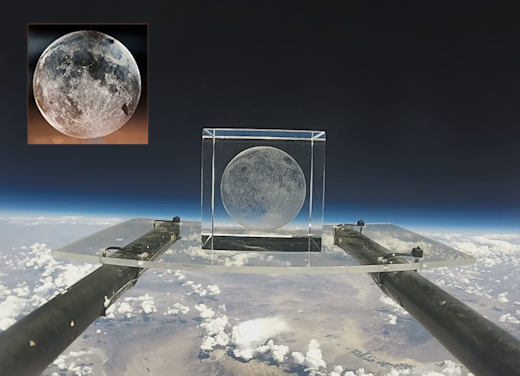
You can have it for $129.95. Inside the crystal cube, a laser has etched authentic lunar topography with all major craters, mountains and lava plains accurately portrayed. This gift comes with a unique gift card showing the cube in flight and telling the story of its journey to the edge of space and back again.
Far Out Gifts: Earth to Sky Store
All sales support hands-on STEM education
Realtime Aurora Photo Gallery
Free: Spaceweather.com Newsletter
Realtime Comet Photo Gallery
Free: Spaceweather.com Newsletter
Realtime Noctilucent Cloud Photo Gallery
Free: Spaceweather.com Newsletter