POTENTIALLY DANGEROUS SUNSPOT: New sunspot AR3806 has a 'delta-class' magnetic field that poses a threat for strong X-class solar flares. Any explosions this weekend will be geoeffective as the sunspot is turning to face Earth. Solar flare alerts: SMS Text
ANOTHER UNEXPECTED GEOMAGNETIC STORM: During the late hours of Aug. 30th, a crack opened in Earth's magnetic field. Solar wind flowed through the gap, sparking an unexpected G1-class geomagnetic storm with auroras in both Europe and the USA. P-M Hedén sends this picture from Vallentuna, Sweden:


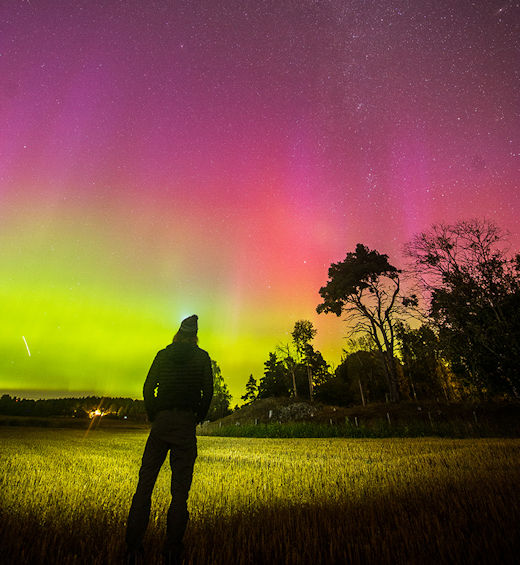
"Last night brought another fantastic display to my home town," says Hedén. "Such a show in colors - love it!"
Sightings were also reported in Estonia ("unusually bright!"), Scotland ("a brief burst") and southeast England ("the 17th night this year!"). In the USA, photographic auroras were widespread including Colorado, Missouri, and Oregon.
What caused the crack to open? It might have been a fragment of a CME's tail--the same CME that caused an even stronger storm on Aug. 28th. Aurora alerts: SMS Text
Realtime Aurora Photo Gallery
Free: Spaceweather.com Newsletter
VERTICAL STAR TRAILS: A favorite of astrophotographers since the invention of the camera, star trails are dizzying. Long exposures reveal a swirling vortex of starlight around the North Celestial Pole. Instead of a vortex, however, Wioleta Gorecka recently visited the Seyschelles and found a rain storm:

"Summer is a good time to travel to interesting places. One of them is the equator, where vertical startrails can be photographed," says Gorecka. "During my vacation in the beautiful Seychelles, this was one of my main goals, and the effect exceeded my expectations."
Realtime Space Weather Photo Gallery
Free: Spaceweather.com Newsletter
GLOW-IN-THE-DARK AURORA PENDANT: Are you looking for a far-out gift? Consider the Glow-in-the-Dark Aurora Pendant. On July 8, 2024, it flew to the stratosphere onboard an Earth to Sky Calculus cosmic ray research balloon:
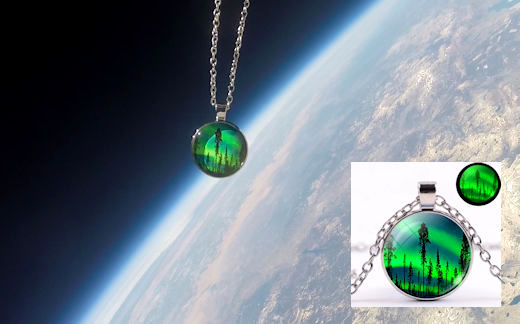
You can have it for $99.95. For 3 hours, the necklace floated 106,444 feet above the Sierra Nevada mountains of central California while radiation sensors inside the balloon's payload gathered data for the students' cosmic ray monitoring project. It comes with a greeting card showing the pendant in flight and explaining the Earth to Sky Calculus radiation experiment.
The students of Earth to Sky Calculus are selling space jewelry to support their cosmic ray ballooning program. Don't wait for Christmas--get yours now!
Far Out Gifts: Earth to Sky Store
All sales support hands-on STEM education
Realtime Space Weather Photo Gallery
Free: Spaceweather.com Newsletter
Realtime Comet Photo Gallery
Free: Spaceweather.com Newsletter
Realtime Noctilucent Cloud Photo Gallery
Free: Spaceweather.com Newsletter