UNEXPECTED CME IMPACT: A CME hit Earth's magnetic field today, Sept. 4th at 1030 UTC. The unexpected impact jolted the USGS magnetometer in Boulder, CO, by 40 nT, a fairly stout blow. A G1 geomagnetic storm watch is in effect as a result of the CME's arrival. CME impact alerts: SMS Text

SOLAR CYCLE 25 CONTINUES TO SURGE: Solar activity continues to intensify. In August 2024, the average monthly sunspot number exceeded 200 for the first time in 23 years, almost doubling the official forecast:

The current solar cycle (Solar Cycle 25) wasn't expected to be this strong. When it began in Dec. 2019, experts predicted it would be weak like its immediate predecessor Solar Cycle 24. Instead, Solar Cycle 25 may be on pace to rival some of the stronger cycles of the 20th century. Already in May 2024 we have experienced a century-class geomagnetic storm with auroras sighted in the South Pacific, central America and south Africa.
The last time sunspot counts were this high, in Sept.-Dec. 2001, the sun was winding up to launch the Great Halloween Storms of '03, which included the strongest X-ray solar flare ever recorded (X45) and a CME so potent it was felt by Voyager at the edge of the solar system. A repeat is not guaranteed, but current sunspot counts tell us it's possible.
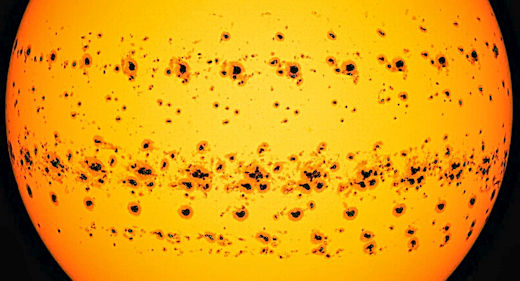
Above: A composite view of sunspots in Aug. 2024. Credit: Senol Sanli
Years from now, we may look back and realize that 2024 was the maximum of Solar Cycle 25. Or not; the original "official forecast" predicted Solar Max would occur in July 2025. Either way, we probably have at least 2 more years of high solar activity ahead. Stay tuned.
Realtime Space Weather Photo Gallery
Free: Spaceweather.com Newsletter
STERLING SILVER MOONCAT: This cat has experienced a geomagnetic storm. Multiple CMEs hit Earth's magnetic field during the weekend of August 10-11. Students of Earth to Sky Calculus launched a cosmic ray balloon into the resulting severe geomagnetic storm. The Sterling Silver Mooncat went along for the ride.:
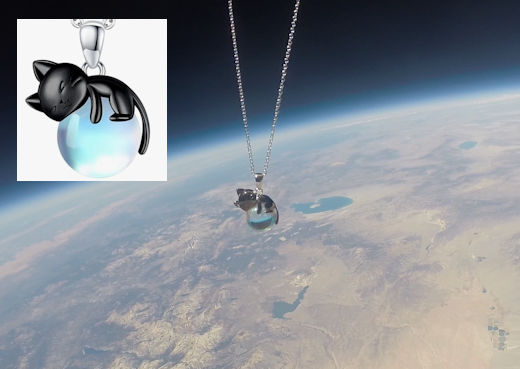
You can have it for $199.95. Supported by a sterling silver frame, the black cat is curled around a genuine blue moonstone. It floated through the stratosphere for almost 3 hours during the storm, gathering radiation data for the students' monitoring program. The Mooncat comes with a greeting card showing the pendant in flight and explaining the radiation experiment.
The students of Earth to Sky Calculus are selling space jewelry to support their cosmic ray ballooning program. Don't wait for Christmas--get yours now!
Far Out Gifts: Earth to Sky Store
All sales support hands-on STEM education
Realtime Aurora Photo Gallery
Free: Spaceweather.com Newsletter
Realtime Comet Photo Gallery
Free: Spaceweather.com Newsletter
Realtime Noctilucent Cloud Photo Gallery
Free: Spaceweather.com Newsletter