ALL QUIET (PROBABLY): Yesterday, a CME was expected to hit Earth. It missed, and no sunspots are actively flaring. As a result, today's space weather is expected to be all quiet (probably). Solar flare alerts: SMS Text
COMET TSUCHINSHAN-ATLAS AT PERIHELION: Today, Comet Tsuchinshan-ATLAS (C/2023 A3) is making its closest approach to the sun (0.40 AU). A surge of solar heat is making the comet visible in dawn twilight. Alan Dyer photographed the comet just before sunrise over Bryce Canyon in Utah:
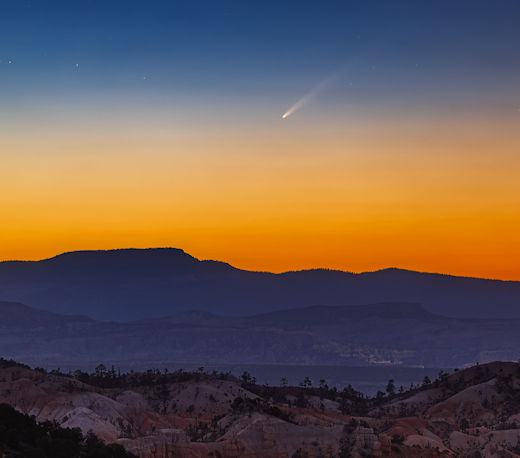
"This is Comet C/2023 A3 Tsuchinshan-ATLAS on the morning of Sept. 27th, the day the comet was at perihelion, its closest point to the sun in its orbit,"says Dyer. "The time was approximately 6:20 am MDT, just 20 minutes after the comet rose over the horizon. It was not visible to the naked eye; however, the comet was obvious on the camera's live viewscreen."
Leading observers estimate the comet's magnitude is about +2.9. It's about to become much brighter. French astronomer Nicolas Lefaudeux has written a computer program to simulate comet tails. This is what he finds will happen to Comet Tsuchinshan-ATLAS in the days ahead:
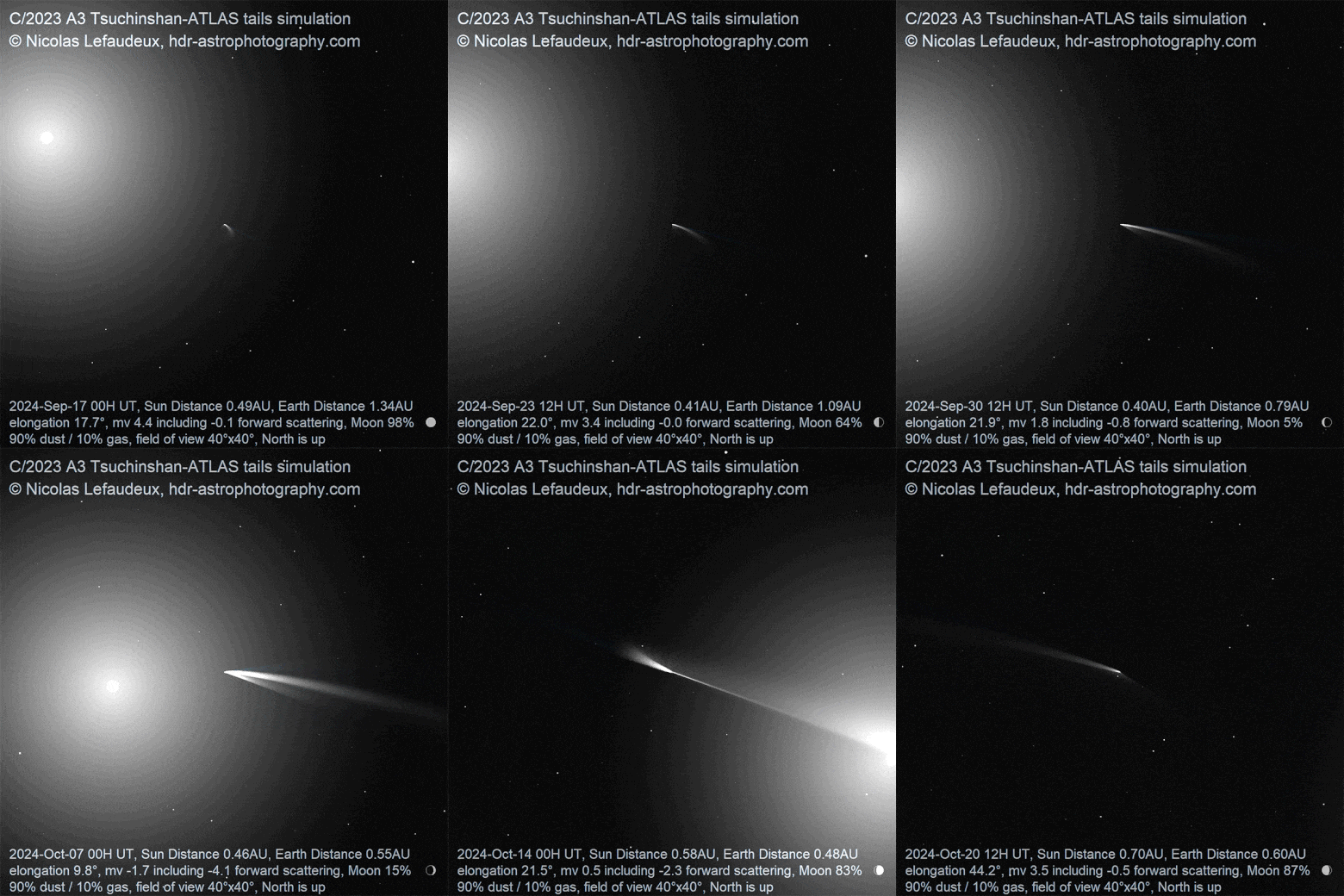
Lefaudeux's simulation shows a massive increase in brightness during the second week of October. At that time, light from the nearby sun will be forward scattered by comet dust, amplifying the comet's brightness to negative magnitudes. If the most optimistic predictions( m < -5.0) come true, it could be visible even in broad daylight like Comet McNaught in 2007.
Maximum brightness is expected to occur between Oct. 9th and Oct. 12th. Stay tuned!
more images: from Ian Griffin of Mount John, South Island, New Zealand; from Jordi L. Coy of Santa Pola, Alicante, Spain; from Eduardo Schaberger Poupeau of Rafaela, Provincia de Santa Fe, Argentina
Realtime Comet Photo Gallery
Free: Spaceweather.com Newsletter
WILD RIDE OF THE SPACE PICKLE: The Christmas pickle is a holiday tradition in the United States. Make way for a new tradition: The Christmas Space Pickle! To raise money for their cosmic ray research, the students of Earth to Sky Calculus have flown a payload-full of glass pickles to the stratosphere:
You can have one for $119.95. Each space-faring gherkin comes with a Christmas card showing your ornament in flight and telling the story of its journey to the edge of space and back again.
The students of Earth to Sky Calculus are selling space ornaments to support their cosmic ray ballooning program. Don't wait for Christmas--get yours now!
Far Out Gifts: Earth to Sky Store
All sales support hands-on STEM education
Realtime Space Weather Photo Gallery
Free: Spaceweather.com Newsletter
Realtime Aurora Photo Gallery
Free: Spaceweather.com Newsletter
Realtime Noctilucent Cloud Photo Gallery
Free: Spaceweather.com Newsletter