INCREASING CHANCE OF FLARES: Days of low solar activity might soon come to an end. Sunspot AR3842 has developed a delta-class magnetic field that harbors energy for X-class solar flares. NOAA forecasters estimate a 10% chance of X-flares and a 55% chance of M-class flares during the next 24 hours. Solar flare alerts: SMS Text
A BIG NEW SUNGRAZING COMET: Astronomers are monitoring a new comet discovered just a few days ago by the ATLAS survey. It's so new, it doesn't have a name yet. Provisionally designated "A11bP7I," the comet appears to be a relatively large sungrazer on course to become a bright naked-eye object in late October. Dennis Möller, Michael Jäger and Gerald Rhemann photographed the new discovery last night in Namibia:
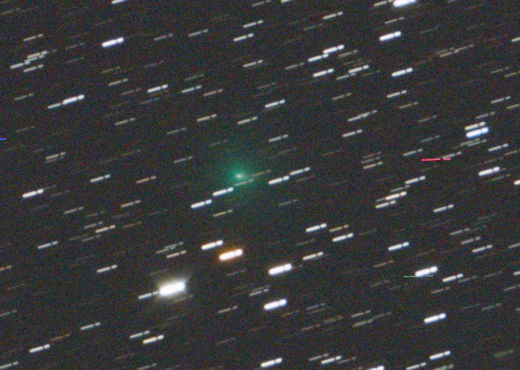
"We are here in Namibia to observe Comet Tsuchinshan-ATLAS," says Jäger. "The new sungrazing comet was discovered not far away, so we took a look. It is already 11th mag with a 2' green coma and a short tail."
The orbit and brightness of A11bP7I remind experts of Comet Lovejoy (C/2011 W3), a sungrazer that flew through the sun's atmosphere in Dec. 2011. Comet Lovejoy emerged from the close encounter intact and put on a spectacular show for amateur astronomers during the Christmas holidays of that year.
Like Lovejoy (pictured below), the new comet is a member of the Kreutz family. Kreutz sungrazers are fragments from the breakup of a giant comet ~1000 years ago. Every day, several fragments pass by the sun and disintegrate; indeed, SOHO coronagraphs have discovered thousands of them. As a rule, they are very small, but A11bP7I could be an exception--a big fragment that survives the heat and becomes visible to the naked eye.
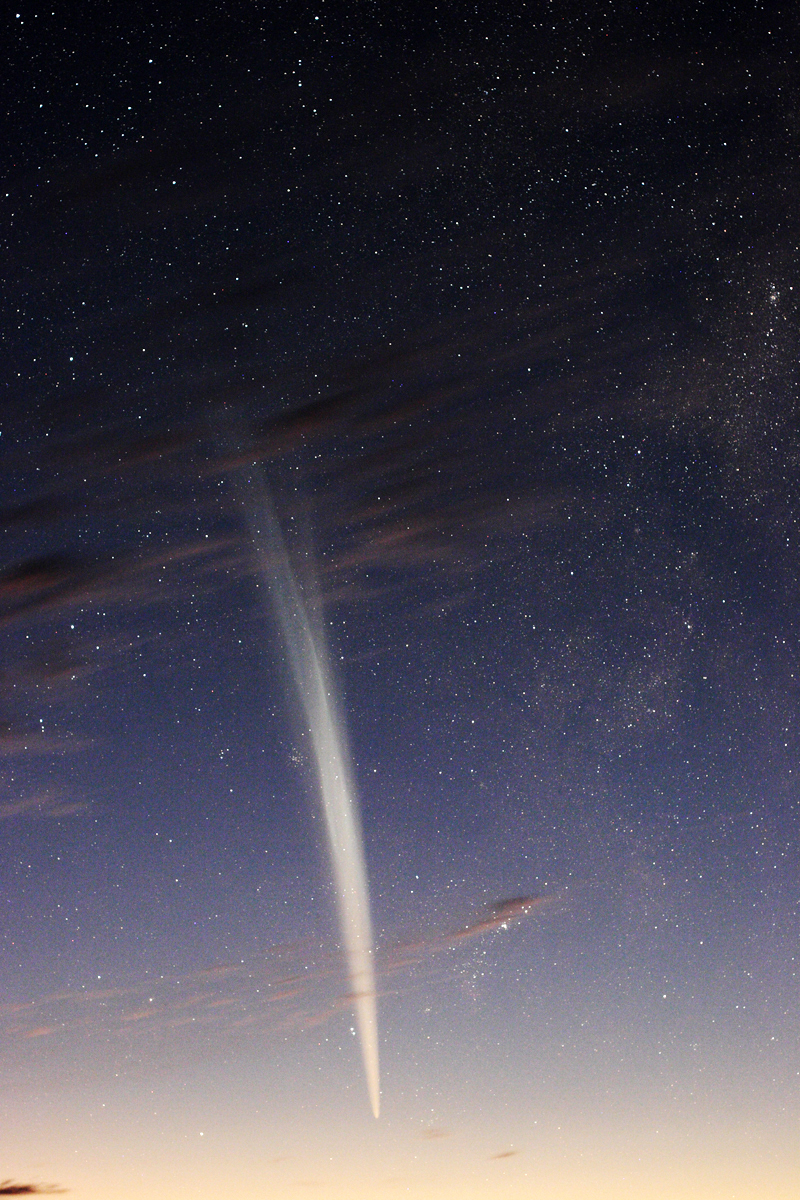
Comet Lovejoy photographed on Dec. 23, 2011, by Lester Barnes of Port Lincoln, South Australia
Experts have also noted a similarity between the orbits of A11bP7I and Great Comet Ikeya–Seki (C/1965 S1). In 1965, Ikeya–Seki became so bright when it passed by the sun that it was visible in broad daylight at magnitude -10. Japanese observers famously saw it at high noon.
Sungrazing comet expert Karl Battams of the Naval Research Lab sounds a note of caution: "While I hope with all my heart for an Ikeya-Seki 2.0, this could be a smaller Kreutz fragment that has simply erupted a little ahead of schedule [making us think it is bigger and brighter than it actually is]. Comparisons with Ikeya-Seki should be treated with extreme caution, but something akin to Comet Lovejoy is certainly not out of the question"
MEANWHILE, COMET TSUCHINSHAN-ATLAS: A11bP7I may or may not become a bright comet. Comet Tsuchinshan-ATLAS (C/2023 A3) already is. Eduardo Schaberger Poupeau sends this Sept. 29th selfie from Rafaela, Argentina:
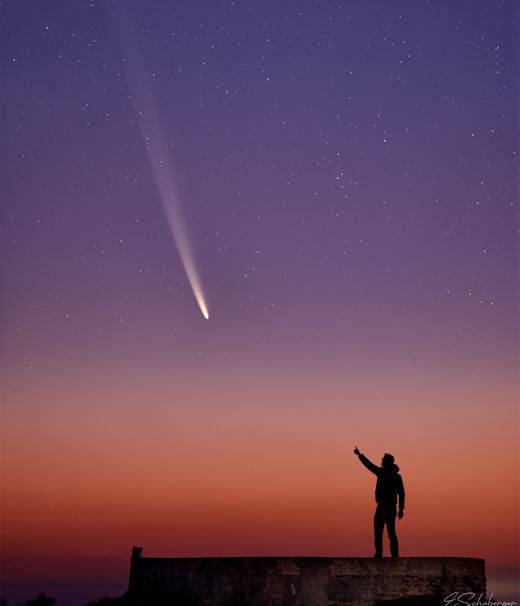
"I couldn't resist capturing the moment," says Poupeau. "Sharing the frame with a comet made me feel part of something much bigger, fleeting, and magnificent at the same time."
Now visible in the early morning sky, Comet Tsuchinshan-ATLAS is about to pass between Earth and the sun, shifting from September mornings to October evenings. Closest approach to Earth: Oct. 12th. By then it could be a beautiful naked-eye comet as bright as a first-magnitude star at dusk.
Recommended reading: Comet C/2023 A3 Tsuchinshan-ATLAS looking good for October by Nick James of the British Astronomical Association.
Realtime Comet Photo Gallery
Free: Spaceweather.com Newsletter
ASTRONAUT SNOOPY COFFEE CUP: Coffee tastes better in a cup that's been to space. On July 16th, the students of Earth to Sky Calculus launched the 'I Need My Space' Snoopy cup to the stratosphere onboard a cosmic ray research balloon. Here it is floating more than 105,315 feet above Earth's surface:

You can have it for $99.95. It's Peanuts for a cup from space! The students are selling Snoopy cups to support their cosmic ray monitoring program. Each one comes with a greeting card showing the cup in flight and telling the story of its trip to the stratosphere and back again.
Far Out Gifts: Earth to Sky Store
All sales support hands-on STEM education
Realtime Space Weather Photo Gallery
Free: Spaceweather.com Newsletter
Realtime Aurora Photo Gallery
Free: Spaceweather.com Newsletter
Realtime Noctilucent Cloud Photo Gallery
Free: Spaceweather.com Newsletter