SIGNIFICANT X-CLASS SOLAR FLARE: Earth-orbiting satellites just detected the second-largest solar flare of Solar Cycle 25 (Oct. 1st @ 22:20 UTC). The X7.1-class blast came from Earth-facing sunspot AR3842, and it may have hurled a CME in our direction. Confirmation awaits fresh data from SOHO coronagraphs. Stay tuned! Solar flare alerts: SMS Text
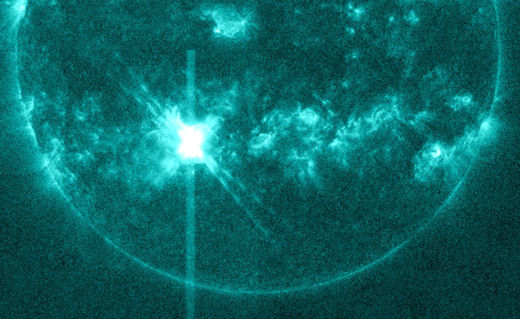
Above: An X7.1-class solar flare on Oct. 1, 2024. Credit: NASA/SDO
Realtime Space Weather Photo Gallery
Free: Spaceweather.com Newsletter
ANNULAR SOLAR ECLIPSE--TOMORROW: The Moon is about to pass directly in front of the sun, producing a 'ring of fire' solar eclipse. The path of annularity passes almost entirely over remote parts of the Pacific Ocean:
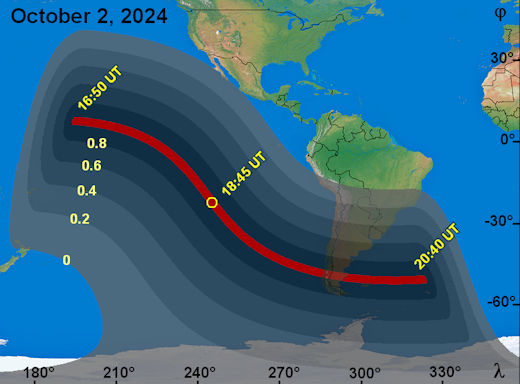 Above: Eclipse visibility map created by Spaceweather.com reader Peter Zimnikoval
Land masses where people can see the ring of fire include Easter Island and the southern tips of Argentina and Chile. Only ~175,000 people live in the path of annularity.
Annular eclipses occur when the Moon is a little too small to cover the entire sun. All around the circumference of the Moon, the sun peeks out from behind lunar craters and mountain ranges, producing the ring-of-fire effect.
Call out to the 175,000: If you have a picture, submit it here.
Realtime Eclipse Photo Gallery
Free: Spaceweather.com Newsletter
MORNING COMET TAIL: Dawn comet Tsuchinshan-ATLAS (C/2023 A3) is getting a little trickier to photograph. This week the comet is sinking back toward the sun, and its bright head is lost in the glare. Don't give up, though. The tail is still visible. David Blanchard sends this picture from Ashurst Lake near Flagstaff, Arizona:

"I was able to photograph the comet tail about 18 minutes before comet rise," says Blanchard. "The head of the comet was 3°37' below the horizon. The tail was 10° to 12° in length. I had hopes that the tail would be bright enough to be reflected in the lake and was successful."
This 'morning comet tail' should remain visible for several days to come. Soon, though, Tsuchinshan-ATLAS will pass between Earth and the sun, crossing entirely to the evening sky. En route, sunlight forward scattered by comet dust could amplify the comet's brightness, making it visible even in broad daylight. The next phase of the show begins on Oct. 9th. Stay tuned!
Realtime Comet Photo Gallery
Free: Spaceweather.com Newsletter
STRATOSPHERE CRYSTAL SUNFLOWER: This sunflower has touched space. The crystal blossom flew to the stratosphere on Feb. 22nd onboard an Earth to Sky Calculus cosmic ray balloon, floating 112,451 feet above the Sierra Nevada mountains of central California:
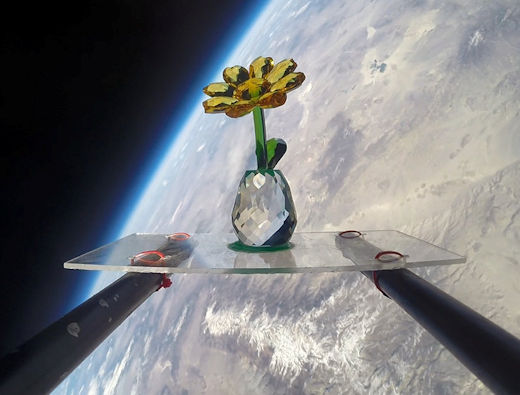
You can have it for $139.95. The students are selling Stratosphere Sunflowers to support their cosmic ray ballooning program. They make great Mother's Day, anniversary, and birthday gifts. Each one comes with a greeting card showing the flower in flight and telling the story of its journey to the edge of space.
Far Out Gifts: Earth to Sky Store
All sales support hands-on STEM education
Realtime Space Weather Photo Gallery
Free: Spaceweather.com Newsletter
Realtime Aurora Photo Gallery
Free: Spaceweather.com Newsletter
Realtime Noctilucent Cloud Photo Gallery
Free: Spaceweather.com Newsletter