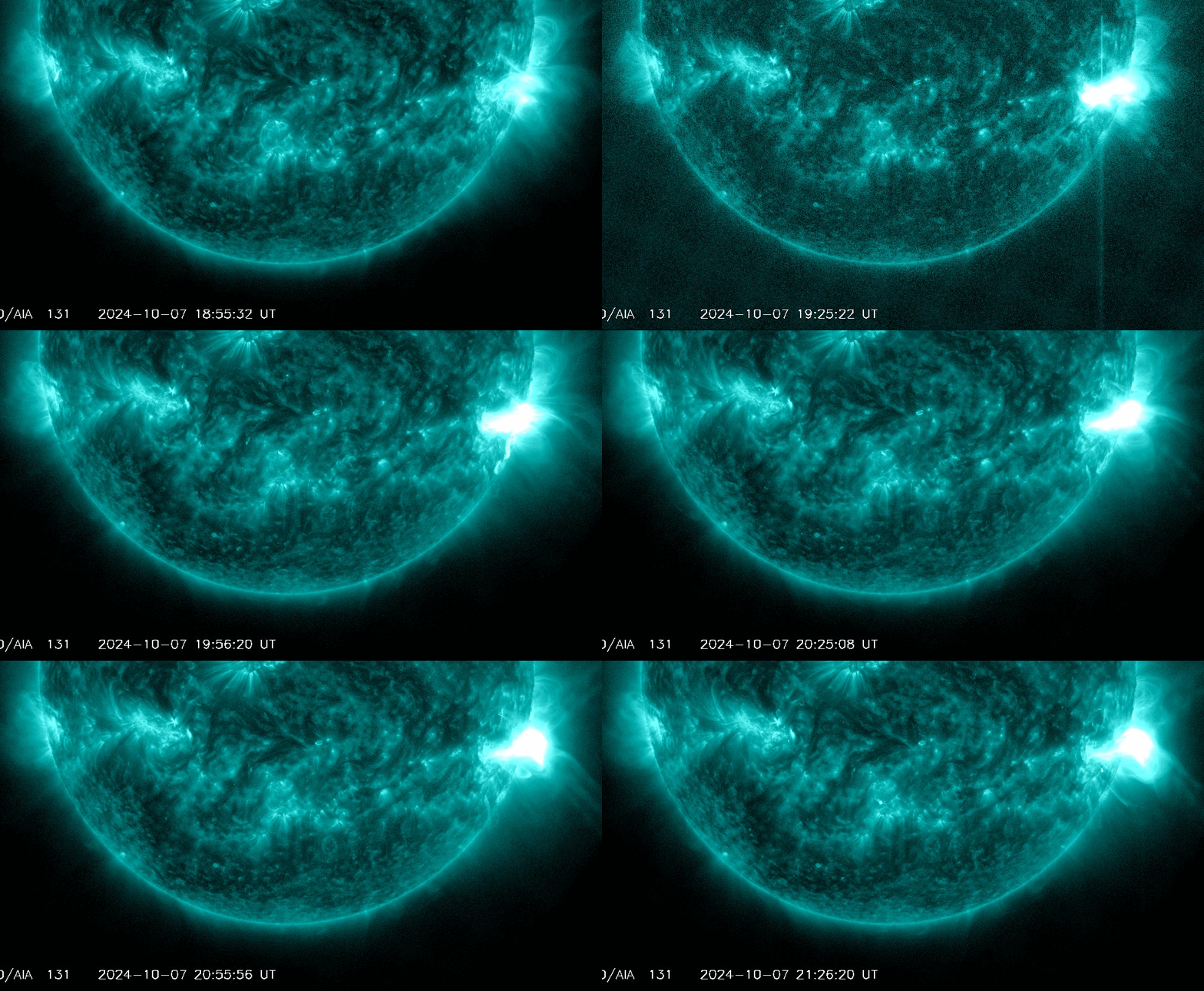
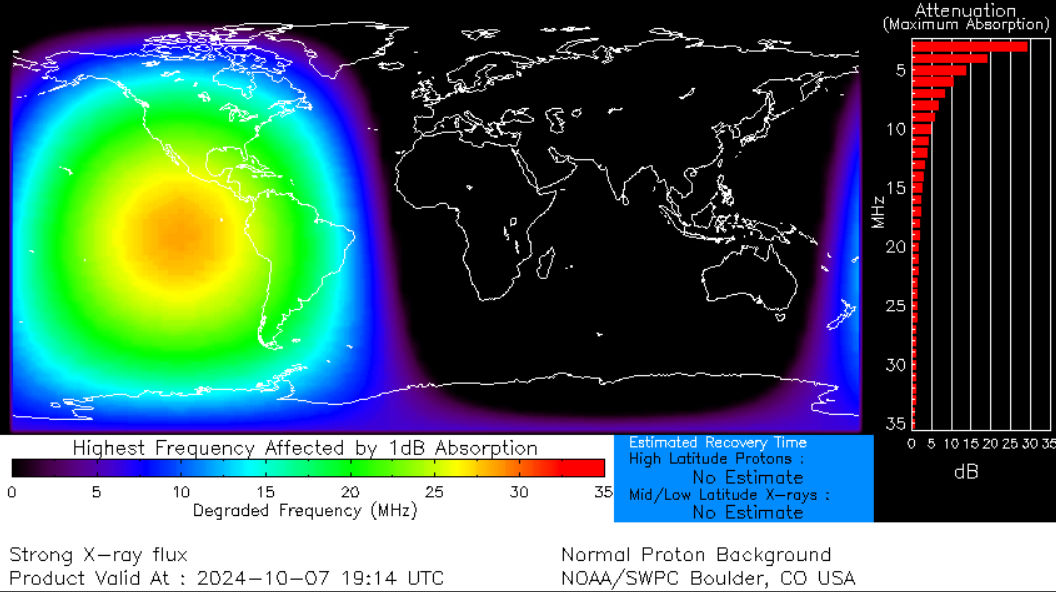
ANOTHER X-CLASS SOLAR FLARE: Active sunspot AR3842 erupted again on Oct. 7th (1913 UTC), producing an X2-class solar flare (movie). Extreme UV radiation caused a shortwave radio blackout over the Americas, and a significant CME was hurled into space. It probably has an Earth-directed component. Confirmation awaits fresh data from SOHO coronagraphs. Solar flare alerts: SMS Text
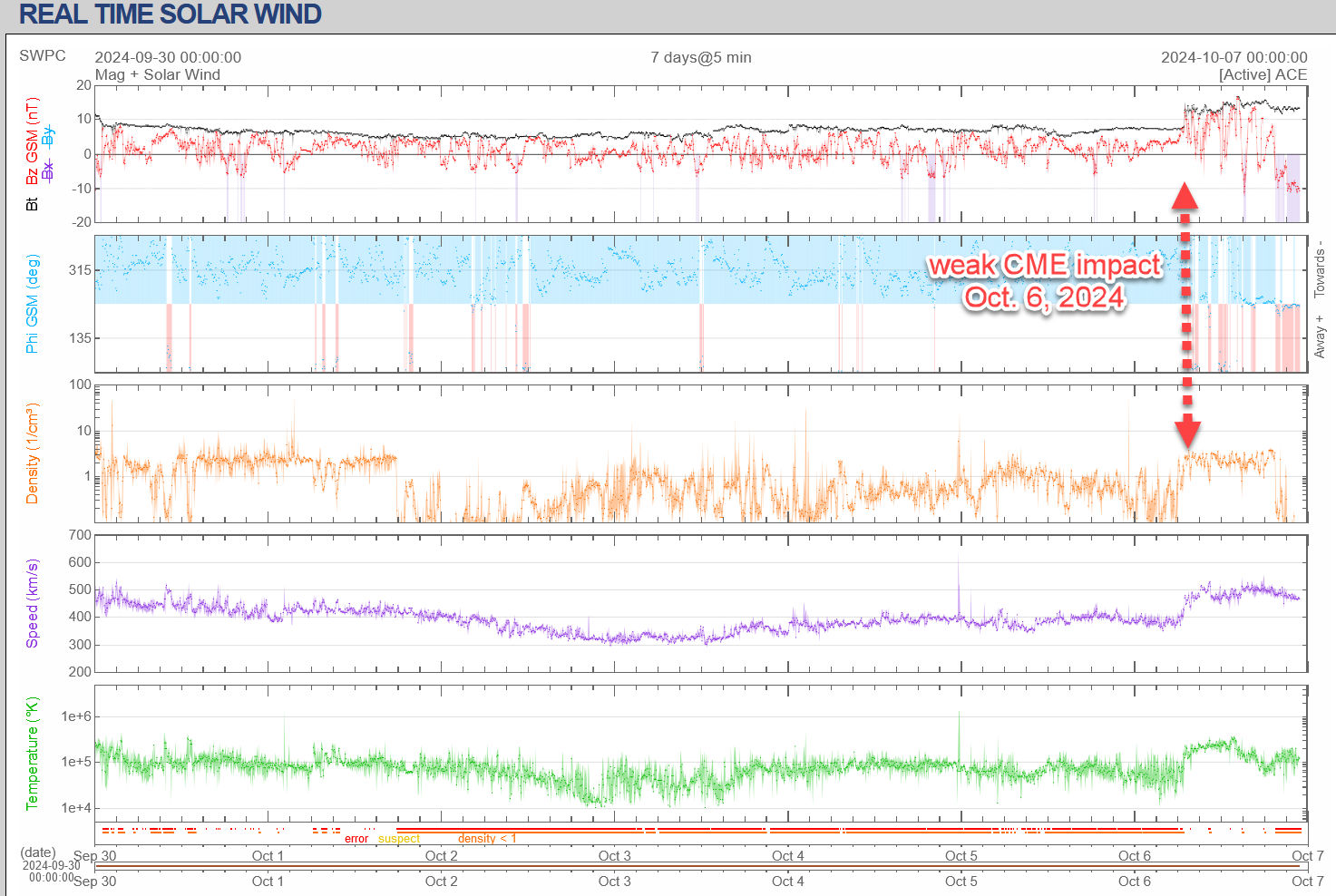
CME IMPACT SPARKS AURORAS IN THE USA: As predicted, a CME struck Earth's magnetic field on Oct 6th. At first, it seemed like a dud. Nothing happened for hours. Then, auroras spread across more than twenty US states. "We were at the Chatham Lighthouse in Cape Cod, when the sky behind us lit up red!," reports Ray Majoran. "My friend Tom, yelled 'Northern Lights!' and we took this picture."
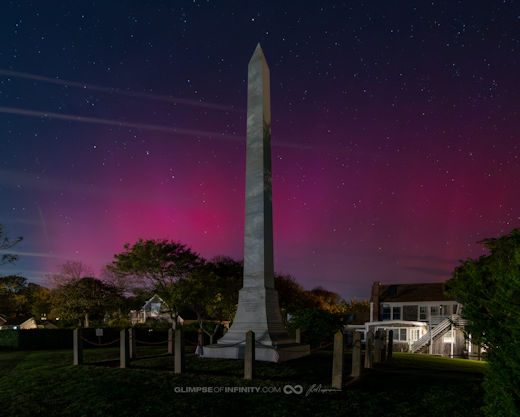
"They lasted brightly for about 5-10 minutes and then faded back," he says. "What a great sight to see in Cape Cod."
Auroras were also seen or photographed in both Dakotas, Illinois, Missouri, Wyoming, Wisconsin, Washington, Kansas, Virginia, Minnesota, Idaho, New York, California, Maine, Vermont, Kentucky, Mississippi, Ohio, Alaska, Pennsylvania, and North Carolina.
The CME was hurled toward Earth by a powerful X9.1-class solar flare on Oct. 3rd. Considering the size of the flare, the CME did not deliver much of a blow. The forecast was rescued by the autumnal "Russell-McPherron effect." At this time of year, even weak CMEs can cause a geomagnetic storm. G1- and G2-storm conditions were observed for nearly 12 hours. CME impact alerts: SMS Text


Realtime Aurora Photo Gallery
Free: Spaceweather.com Newsletter
THE FINAL MORNING OF COMET TSUCHINSHAN-ATLAS: Perched atop Cabreja Mountain on Gran Canaria Island, Frank A. Rodriguez has photographed Comet Tsuchinshan-ATLAS rising ahead of the sun on 15 consecutive mornings. The morning of Oct. 6th may have been the last:
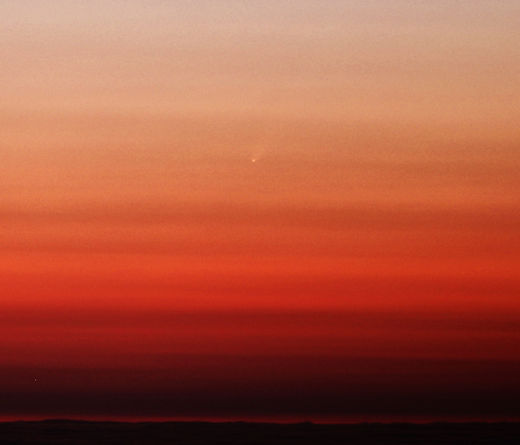
"This was an 'ultra extreme' observation with the comet already completely immersed in twilight and less than one degree high with respect to the horizon," says Rodriguez. "The comet's morning campaign from our latitude officially ends. In a few days we will begin with the evening observations."
The comet will now pass between Earth and the sun, shifting from the morning to the evening sky. A date of particular interest is Oct. 9th when the comet will be only 4 degrees from the sun. At that time, comet dust could forward scatter sunlight toward Earth, significantly amplifying the comet's brightness. It might even become visible in broad daylight like Comet McNaught in 2007.
If you decide to observe Comet Tsuchinshan-ATLAS this week, be very careful. The comet is going to be dangerously close to the sun. Stray sunlight magnified by optics can cause serious eye damage. Pro tip: Stand in the shadow of a building, completely blocking the sun, but not the comet. Many astronomers did that in January 2007, and they captured some marvelous pictures of Comet McNaught.
Realtime Space Weather Photo Gallery
Free: Spaceweather.com Newsletter
GLOW-IN-THE-DARK AURORA PENDANT: Are you looking for a far-out gift? Consider the Glow-in-the-Dark Aurora Pendant. On July 8, 2024, it flew to the stratosphere onboard an Earth to Sky Calculus cosmic ray research balloon:
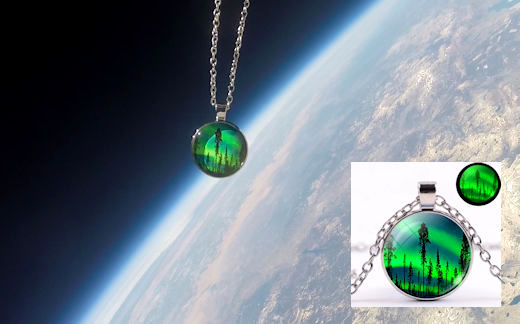
You can have it for $99.95. For 3 hours, the necklace floated 106,444 feet above the Sierra Nevada mountains of central California while radiation sensors inside the balloon's payload gathered data for the students' cosmic ray monitoring project. It comes with a greeting card showing the pendant in flight and explaining the Earth to Sky Calculus radiation experiment.
The students of Earth to Sky Calculus are selling space jewelry to support their cosmic ray ballooning program. Don't wait for Christmas--get yours now!
Far Out Gifts: Earth to Sky Store
All sales support hands-on STEM education
Realtime Comet Photo Gallery
Free: Spaceweather.com Newsletter