GEOMAGNETIC STORM WATCH (G1): Minor G1-class geomagnetic storms are possible on Oct. 16th due to a CME now en route to Earth. It was launched from sunspot AR3854 on Oct. 11th, and is expected to deliver only a glancing blow. CME impact alerts: SMS Text

WATCH SOHO CROSS THE COMET'S ORBITAL PLANE: Like Earth, the Solar and Heliospheric Observatory (SOHO) crossed the orbital plane of Comet Tsuchinshan-ATLAS on Oct. 14th. This movie from the spacecraft's coronagraph shows what happened:
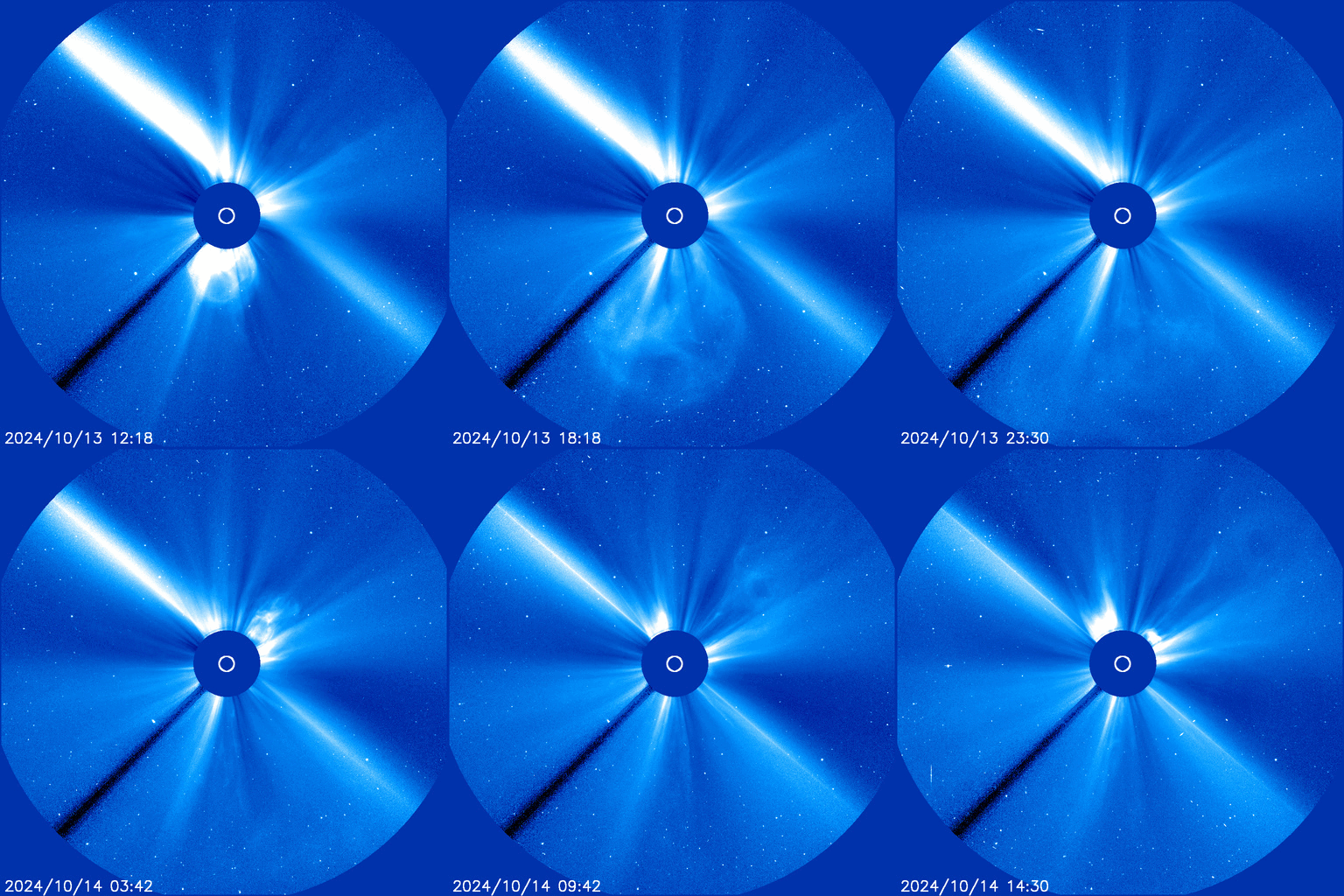
The diagonal band of light is comet dust scattering sunlight into the coronagraph's camera. When SOHO crosses the orbital plane, the band shrinks into an equisitely thin line. Imagine flying a spacecraft through the rings of Saturn and seeing them edge-on. Something similar happened to SOHO.
Here on Earth, we saw the thin line as well. It was the 'anti-tail' sticking out of the comet's head. You can see it in this amazing movie from Lorenzo Comolli of Sicily, Italy, taken at the same time as SOHO's movie. Comet Tsuchinshan-ATLAS has definitely lived up to the hype.
COMET TSUCHINSHAN-ATLAS IN THE MOONLIGHT: Comet Tsuchinshan-ATLAS is dimming a little as it recedes from the sun, but it is still a beautiful sight in the evening sky. Petr Horálek photographed it in bright moonlight on Oct. 15th:

"The nearly full Moon makes the comet a bit harder to see (just for a while - only 2 days), but definitely it is still very photogenic!" says Horálek.
See for yourself. The comet pops out of the twilight about 45 minutes after local sunset. It is easy to find using binoculars and, then, once found, is equally easy to see with the unaided eye. The comet's long tail stretches more than 10 degrees above the western horizon, remaining visible in the moonlight for as much as an hour after the head of the comet sets. Enjoy the view!
Realtime Comet Photo Gallery
Free: Spaceweather.com Newsletter
THE NEW MOONCAT: On Oct. 11th, the students of Earth to Sky Calculus launched a cosmic ray balloon into a severe geomagnetic storm. Their mission: To discover the storm's effect on atmospheric radiation. The New Mooncat went along for the ride.
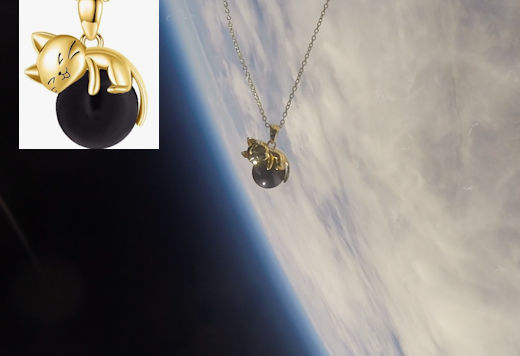
You can have it for $199.95. Wrapped around a circular stone of polished black onyx, the golden cat floated through the stratosphere for almost 3 hours while radiation sensors in the payload measured the storm. The pendant comes with a greeting card showing the cat in flight and telling the story of its journey to the stratosphere and back.
The students of Earth to Sky Calculus are selling space jewelry to support their cosmic ray ballooning program. Don't wait for Christmas--get yours now!
Far Out Gifts: Earth to Sky Store
All sales support hands-on STEM education
Realtime Aurora Photo Gallery
Free: Spaceweather.com Newsletter
Realtime Space Weather Photo Gallery
Free: Spaceweather.com Newsletter