INCREASING CHANCE OF FLARES: New sunspot 3856 has developed a 'beta-gamma-delta' magnetic field that harbors energy for strong explosions. NOAA forecasters estimate an 80% chance of M-class flares and a 20% chance of X-flares on Oct. 17th. The sunspot is directly facing Earth, so any flares will be geoeffective. CME impact alerts: SMS Text
ACTIVITY IN THE CORE OF COMET TSUCHINSHAN-ATLAS: Now that Comet Tsuchinshan-ATLAS is climbing higher in the evening sky, astronomers are taking a closer look at its core. There's a lot happening in there. Maximilian Teodorescu sends this close-up from Calugareni, Romania:
"Some very nice details resulted from my Oct. 16th imaging session, including jets around the nucleus of Comet Tsuchinshan-ATLAS," says Teodorescu. "To reveal these structures I processed and stacked 350 images using the Larson-Sekanina algorithm."
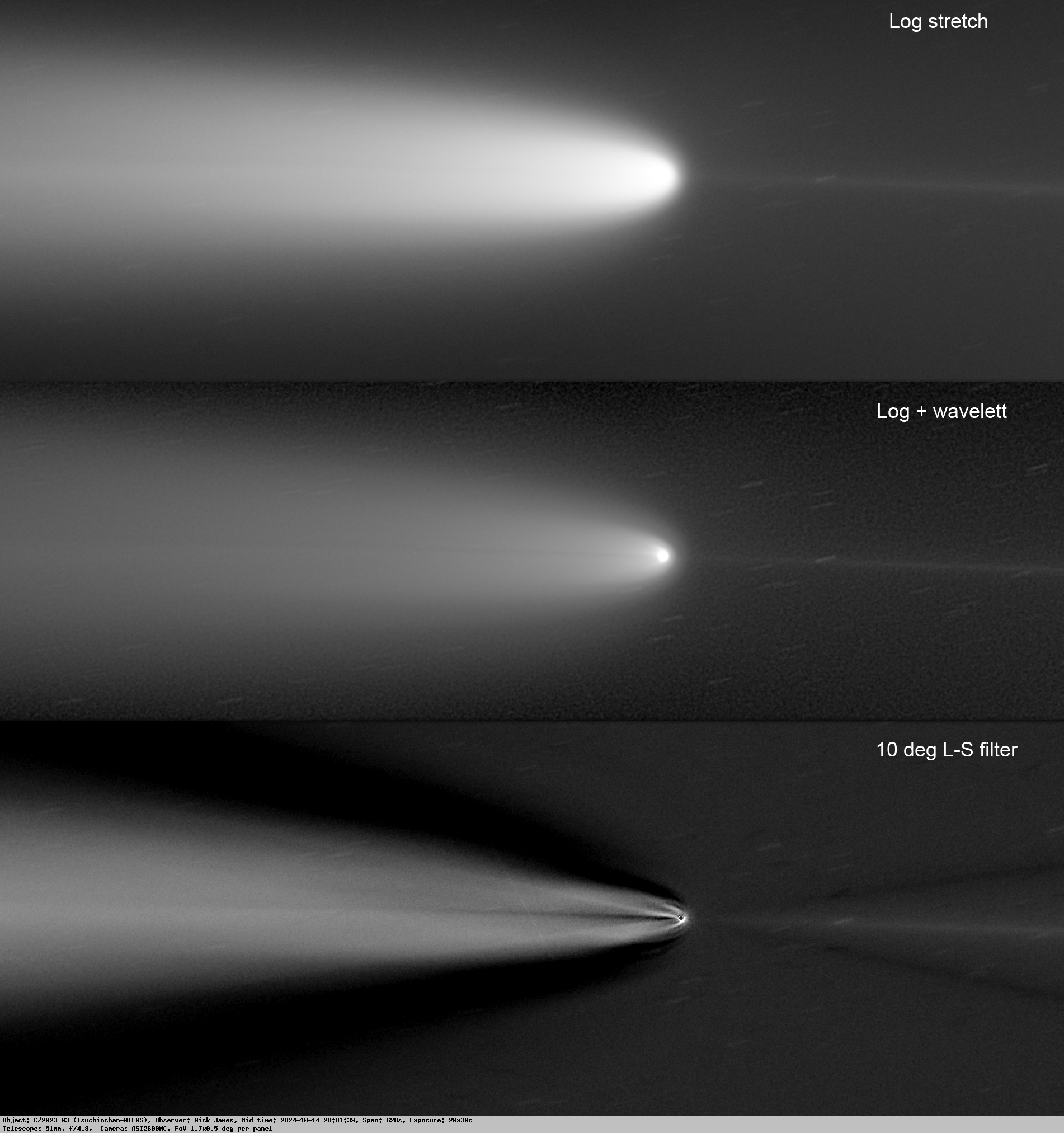
Nick James of the Bristish Astronomical Association has looked at Teodorescu's images and says "they look realistic. The parabolic hoods, in particular, are characteristic of active comets. I have seen similar structures in my own images of the comet on Oct. 14th."
With plumes of dust and gas actively flowing into the comet's atmosphere, it should remain a good target for astrophotographers for many nights to come even as the comet recedes from Earth. Stay tuned!
Realtime Comet Photo Gallery
Free: Spaceweather.com Newsletter
COMET TSUCHINSHAN-ATLAS AND THE NORTHERN LIGHTS: Twilight, moonlight, Northern Lights and a comet. Wioleta Gorecka saw them all last night in Hvalfjörður, Iceland:

"The season for Northern Lights has begun here in Iceland, so it was only a matter of time before I caught auroras alongside Comet Tsuchinshan-ATLAS," says Gorecka. "I really like to see how beautiful they look side by side."
Update: Naked-eye observations of the comet aren't as easy as they were a few nights ago. This is caused by two factors: Comet Tsuchinshan-ATLAS is starting to dim as it moves further from Earth, and, on top of that, it has to compete with full Moonlight. Nevertheless, observers say the comet is still an easy target for binoculars and smartphones. Point your phone toward the west after sunset and take a 10 second exposure in Night Mode. You might be surprised at what you catch.
Realtime Comet Photo Gallery
Free: Spaceweather.com Newsletter
THE NEW MOONCAT: On Oct. 11th, the students of Earth to Sky Calculus launched a cosmic ray balloon into a severe geomagnetic storm. Their mission: To discover the storm's effect on atmospheric radiation. The New Mooncat went along for the ride.
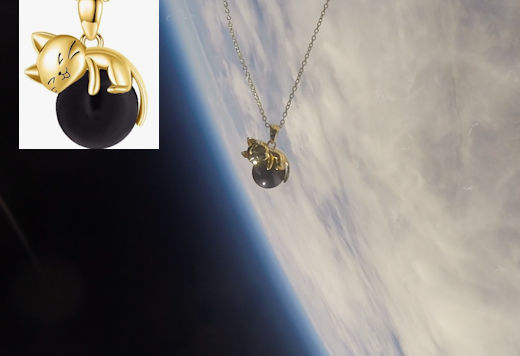
You can have it for $199.95. Wrapped around a circular stone of polished black onyx, the golden cat floated through the stratosphere for almost 3 hours while radiation sensors in the payload measured the storm. The pendant comes with a greeting card showing the cat in flight and telling the story of its journey to the stratosphere and back.
The students of Earth to Sky Calculus are selling space jewelry to support their cosmic ray ballooning program. Don't wait for Christmas--get yours now!
Far Out Gifts: Earth to Sky Store
All sales support hands-on STEM education
Realtime Aurora Photo Gallery
Free: Spaceweather.com Newsletter
Realtime Space Weather Photo Gallery
Free: Spaceweather.com Newsletter