SOLAR MAX IS UNDERWAY: In a joint statement on Oct. 15th, NASA and NOAA announced that Solar Maximum is underway. If you saw last week's geomagnetic storm, you probably reached the same conclusion. Good news: Solar Max is not a narrow moment in time; it is a lengthy phase of solar activity that can last for 2 or 3 years. More aurora outbursts are likely in 2024 and 2025. Listen to the press conference here.
THE NIGHT WHEN ROADS IN KENTUCKY TURNED RED: The severe geomagnetic storm of Oct. 10th sparked bright auroras over many US states. Judy Lundquist photographed the display from Lawrenceburg, Kentucky. But the lights overhead were, in fact, not auroras:
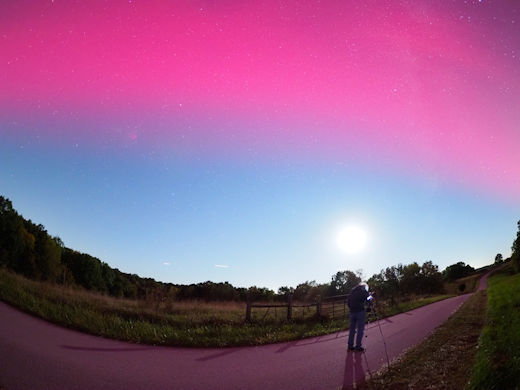
"It was an SAR arc," she says. "The red glow was reflected in the blacktop of our country road. It was extremely bright for this far south."
SAR arcs were discovered in 1956 at the beginning of the Space Age. At first, researchers didn’t know what they were and unwittingly gave them a misleading name: "Stable Auroral Red arcs." However, they are not auroras; the red glow comes from Earth's ring current system.
Yes, Earth has rings. They're made of electricity--a donut-shaped circuit carrying millions of amps around our planet. On Oct 10th, severe geomagnetic activity overheated the ring current, and some of that heat leaked into the upper atmosphere, producing a red glow.
With the arrival of Solar Max, we can expect to see many more SAR arcs in the months ahead. Frequent geomagnetic storms will heat and overheat Earth's ring current, potentially changing the color of country roads near you. Geomagnetic storm alerts: SMS Text
Realtime SAR arc Photo Gallery
Free: Spaceweather.com Newsletter
THE NEW MOONCAT: On Oct. 11th, the students of Earth to Sky Calculus launched a cosmic ray balloon into a severe geomagnetic storm. Their mission: To discover the storm's effect on atmospheric radiation. The New Mooncat went along for the ride.
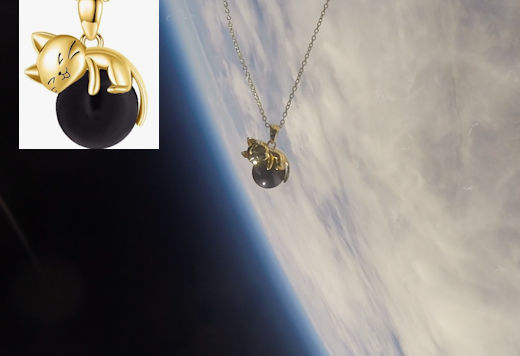
You can have it for $199.95. Wrapped around a circular stone of polished black onyx, the golden cat floated through the stratosphere for almost 3 hours while radiation sensors in the payload measured the storm. The pendant comes with a greeting card showing the cat in flight and telling the story of its journey to the stratosphere and back.
The students of Earth to Sky Calculus are selling space jewelry to support their cosmic ray ballooning program. Don't wait for Christmas--get yours now!
Far Out Gifts: Earth to Sky Store
All sales support hands-on STEM education
COMET TSUCHINSHAN-ATLAS VS STARLINK: In 2019, when SpaceX began launching Starlink satellites, astronomers worried that a sprawling megaconstellation in Earth orbit might interfere with observations of the night sky. Five years and more than 7000 Starlinks later, here's the situation:
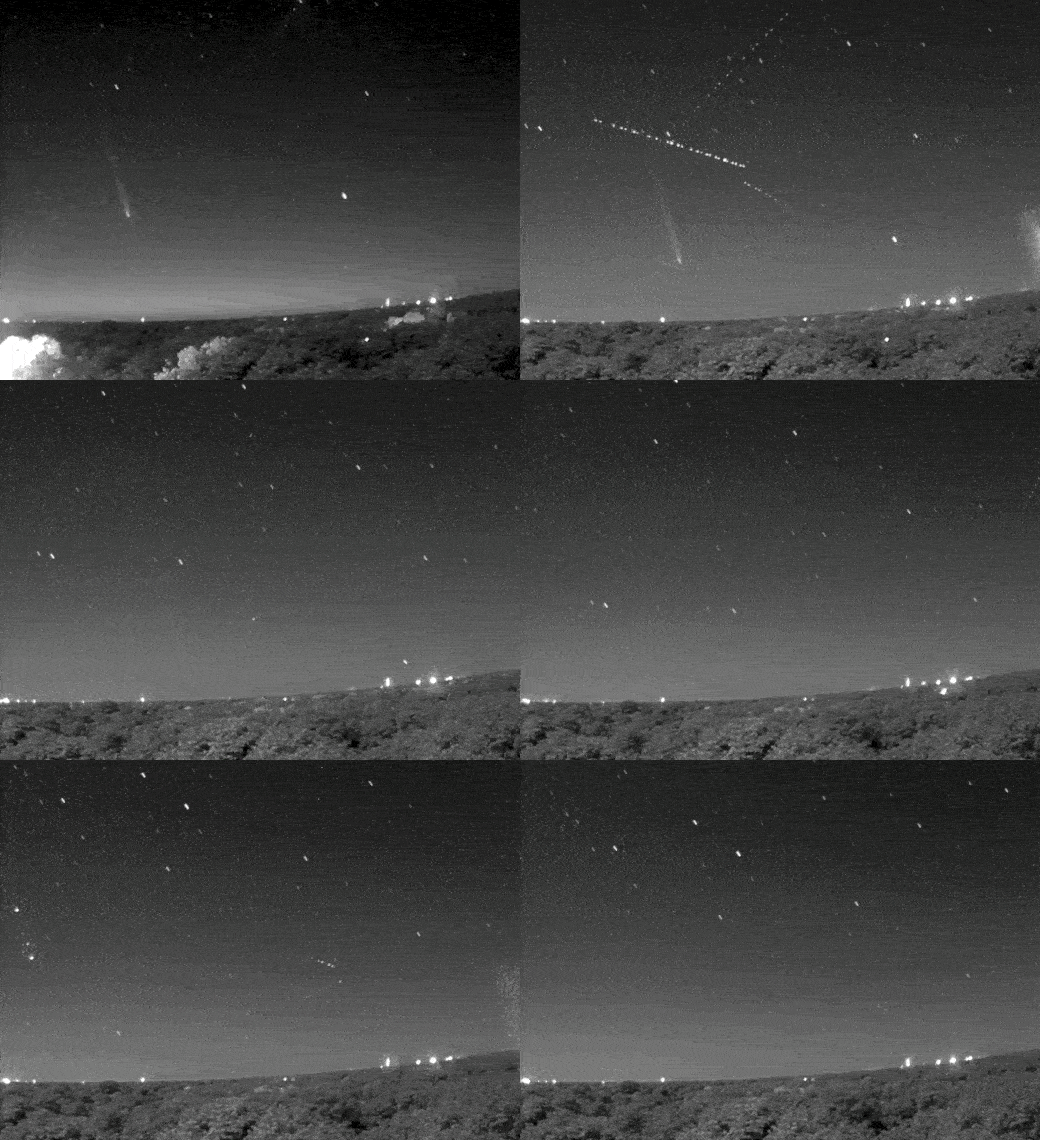
"This is a timelapse of Comet Tsuchinshan-ATLAS as it set in the west just after sunset on Oct. 14th," says photographer Kevin Palivec of Hawley, Texas. "I was surprised by the number of Starlink satellites that could be seen glinting in the sun just to the right of the comet! The crosshatch trails are all satellites as the sun glints off them. The longer trails are aircraft."
Update: Naked-eye observations of Comet Tsuchinshan–ATLAS aren't as easy as they were a few nights ago. This is caused by two factors: The comet is starting to dim as it moves further from Earth, and, on top of that, it has to compete with full Moonlight. Nevertheless, observers say the comet is still an easy target for binoculars and smartphones. Point your phone toward the west after sunset and take a 10 second exposure in Night Mode. You might even catch a couple of Starlinks.
Realtime Comet Photo Gallery
Free: Spaceweather.com Newsletter
Realtime Aurora Photo Gallery
Free: Spaceweather.com Newsletter
Realtime Space Weather Photo Gallery
Free: Spaceweather.com Newsletter