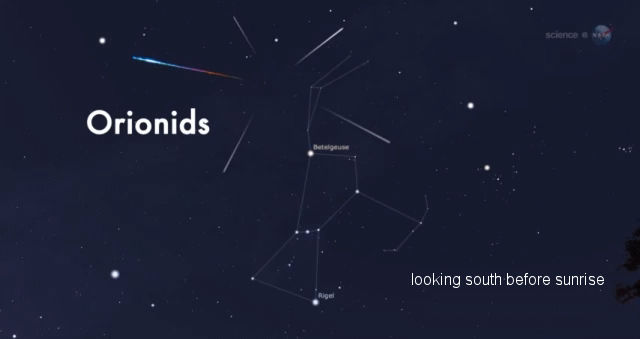
THE ORIONID METEOR SHOWER: The annual Orionid meteor shower is underway as Earth passes through a stream of debris from Halley's Comet. The best time to look is during the hours before sunrise on Monday morning. Observers in both hemispheres can see this shower, which could produce up to a dozen meteors per hour. [sky map]
COMET TSUCHINSHAN-ATLAS FROM THE SOUTHERN HEMISPHERE: Astronomers in the northern hemisphere have been enjoying Comet Tsuchinshan-ATLAS since it emerged from the sun's glare a week ago. Observers in the southern hemisphere are getting their first looks now. Eduardo Schaberger Poupeau sends this picture from Rafaela, Argentina:
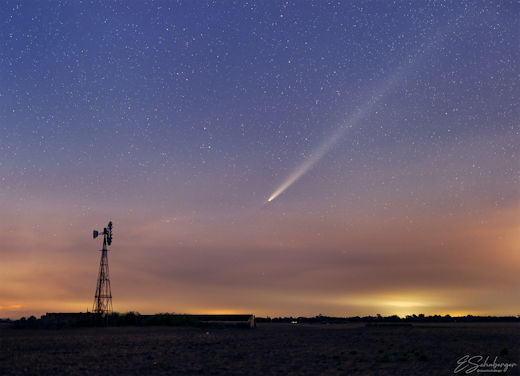
"While people in the Northern Hemisphere currently enjoy a better view of this comet, I succeeded in photographing it right here in the rural landscapes of north-central Argentina," says Poupeau. "After many failed attempts due to clouds and the comet’s low altitude, Friday, Oct. 18th, finally brought success. The comet revealed its long tail in all its glory, with its anti-tail also visible, both submerged in the twilight sky."
Observing update: Comet Tsuchinshan-ATLAS has faded in brightness since it first appeared as a evening object last week. Currently, the head of the comet is about as bright as a 4th magnitude star--about 6 times dimmer than before. This means it is difficult to see with the unaided eye. It's still a fairly easy target for binoculars, though, and even ordinary smartphone cameras are capable of revealing the comet's long tail. Be sure to use "Night Mode"!
Realtime Comet Photo Gallery
Free: Spaceweather.com Newsletter
THE NEW MOONCAT: On Oct. 11th, the students of Earth to Sky Calculus launched a cosmic ray balloon into a severe geomagnetic storm. Their mission: To discover the storm's effect on atmospheric radiation. The New Mooncat went along for the ride.
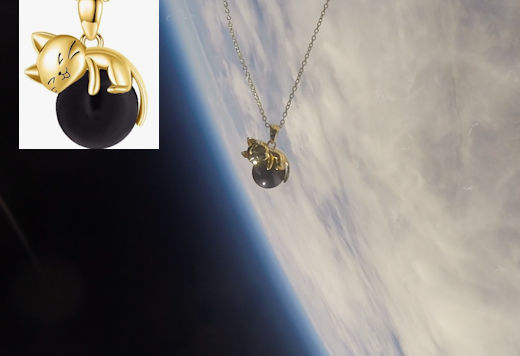
You can have it for $199.95. Wrapped around a circular stone of polished black onyx, the golden cat floated through the stratosphere for almost 3 hours while radiation sensors in the payload measured the storm. The pendant comes with a greeting card showing the cat in flight and telling the story of its journey to the stratosphere and back.
The students of Earth to Sky Calculus are selling space jewelry to support their cosmic ray ballooning program. Don't wait for Christmas--get yours now!
Far Out Gifts: Earth to Sky Store
All sales support hands-on STEM education
Realtime Aurora Photo Gallery
Free: Spaceweather.com Newsletter
Realtime Space Weather Photo Gallery
Free: Spaceweather.com Newsletter