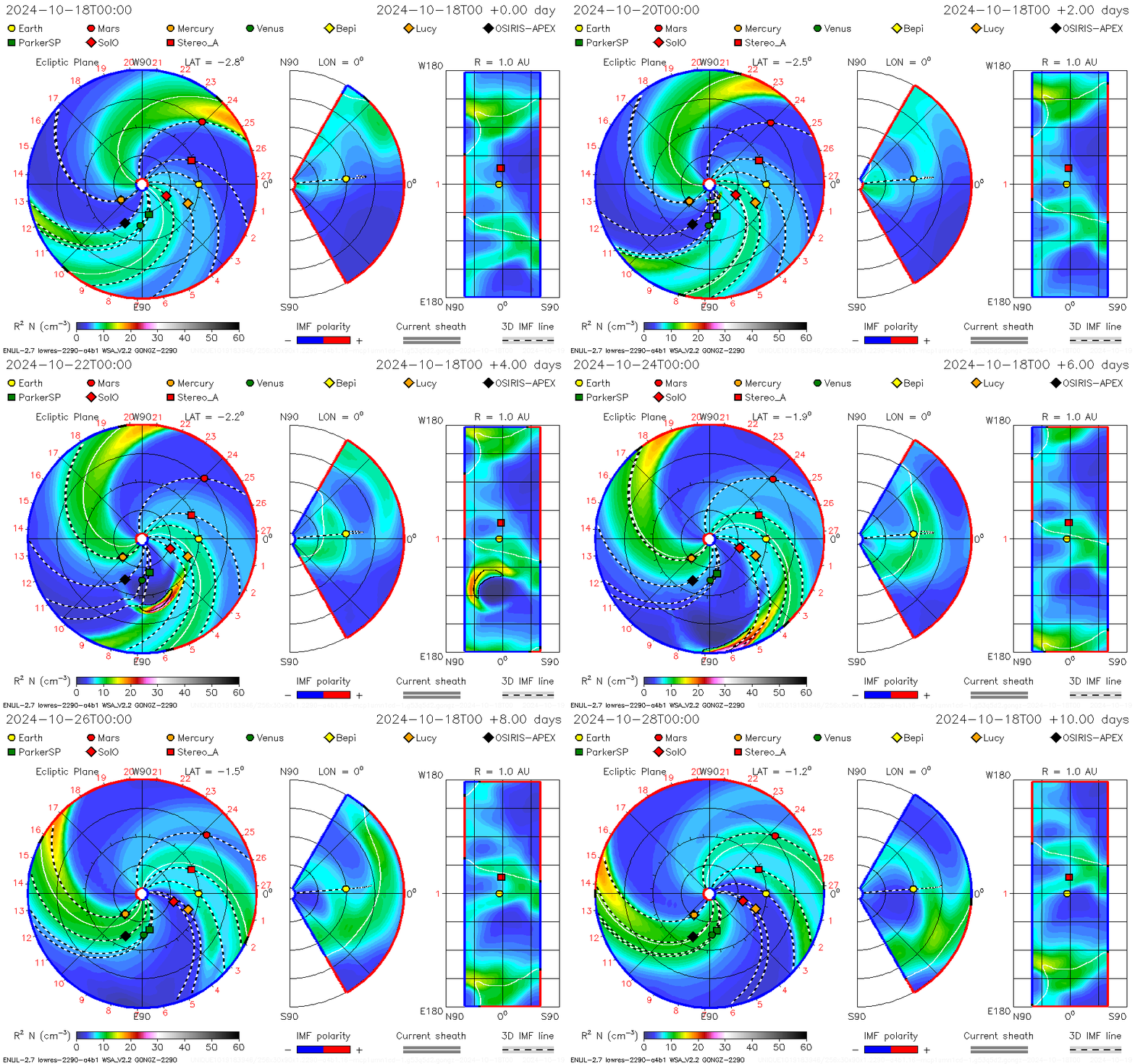
CME TARGETS VENUS AND THE PARKER PROBE: The sun just hurled a CME straight toward Venus. According to a NASA model, it struck the planet during the early hours of Oct. 21st and, at the same time, engulfed NASA's Parker Solar Probe. Why are the two so close together? The spacecraft is plunging toward Venus for a flyby on Nov. 6th that will bend its orbit toward the sun for a record-breaking close approach on Christmas Eve. Full story.

A HEADLESS COMET FOR HALLOWEEN? Last last week, Comet ATLAS (C/2024 S1) suddenly increased in brightness by 2 magnitudes, buoying the hopes of astronomers who thought the sungrazer might become a Great Comet in late October. Just as quickly, it dashed them. Last night, the comet abruptly faded and seemingly lost its gaseous atmosphere.
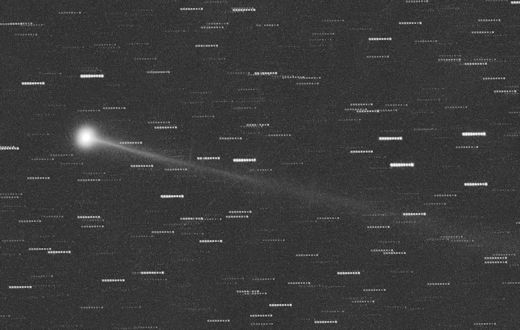
An outburst of Comet ATLAS on Oct. 19th. Credit: Michael Jaeger (Farm Tivoli, Namibia)
"The comet has almost certainly nearly fully disintegrated," says Qicheng Zhang of the Lowell Observatory. "There's a small chance it could very briefly spike in brightness in the next day or two as disintegrating comets occasionally go out with multiple closely-spaced outbursts. There's probably not much left of it's primary nucleus, though."
Now for the good news: The comet's crumbling corpse will enter the field of view of SOHO coronagraphs on Oct. 26th (1400 UT), and it could put on a good show for the spacecraft's cameras.
"The comet will become fairly bright in the SOHO coronagraphs as any rocky material in the debris field starts sublimating," says Zhang. "I expect peak brightness to occur 12 hours before perihelion (0.008 AU on Oct. 28th)."
There's another tantalizing possibility. If any rocky fragments hiding in the current debris field are larger than ~100 meters, they could provide raw material for a bright tail that swings around the sun and becomes visible in the night sky after perihelion. If so, astrophotographers would be able to photograph a "headless comet" for Halloween. Stay tuned!
Realtime Space Weather Photo Gallery
Free: Spaceweather.com Newsletter
COMET TSUCHINSHAN-ATLAS AND THE MILKY WAY: Now that the bright Moon has left the evening sky, photographers are able to see a rare juxtaposition of two celestial wonders: Comet Tsuchinshan-ATLAS and the Milky Way. Eduardo Schaberger Poupeau sends this picture from Raphael, Argentina:
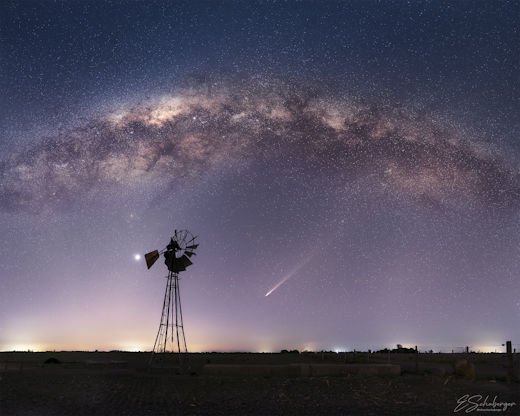
"On Oct. 19th, a timeworn windmill stood silhouetted against the sky as night began to fall," says Poupeau. "Above it, Comet Tsuchinshan/ATLAS—a fleeting visitor that may never return—and the bright planet Venus shared the horizon with the Milky Way. Each element came together in a moment that connected the earthly with the infinite universe, where the ephemeral meets the eternal."
more images: from David Kriegler of Gulf Shores, Alabama; from Chris Cook in the Mojave Desert of California;
Realtime Comet Photo Gallery
Free: Spaceweather.com Newsletter
THE NEW MOONCAT: On Oct. 11th, the students of Earth to Sky Calculus launched a cosmic ray balloon into a severe geomagnetic storm. Their mission: To discover the storm's effect on atmospheric radiation. The New Mooncat went along for the ride.
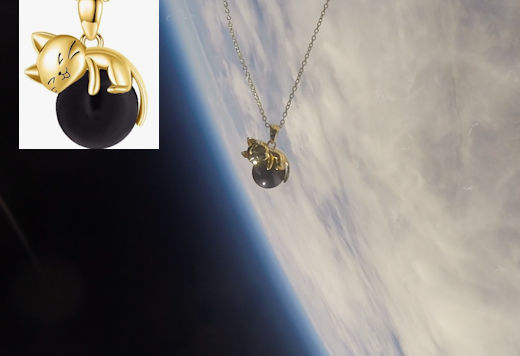
You can have it for $199.95. Wrapped around a circular stone of polished black onyx, the golden cat floated through the stratosphere for almost 3 hours while radiation sensors in the payload measured the storm. The pendant comes with a greeting card showing the cat in flight and telling the story of its journey to the stratosphere and back.
The students of Earth to Sky Calculus are selling space jewelry to support their cosmic ray ballooning program. Don't wait for Christmas--get yours now!
Far Out Gifts: Earth to Sky Store
All sales support hands-on STEM education
Realtime Aurora Photo Gallery
Free: Spaceweather.com Newsletter