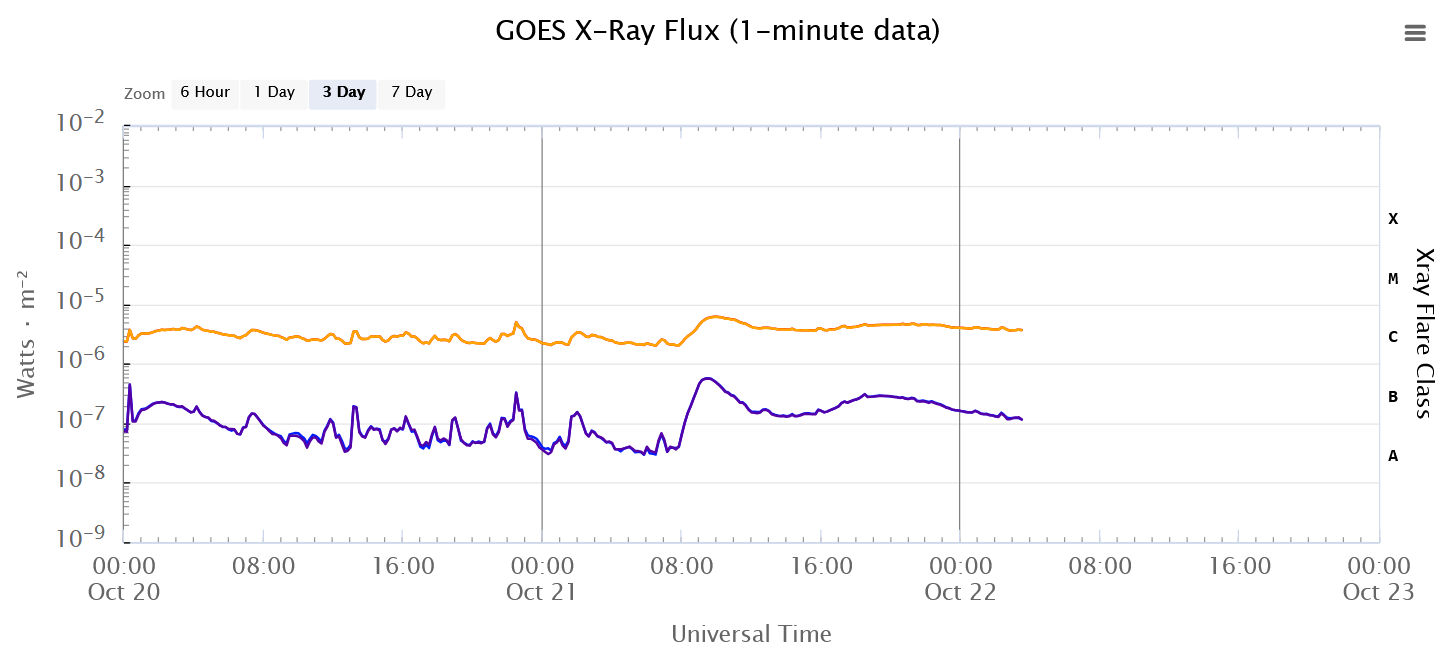
THE SUN IS TAKING A QUICK BREAK: Solar Max is hard work. Just ask the sun. After flaring almost without pause for the past 10 months, the sun is taking a quick break. Solar activity has been low for the past 48 hours with no flares stronger than category C. The quiet won't last. Solar Max is expected to continue for at least another year; flaring should resume shortly. Solar flare alerts: SMS Text
A HEADLESS COMET FOR HALLOWEEN? Headless comets are a real thing, and we might see one this weekend. Comet ATLAS (C/2024 S1) is falling toward the sun for a close encounter on Oct. 28th. Astronomers monitoring the comet say it is fluctuating in brightness by +/- 2 magnitudes--a sign that its core is breaking apart.
"The comet has almost certainly disintegrated," says Qicheng Zhang of the Lowell Observatory. "There's probably not much left of its primary core."
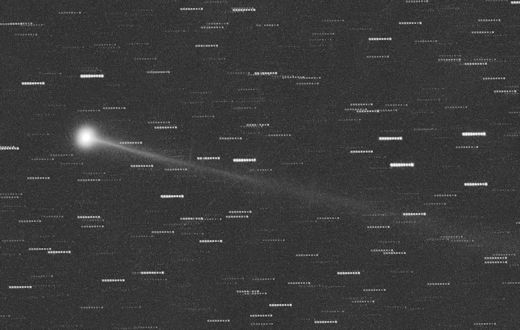
Comet ATLAS on Oct. 19th. Credit: Michael Jaeger (Farm Tivoli, Namibia)
In other words, the comet may be all tail and no head. We'll find out soon. Comet ATLAS will enter the field of view of SOHO coronagraphs on Oct. 26th (1400 UT), and it could put on a good show for the spacecraft's cameras.
"The comet could become fairly bright in the SOHO coronagraphs," says Zhang, who predicts a magnitude of +2 during the hours before perihelion (closest approach to the sun) on Oct. 28th.
No one can say for sure what will happen next. The comet's debris field may well contain dark fragments made of rock. Those fragments are not disintegrating now, but they might on Oct. 28th when the comet is only 0.008 AU from the sun. Fragments larger than ~100 meters would provide enough raw material for a bright tail that swings around the sun and becomes visible in the night sky after perihelion--a "headless comet" for Halloween! Stay tuned.
Realtime Space Weather Photo Gallery
Free: Spaceweather.com Newsletter
MEANWHILE COMET TSUCHINSHAN-ATLAS: Comet Tsuchinshan-ATLAS has faded to magnitude +5 and is no longer easily visible to the naked eye. It's still a great target for photographers. Tony Surma-Hawes took this picture using his iPhone 16 in Queensland, Australia:
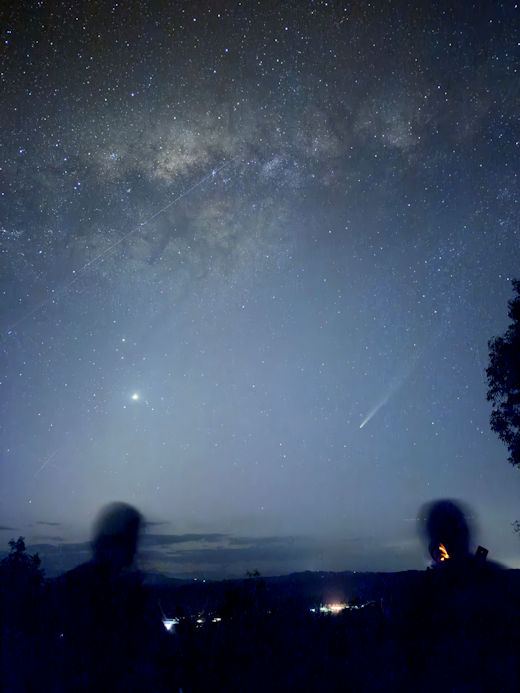
"I photographed the comet with my son and three of his friends," says Surma-Hawes. "We also caught a Starlink train passing overhead. As impressed the boys were with the comet in their cameras, their collective minds were blown by the procession of satellites. I have to say I had never seen the like myself."
If you have a modern smartphone, you can take a picture like this too. Go outside after sunset, point your phone at the western sky, and take a 10 second exposure in Night Mode. The comet is surprisingly easy to catch. Submit your photos here.
Realtime Comet Photo Gallery
Free: Spaceweather.com Newsletter
THE NEW MOONCAT: On Oct. 11th, the students of Earth to Sky Calculus launched a cosmic ray balloon into a severe geomagnetic storm. Their mission: To discover the storm's effect on atmospheric radiation. The New Mooncat went along for the ride.
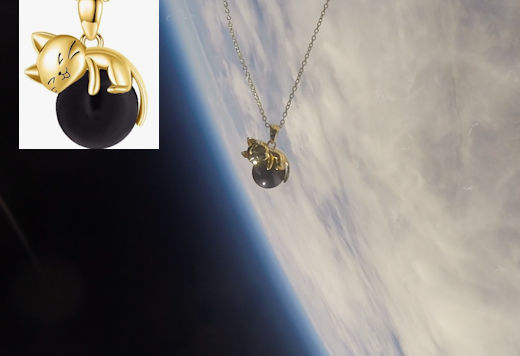
You can have it for $199.95. Wrapped around a circular stone of polished black onyx, the golden cat floated through the stratosphere for almost 3 hours while radiation sensors in the payload measured the storm. The pendant comes with a greeting card showing the cat in flight and telling the story of its journey to the stratosphere and back.
The students of Earth to Sky Calculus are selling space jewelry to support their cosmic ray ballooning program. Don't wait for Christmas--get yours now!
Far Out Gifts: Earth to Sky Store
All sales support hands-on STEM education
Realtime Aurora Photo Gallery
Free: Spaceweather.com Newsletter