WANTED! STORIES FROM FARMERS: This year, strong geomagnetic storms have wreaked havoc with GPS-guided agricultural equipment. It's been driving some farmers crazy. Are you one of them? Please contact Dr. Tony Phillips. He wants to hear your story. Geomagnetic storm alerts: SMS Text
ATMOSPHERIC RADIATION IS PLUMMETING: Cosmic rays in our atmosphere just hit a 10-year low. The sharp decline is shown in this dataset of more than 300 high-altitude balloon flights over California from 2015 to 2024:
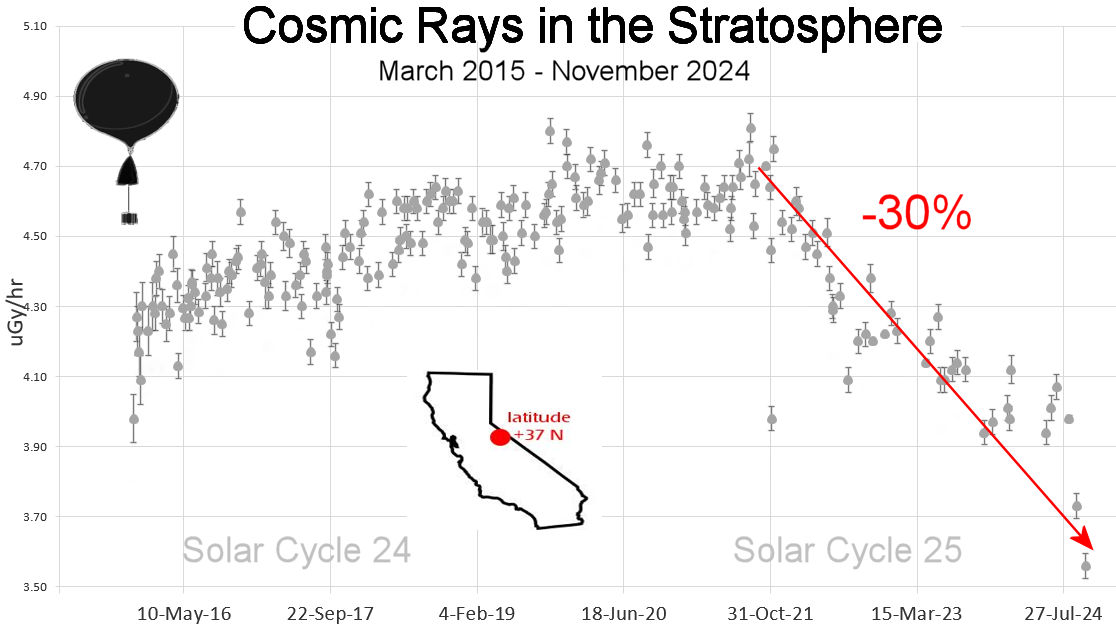
According to the data, atmospheric radiation has been dropping about 10% per year for the past three years, resulting in a nearly 1/3rd decrease overall. The decline isn't only in the stratosphere. It is also filtering down to aviation altitudes. This means air travelers are absorbing less radiation when they fly.
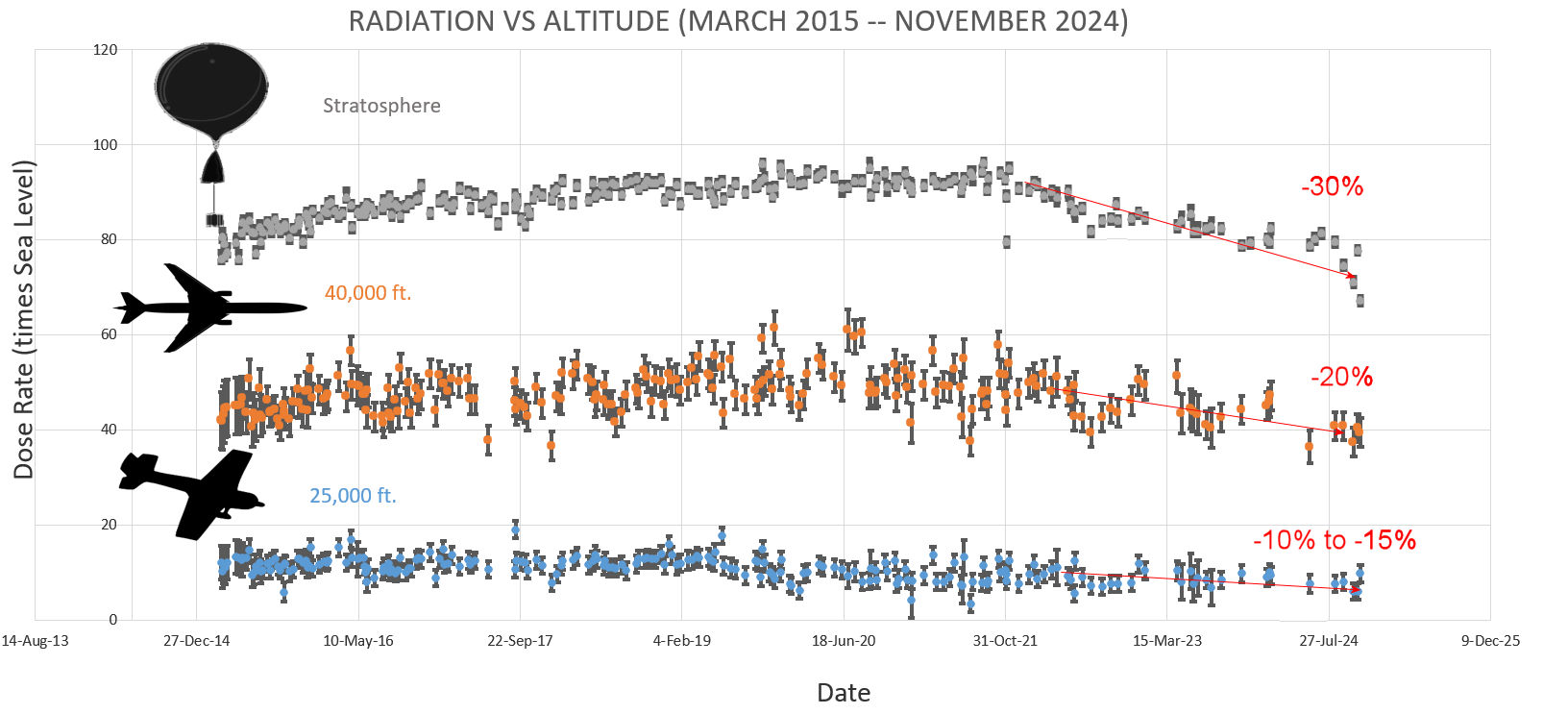
At first glance, this seems counterintuitive. NASA and NOAA recently announced that Solar Maximum has arrived, bringing solar activity to 10+ year high. So why is radiation decreasing? Answer: We're not measuring radiation from the sun. This radiation comes from deep space.
Supernova explosions and other violent events fill the Milky Way with high energy particles called "galactic cosmic rays." These subatomic cannonballs penetrate the walls of spacecraft and pose a long-term health threat to astronauts. They're actually worse than solar flares.
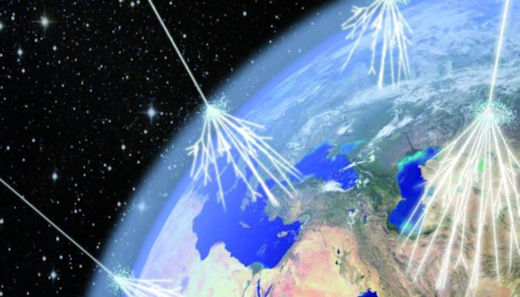 An artist's concept of galactic cosmic rays hitting Earth. [Learn more]
When galactic cosmic rays hit the top of Earth's atmosphere, they create a spray of secondary cosmic rays, which we measure using radiation sensors and high-altitude balloons. "We" means Spaceweather.com and the students of Earth to Sky Calculus. It's a STEM program that started more than a decade ago, teaching kids how to do science and manage a DIY space program.
Galactic cosmic rays are decreasing because of Solar Maximum. Over the past few years, the sun's magnetic field has grown stronger and more complex as the solar cycle reaches its peak. This makes it harder for cosmic rays to penetrate the solar system, and accounts for the decrease we have observed.
 Who cares? Astronauts, obviously. The European Space Agency calls galactic cosmic rays "a show stopper" for Mars exploration. Air travelers are also affected. A 2018 Harvard study cited cosmic rays as a risk factor for cancer in flight crews. There are also controversial studies linking cosmic rays to cardiac arrhythmia (Google it).
At the moment, there is no sign of the decline slowing down. Stay tuned for more data as we continue to launch balloons into Solar Cycle 25.
Would you like to support our balloon program? Buy a Christmas gift from the Earth to Sky Store :)
Realtime Space Weather Photo Gallery
Free: Spaceweather.com Newsletter
BLACK FRIDAY AT THE EDGE OF SPACE: Christmas is coming. Are you looking for a far-out gift? Check out the Earth to Sky Store. It's filled with unique items that have flown to the edge of space onboard cosmic ray research balloons.

Carried aloft by giant helium balloons, these unique gifts have flown above 99.7% of Earth's atmosphere, experiencing space-like blasts of cosmic rays, extreme cold, and a wild ride parachuting back to Earth after the balloon explodes. Even Amazon doesn't carry items this far out.
Don't forget to enter coupon code "HANDOFAPOLLO" at checkout for a 10% Early Black Friday discount.
Far Out Gifts: Earth to Sky Store
All sales support hands-on STEM education
Realtime Comet Photo Gallery
Free: Spaceweather.com Newsletter
Realtime Aurora Photo Gallery
Free: Spaceweather.com Newsletter