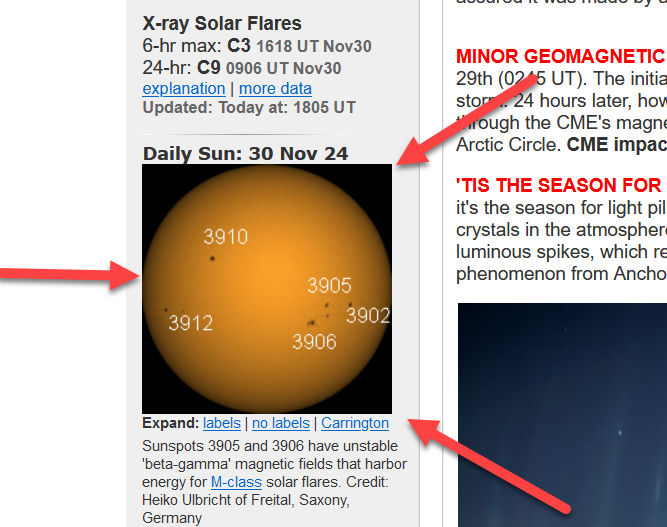
"EXTENSIVE DAMAGE" TO SDO DATA SERVERS: For the rest of the year, Daily Sun images on Spaceweather.com will look a little different. Normally, we share full-disk images from NASA's Solar Dynamics Observatory (SDO). However, a broken pipe and subsequent flood at Stanford University's Joint Science Operations Center has caused extensive damage to many SDO data servers. Repairs won't be complete until 2025. Now for the good news: Our readers are filling in the gap. Daily images of the sun are routinely taken by many skilled amateur astronomers around the world. We will be sharing their results right here.
'TIS THE SEASON FOR LIGHT PILLARS: Winter is coming. And that means it's the season for light pillars. As northern air gets colder and colder, ice crystals in the atmosphere catch the rays of urban lights and shape them into luminous spikes, which reach toward the sky. Jameson Parry observed the phenomenon from Anchorage, Alaska, on Nov. 27th:

"All around me there were pillars of light coming from every bright city light source," says Parry. "It was about 11:30 PM. The temp was 2 degrees F and humidity was about 90%."
The colors of light pillars correspond to the bulbs that create them. Blue-white pillars like Parry saw come from modern LED lamps. High pressure sodium bulbs, on the other hand, create warm orange hues. Some cities have a mixture of the two, which can create a colorful aurora-like display.
Sometimes, when urban lights are hidden behind buildings or trees, the resulting pillars appear as disembodied streaks in the night sky. "That's what I saw last night in northeast Wisconsin," reports Jacob Woulf:
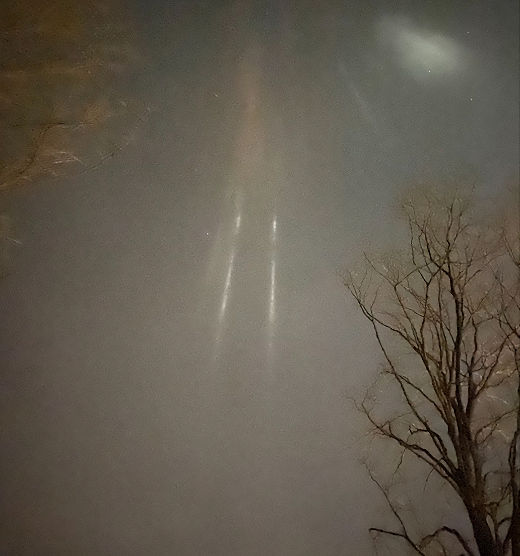
"These mysterious lights were shining right above me," he says. "Now I know they were light pillars."
Readers, if you photograph this phenomenon, submit your images here.
Realtime Space Weather Photo Gallery
Free: Spaceweather.com Newsletter
BLACK FRIDAY AT THE EDGE OF SPACE: Christmas is coming. Are you looking for a far-out gift? Check out the Earth to Sky Store. It's filled with unique items that have flown to the edge of space onboard cosmic ray research balloons.

Carried aloft by giant helium balloons, these unique gifts have flown above 99.7% of Earth's atmosphere, experiencing space-like blasts of cosmic rays, extreme cold, and a wild ride parachuting back to Earth after the balloon explodes. Even Amazon doesn't carry items this far out.
Don't forget to enter coupon code "BLACKCAT" at checkout for a 10% holiday discount.
Far Out Gifts: Earth to Sky Store
All sales support hands-on STEM education
Realtime Comet Photo Gallery
Free: Spaceweather.com Newsletter
Realtime Aurora Photo Gallery
Free: Spaceweather.com Newsletter