"EXTENSIVE DAMAGE" TO SOLAR DATA SERVERS: For the rest of the year, Daily Sun images on Spaceweather.com will look a little different. Normally, we share full-disk images from NASA's Solar Dynamics Observatory (SDO). However, a broken pipe and subsequent flood at Stanford University's Joint Science Operations Center has caused extensive damage to many SDO data servers. Repairs won't be complete until 2025. Now for the good news: Our readers are filling in the gap. Daily images of the sun are routinely taken by many skilled amateur astronomers around the world. We will be sharing their results right here.
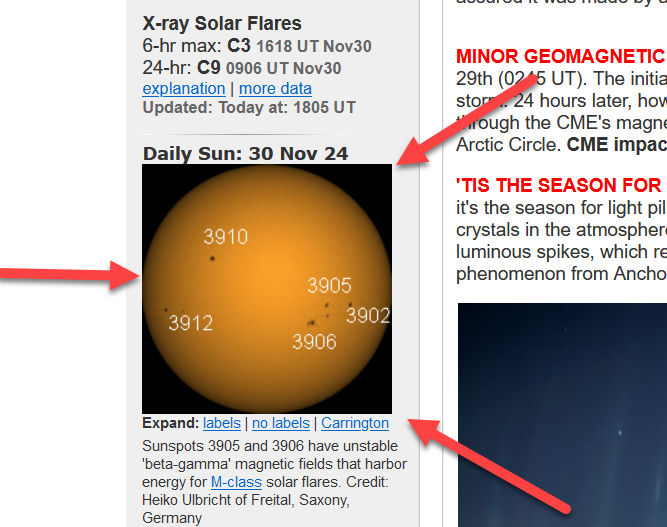
THE SOUTHERN HEMISPHERE IS STILL IN CHARGE: NASA and NOAA announced in October that Solar Maximum has arrived. Only half of the sun is paying attention. The sun's southern hemisphere continues to dominate sunspot production:
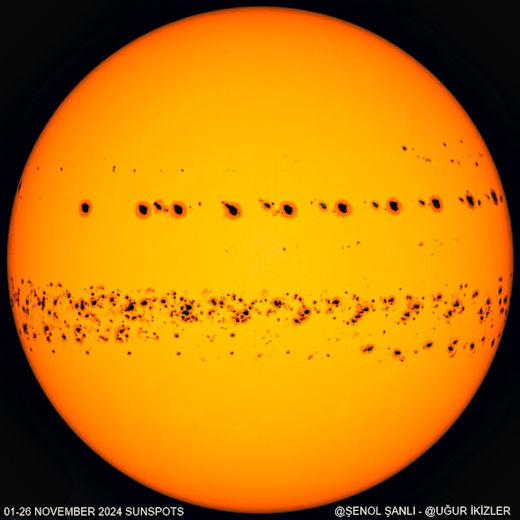
Composite of daily sun images from NASA's SDO. Credit: Şenol ŞANLI and Uğur İKİZLER
This is a composite image of all sunspots in November 2024. Southern sunspots outnumbered northern sunspots 4:1 according to hemispheric data from the Royal Observatory of Belgium (WDC-SILSO). This is the 6th month in a row the south has significantly outperformed the north. You can see the same pattern visually in composite images from October, September, August, July, and, to a lesser extent, June 2024.
What’s going on? Solar physicists have long known that the two hemispheres of the sun don’t always perform in sync. Solar Max in the north can be offset from Solar Max in the south by as much as two years, a delay known as the "Gnevyshev gap." This means half of Solar Max may still lie in the future--welcome news for sky watchers eager for more years of auroras. Stay tuned!
Realtime Aurora Photo Gallery
Free: Spaceweather.com Newsletter
UNUSUAL LIGHT PILLARS: This report is for connoisseurs of light pillars. Light pillars are a common sight during winter when artificial lights bounce off ice crystals suspended in the air. They look like this. The light pillars Angela M. saw this weekend at an airport in Finland, however, were not common:

Note the flared tops. That's what's unusual. Ordinary light pillars shoot straight into the sky with pointy tips. The V-shaped tops of these pillars are extremely rare.
The vast majority of light pillars are caused by ice crystals that look like tiny microscopic plates. However, ice crystals floating around the Rovaniemi airport were not little plates; instead, they were little pencils. Pencil-shaped ice crystals create the flare. To see the shape, common crystal plates must be absent. No one knows where they went! So there is an element of mystery, as well.
Realtime Space Weather Photo Gallery
Free: Spaceweather.com Newsletter
BLACK FRIDAY AT THE EDGE OF SPACE: Christmas is coming. Are you looking for a far-out gift? Check out the Earth to Sky Store. It's filled with unique items that have flown to the edge of space onboard cosmic ray research balloons.

Carried aloft by giant helium balloons, these unique gifts have flown above 99.7% of Earth's atmosphere, experiencing space-like blasts of cosmic rays, extreme cold, and a wild ride parachuting back to Earth after the balloon explodes. Even Amazon doesn't carry items this far out.
Don't forget to enter coupon code "BLACKCAT" at checkout for a 10% holiday discount.
Far Out Gifts: Earth to Sky Store
All sales support hands-on STEM education
Realtime Comet Photo Gallery
Free: Spaceweather.com Newsletter