QUIET WITH A SLIGHT CHANCE OF FLARES: Although the sun is peppered with sunspots, none of them is actively flaring. Solar activity is therefore low. NOAA forecasters estimate a slight 5% chance the sun will break the silence with an X-class solar flare on Dec. 3rd. Solar flare alerts: SMS Text
A MASSIVE THUNDERSTORM ON JUPITER: This week, Jupiter is at its closest to Earth--an event called "opposition." It's a great time to see a massive thunderstorm brewing on the giant planet. The storm is circled in this image from Austrian photographer Michael Karrer:
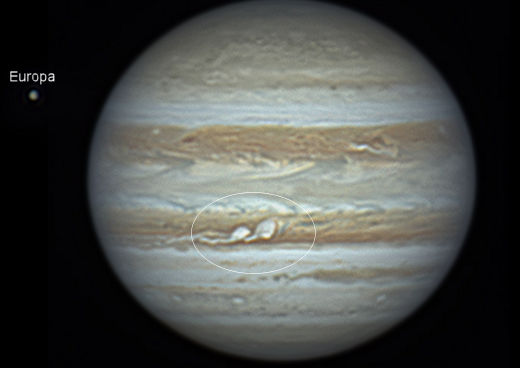
Karrer's photo, captured with an 8-inch Celestron telescope, captured two white swirls breaking through Jupiter's brown South Equatorial Belt (SEB). "These are giant thunderstorms," explains John Rogers of the British Astronomical Association. "The last time we saw storms like this was 8 years ago in 2016-17."
The white swirls are convective plumes rising from a location perhaps 100 km below the brown SEB. Although the plumes are not very deep (compared to the vast depth of Jupiter's atmosphere), they are wide enough to swallow Earth with room to spare. Rogers believes these storms could spread rapidly through the SEB, causing the familiar brown belt to fade as its color is diluted by the white storm front.
Astrophotographers, this is your chance to monitor a fast-changing alien tempest. Jupiter rises in the east at sunset and stays up all night long. Shining at magnitude -2.8 (only the sun, Moon and Venus are brighter), the giant planet is now an easy target for backyard telescopes. Point your optics here.
Realtime Space Weather Photo Gallery
Free: Spaceweather.com Newsletter
UNUSUAL LIGHT PILLARS: This report is for connoisseurs of light pillars. Light pillars are a common sight during winter when artificial lights bounce off ice crystals suspended in the air. They look like this. The light pillars Angela M. saw this weekend at an airport in Finland, however, were not common:

Note the flared tops. That's what's unusual. Ordinary light pillars shoot straight into the sky with pointy tips. The V-shaped tops of these pillars are extremely rare.
The vast majority of light pillars are caused by ice crystals that look like tiny microscopic plates. However, ice crystals floating around the Rovaniemi airport were not little plates; instead, they were little pencils. Pencil-shaped ice crystals create the flare. To see the shape, common crystal plates must be absent. No one knows where they went! So there is an element of mystery, as well.
Realtime Space Weather Photo Gallery
Free: Spaceweather.com Newsletter
BLACK FRIDAY AT THE EDGE OF SPACE: Christmas is coming. Are you looking for a far-out gift? Check out the Earth to Sky Store. It's filled with unique items that have flown to the edge of space onboard cosmic ray research balloons.

Carried aloft by giant helium balloons, these unique gifts have flown above 99.7% of Earth's atmosphere, experiencing space-like blasts of cosmic rays, extreme cold, and a wild ride parachuting back to Earth after the balloon explodes. Even Amazon doesn't carry items this far out.
Don't forget to enter coupon code "BLACKCAT" at checkout for a 10% holiday discount.
Far Out Gifts: Earth to Sky Store
All sales support hands-on STEM education
Realtime Comet Photo Gallery
Free: Spaceweather.com Newsletter
Realtime Aurora Photo Gallery
Free: Spaceweather.com Newsletter