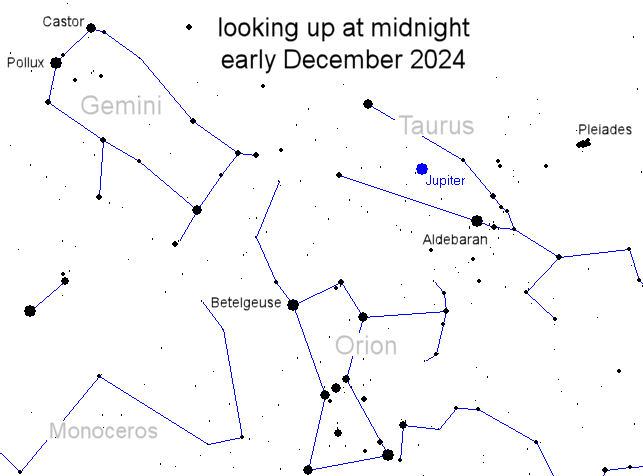
TODAY IS JUPITER'S CLOSEST APPROACH: Today, Dec. 6th, Jupiter is making its closest approach to Earth for 2024-2025. Extra-big and extra-bright, the giant planet rises in the east at sunset and soars overhead at midnight, outshining every star in the night sky. Look for it between the horns of Taurus the Bull: sky map.
MAGNETIC FROTH ON THE SUN: Solar Max has arrived, but only half the sun is fully partcipating. For the past 6 months, most flares and sunspots have been located below the sun's equator. A new image from Eliot Herman of Tuscon, Arizona, adds one more item to the list:
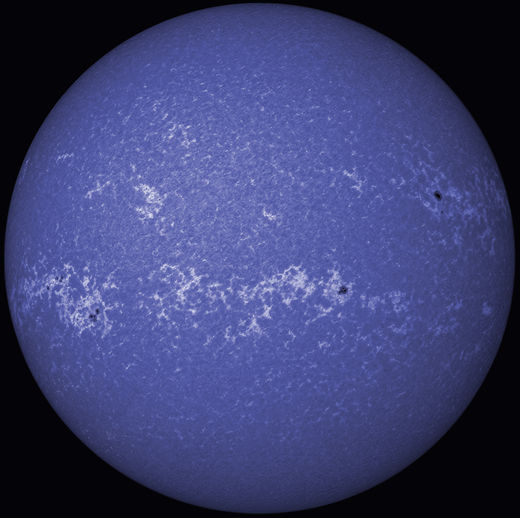
Magnetic froth. It is concentrated in a bright turbulent band stretching across the sun's southern hemisphere.
To take this picture on Dec. 5th, Herman used a Lunt solar telescope with a filter tuned to the blue glow of calcium ions in the sun's atmosphere. Calcium K filters are excellent detectors of magnetic froth--the bright and bubbly sea of magnetism that heralds the emergence of many sunspot groups. Clearly, the sun's southern hemisphere is seething with potential for sunspot genesis.
Meanwhile, the north has barely any froth at all. Catch up, North! Until it does, half of Solar Max is yet to come. Stay tuned.
Realtime Space Weather Photo Gallery
Free: Spaceweather.com Newsletter
DIAMOND DUST SUN HALOS: The hum, chug and boom of snowmaking machines means one thing. Ski season has arrived? Yes, but also, look toward the sun! Steven Poole's Dec. 4th photo from the Jackson Hole Ski Area in Wyoming shows why:
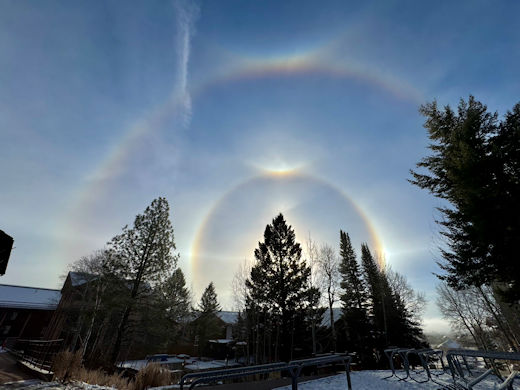
"The sun halos this morning were spectacular," says Poole.
Diamond dust sun halos, to be precise. Ordinary sun halos are caused by ice crystals forming naturally in high cirrus clouds. Snowmaking machines create a special type of crystal called "diamond dust." These man-made crystals tend to be more optically perfect than natural crystals in clouds, producing extra-sharp halos of exquisite complexity.
The display Poole witnessed is actually a combination of at least 6 different halos: a 22-degree halo, an upper tangent arc, a parhelic circle, a 46-degree halo, a circumzenithal arc, and a couple of sundogs hidden behind the trees.
Realtime Space Weather Photo Gallery
Free: Spaceweather.com Newsletter
CHRISTMAS GIFTS FROM THE EDGE OF SPACE: Christmas is coming. Are you looking for a far-out gift? Check out the Earth to Sky Store. It's filled with unique items that have flown to the edge of space onboard cosmic ray research balloons.

Carried aloft by giant helium balloons, these unique gifts have flown above 99.7% of Earth's atmosphere, experiencing space-like blasts of cosmic rays, extreme cold, and a wild ride parachuting back to Earth after the balloon explodes. Even Amazon doesn't carry items this far out.
Don't forget to enter coupon code "BLACKCAT" at checkout for a 10% holiday discount.
Far Out Gifts: Earth to Sky Store
All sales support hands-on STEM education
Realtime Comet Photo Gallery
Free: Spaceweather.com Newsletter
Realtime Aurora Photo Gallery
Free: Spaceweather.com Newsletter