CHANCE OF FLARES THIS WEEKEND: The sun is crackling with M-class solar flares. There were five of them yesterday, none stronger than M2. This kind of low-level M-class flaring keeps Earth's upper atmosphere in an enhanced state of ionization without actually causing a major space weather event. NOAA forecasters say there is a 50% chance of more M-flares during the next 24 hours. Solar flare alerts: SMS Text
SUPERFLARES ON SUN-LIKE STARS: Now we have to worry about superflares. A new study published yesterday in Science concludes that sun-like stars in the Milky Way produce superflares approximately once every 100 years. Superflares are solar flares more than ~50 times stronger than the Carrington Event. If one hit Earth, it could bring down power grids, disable satellite networks, and more.
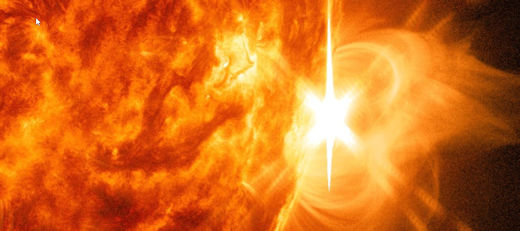
An X1-class solar flare on the sun. A superflare could be hundreds of times stronger
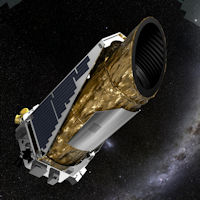
Led by Valeriy Vasilyev of the Max Planck Institut in Göttingen, Germany, a team of 10 astronomers looked at brightness measurements of 56,450 sun-like stars--far more than any previous study. The data were collected by NASA's Kepler space telescope between 2009 and 2018.
"We identified 2889 superflares on 2527 sun-like stars," they wrote in the paper. "This detection rate indicates that superflares with energies >1034 erg occur roughly once per century on stars with sun-like temperature and variability."
 Previous studies of sun-like stars reached very different conclusions. "Those studies found frequencies approximately two orders of magnitude lower than our measurements," the authors acknowledge. In other words, superflares would be expected only once every 1,000 to 10,000 years--a relatively safe interval.
Right: NASA's Kepler space telescope
This new study may be superior, however. Improved techniques for analyzing Kepler data allowed the team to search for flares from tens of thousands of stars excluded from previous studies. Indeed, they found 1941 superflares never before noticed in Kepler's data set.
In the Science paper, the authors compare flares according to their energy in ergs. A superflare is any flare >1034 erg. The Carrington solar flare (Sept. 1, 1859) was ~5 × 1032 erg, while the strongest flare of the Space Age (Oct. 28, 2003) registered 7 × 1032 erg.
These dates and energies tell us that Earth has *not* been hit by a superflare in the past century or so. However, that doesn't mean the study is wrong. We could simply be overdue. Or the sun may be less active than other sun-like stars.
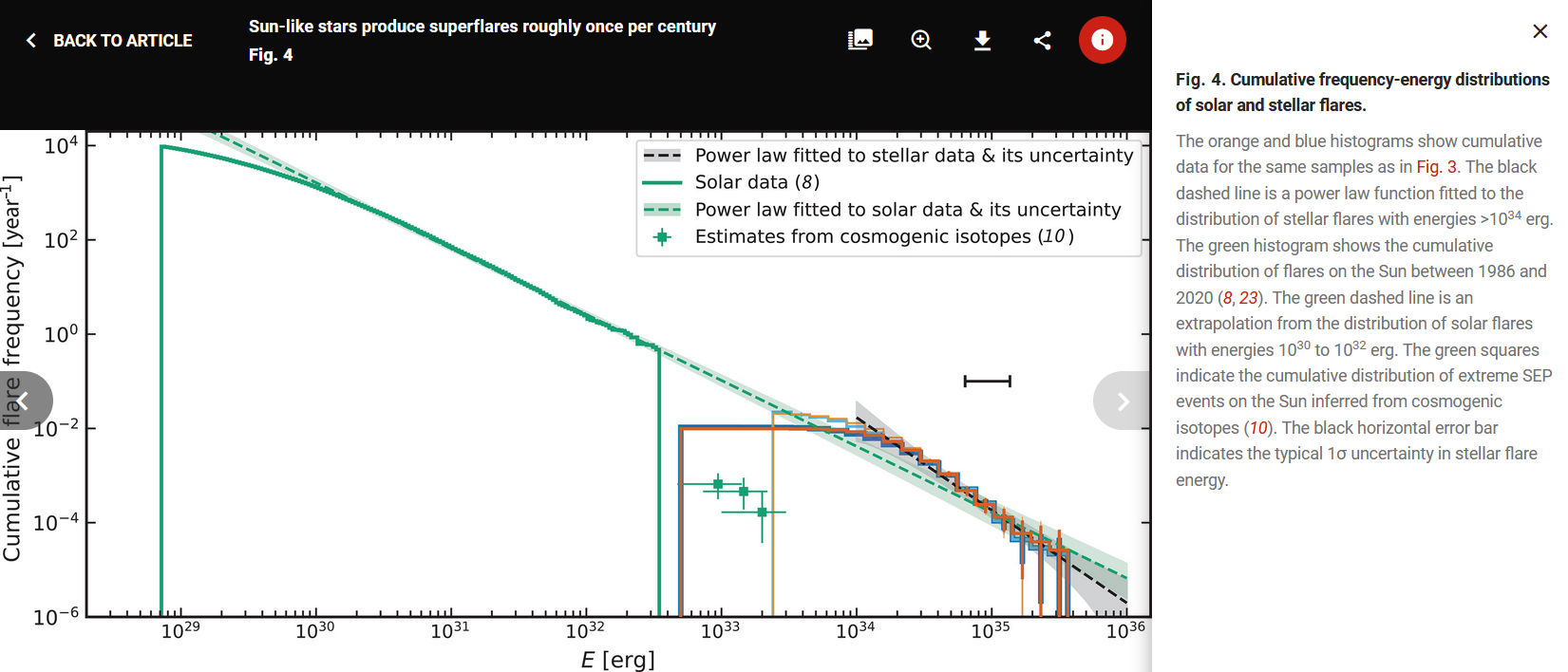
This is the key plot from the new paper. Note how the rate of superflares from Kepler stars (orange) exceeds what is expected from an extrapolation of solar data (green). [full caption]
"If our sample of sun-like stars is representative of the sun's future behavior, it is substantially more likely to produce a superflare than was previously thought," the researchers say. A big IF... but at the same time, disturbingly plausible.
Read the original research here.
Realtime Space Weather Photo Gallery
Free: Spaceweather.com Newsletter
CHRISTMAS GIFTS FROM THE EDGE OF SPACE: Christmas is coming. Are you looking for a far-out gift? Check out the Earth to Sky Store. It's filled with unique items that have flown to the edge of space onboard cosmic ray research balloons.

Carried aloft by giant helium balloons, these unique gifts have flown above 99.7% of Earth's atmosphere, experiencing space-like blasts of cosmic rays, extreme cold, and a wild ride parachuting back to Earth after the balloon explodes. Even Amazon doesn't carry items this far out.
Don't forget to enter coupon code "BLACKCAT" at checkout for a 10% holiday discount.
Far Out Gifts: Earth to Sky Store
All sales support hands-on STEM education
Realtime Comet Photo Gallery
Free: Spaceweather.com Newsletter
Realtime Aurora Photo Gallery
Free: Spaceweather.com Newsletter