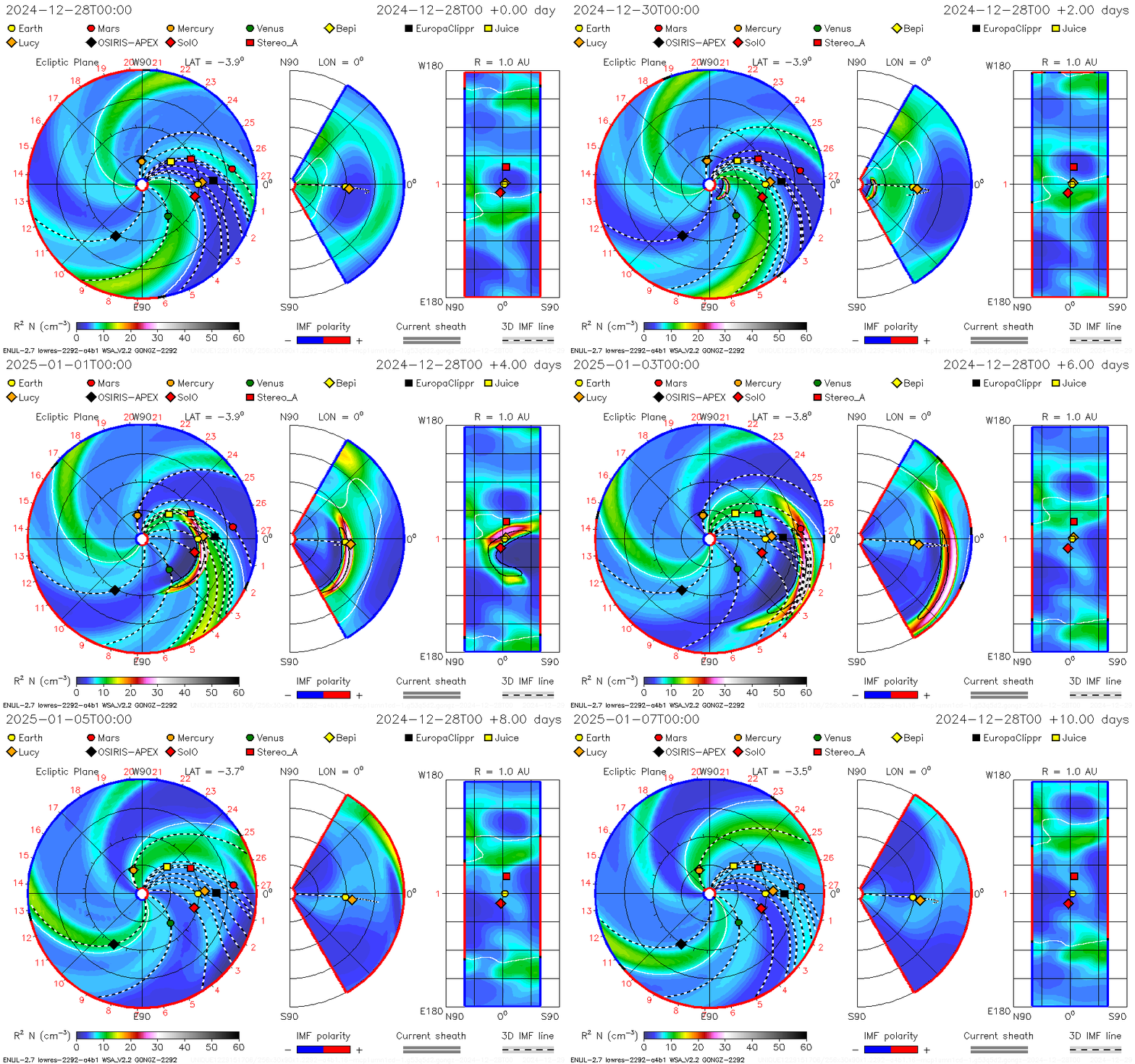
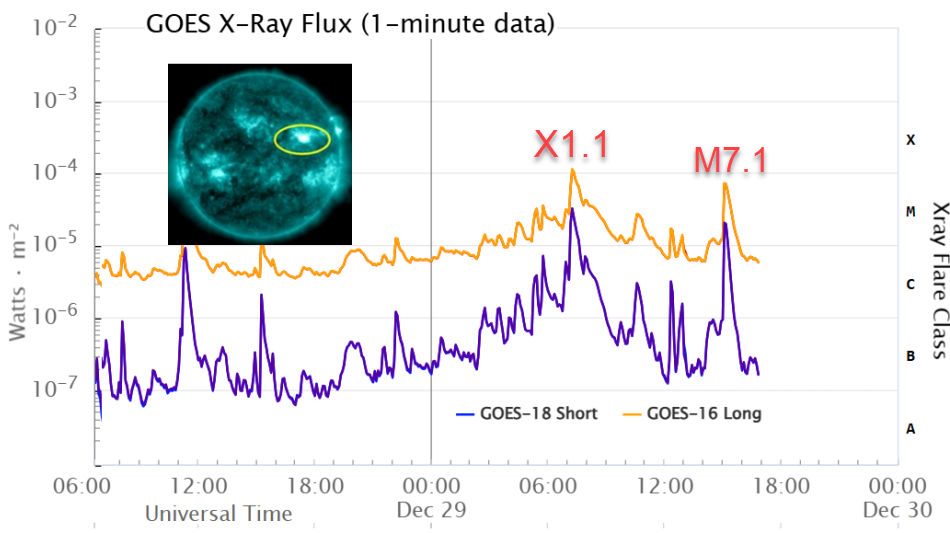
STRONG SOLAR ACTIVITY RESUMES: The quiet has broken. Today sunspot 3936 produced a strong X1-class solar flare (0717 UT) along with a series of M-class flares peaking at M7 (1509 UT). As a result of these explosions, at least one CME is heading for Earth, and a NASA model shows it reaching Earth late on Dec. 31st. Stay tuned for an updated forecast. CME impact alerts: SMS Text
SUNGRAZING COMET ATLAS: Some writers are calling it "the brightest comet of 2025." Maybe. If Comet ATLAS (C/2024 G3) survives its brush with the sun next month, it could become very bright indeed. At the moment, it is barely visible in the morning sky of the southern hemisphere. Nick James of the British Astronomical Association photographed the comet on Dec. 28th using a remote-controled telescope in Chile:
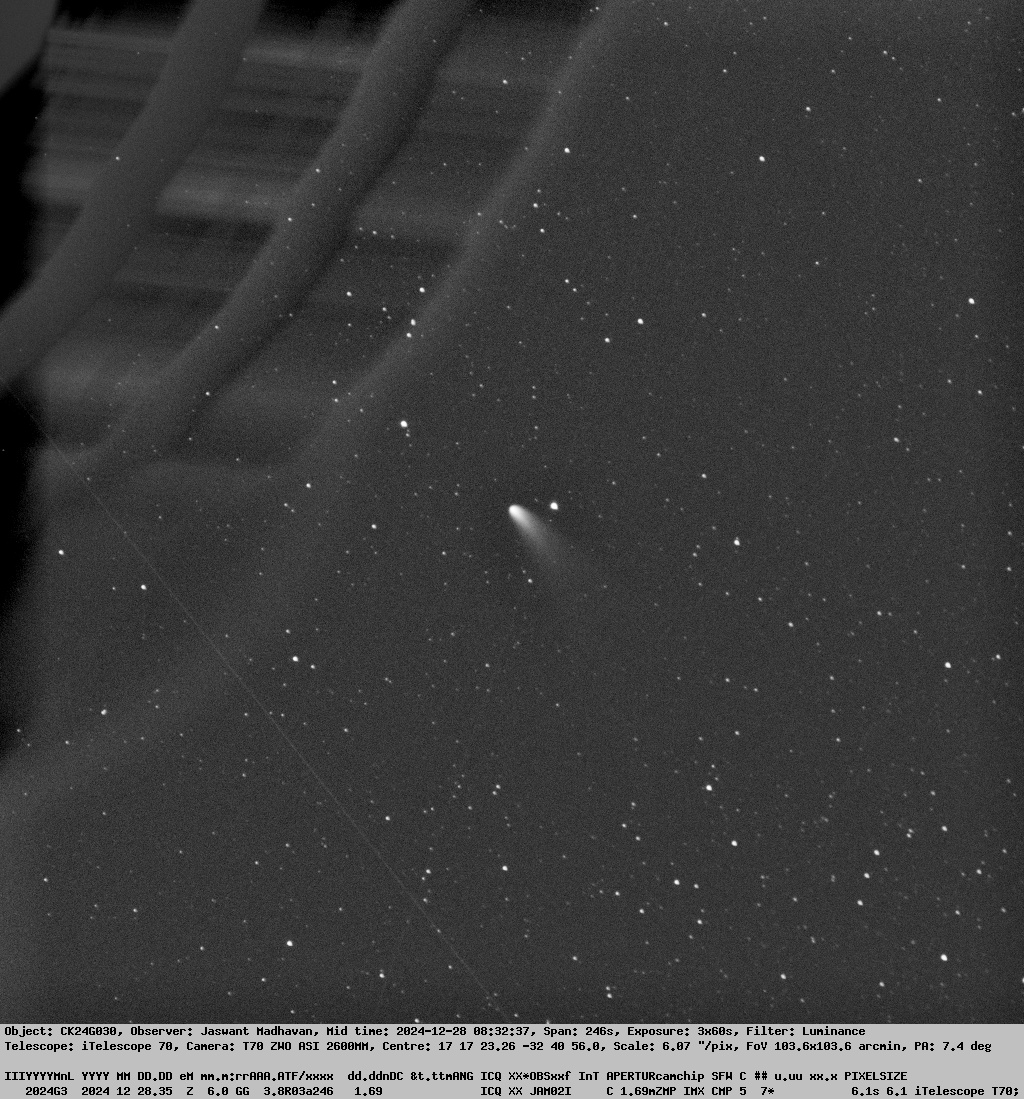
Note: The lattice structure on the left is the edge of the observatory dome.
"This morning, the comet had a total magnitude of +6.0," says James. It was very low in the sky, but "the T70 telescope at X07 in Chile is able to get down to the mountain ridge horizon, which is around 4 degrees."
The fact that Comet ATLAS is hugging the morning horizon explains why so few astronomers are observing it. It is easily eclipsed by trees and hillsides.
Soon, however, the comet may attract much more attention. On Jan. 13th, it will be only 0.09 AU from the sun. Extreme heat could boost the comet's brightness to magnitude -3.5, almost as bright as Venus; or, it could be completely destroyed. Either way, Comet ATLAS is about to put on a show. SOHO coronagraphs will pick up the comet starting Jan. 11th. Stay tuned!
Realtime Comet Photo Gallery
Free: Spaceweather.com Newsletter
SUNSET MIRAGE: On Dec. 28th, when the sun set over Hungary, strange things happened to the solar disk. Kuli Zoltán photographed the distortions from the town of Piszkesteto:
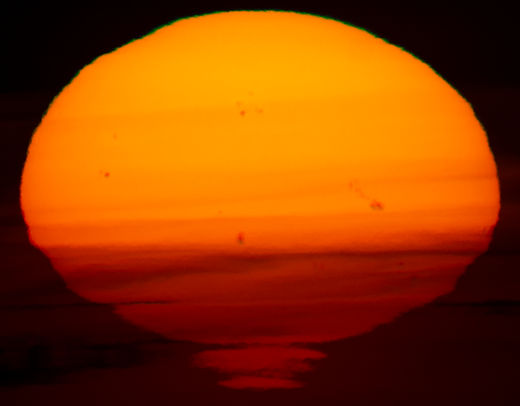
"Using my 80 mm refracting telescope, I watched the sun divide itself into slices and change into strange shapes," says Zoltán. "At the end, there was an emerald green flash."
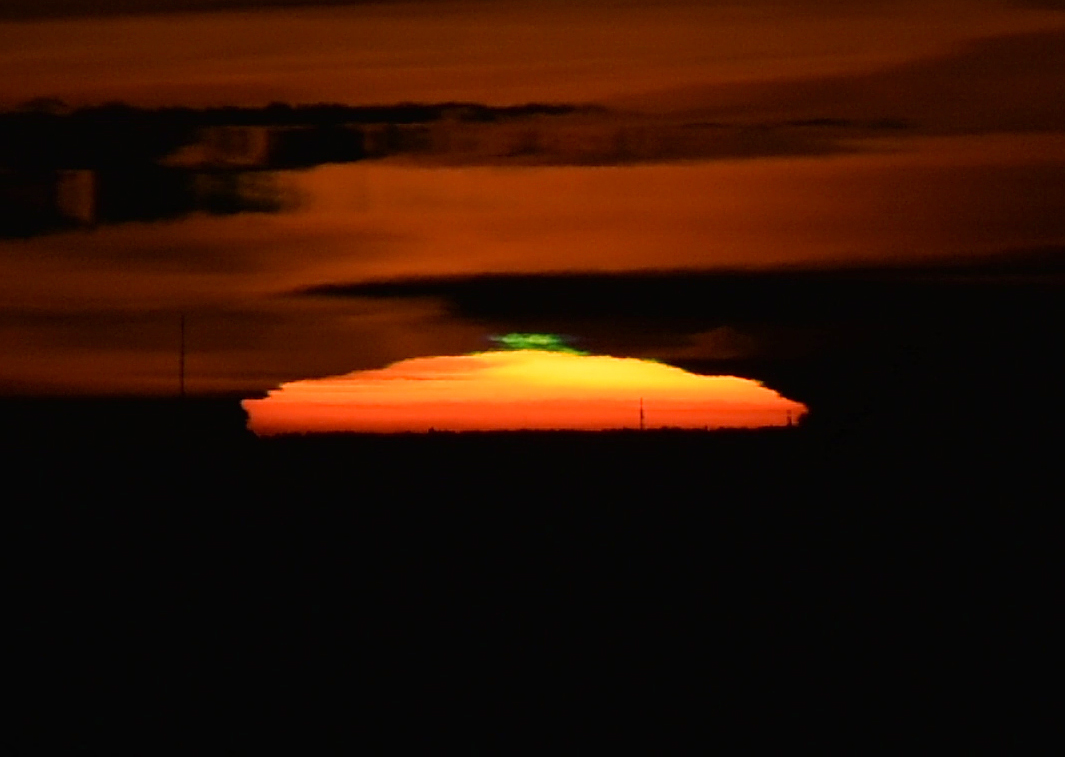
This is, of course, a mirage, caused by afternoon temperature inversions in the atmosphere over Hungary. The slices Zoltán witnessed are evidence of atmospheric ducts: Pancaked layers of warm and cold air squashed the solar disk, stacking multiple layers in a "mock mirage" display. What a way to end the day!
Realtime Space Weather Photo Gallery
Free: Spaceweather.com Newsletter
CHRISTMAS GIFTS FROM THE EDGE OF SPACE: Christmas is here! Are you looking for a far-out gift? Check out the Earth to Sky Store. It's filled with unique items that have flown to the edge of space onboard cosmic ray research balloons.

Carried aloft by giant helium balloons, these unique gifts have flown above 99.7% of Earth's atmosphere, experiencing space-like blasts of cosmic rays, extreme cold, and a wild ride parachuting back to Earth after the balloon explodes. Even Amazon doesn't carry items this far out.
Don't forget to enter coupon code "BLACKCAT" at checkout for a 10% holiday discount.
Far Out Gifts: Earth to Sky Store
All sales support hands-on STEM education
Realtime Comet Photo Gallery
Free: Spaceweather.com Newsletter
Realtime Aurora Photo Gallery
Free: Spaceweather.com Newsletter