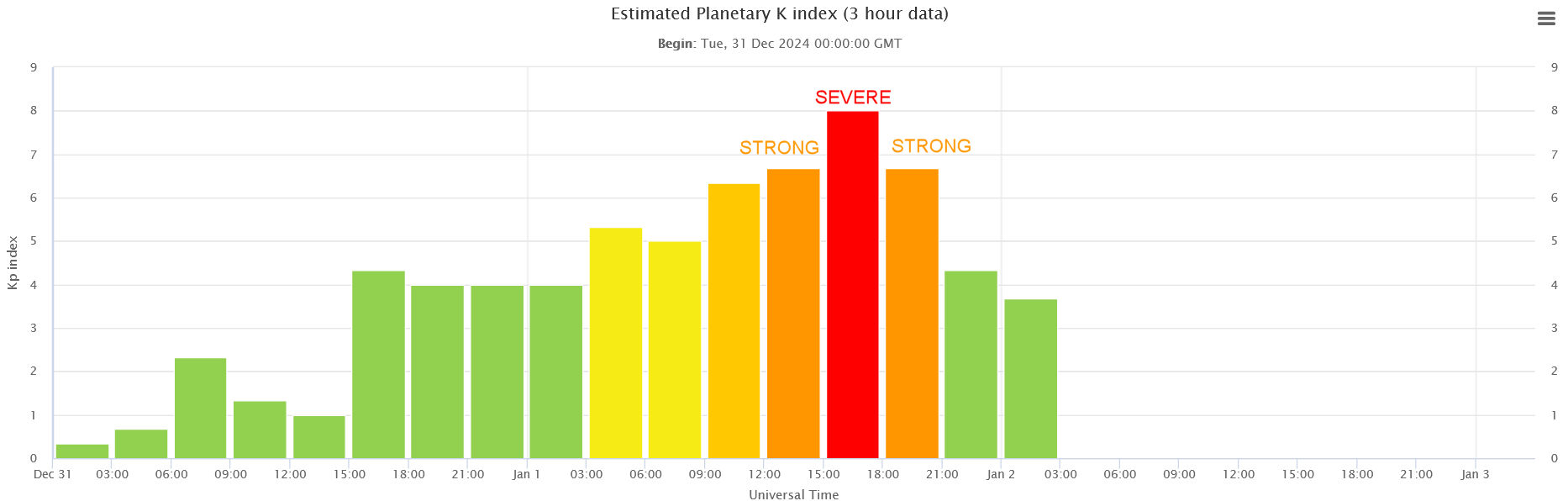
THE STORM IS OVER: 2025 is off to a good start. For more than 9 hours on Jan. 1st, Earth's magnetic field was rattled by a strong-to-severe (G3-to-G4) geomagnetic storm. During the event, Northern Lights descended as far south as Mexico, Colorado and Arizona, with eye-popping explosions of color over Alaska, Scandinavia and New Zealand. All of this was caused by a CME impact on Dec. 31st. Did you sleep through the show? Next time get a wake-up call from Space Weather Alerts.


NOT ALL OF THOSE AURORAS WERE AURORAS: The realtime aurora gallery is full of photos from last night's geomagnetic storm. Take a closer look. Not all of the auroras were actually auroras. Here's an example from Fermanagh, Northern Ireland:
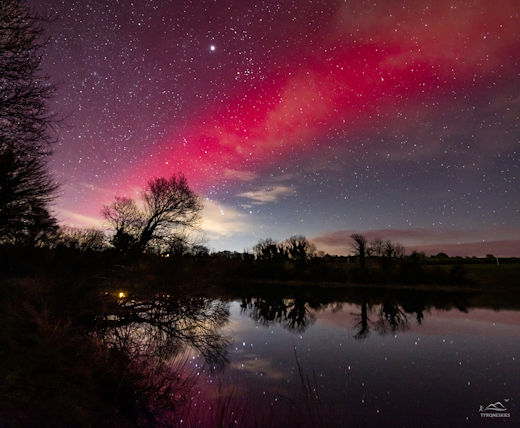
"This is a beautiful SAR arc," explains photographer Paul Martin. "It stretched across the sky after the main aurora show earlier in the evening. What a way to kick off 2025!"
SAR arcs were discovered in 1956 at the beginning of the Space Age. Researchers didn’t know what they were and unwittingly gave them a misleading name: "Stable Auroral Red arcs" or SAR arcs.
In fact, SAR arcs are not auroras. Auroras appear when charged particles from space rain down on the atmosphere, causing it to glow. SAR arcs form differently. They are a sign of heat energy leaking into the upper atmosphere from Earth's ring current system–a donut-shaped circuit carrying millions of amps around our planet.
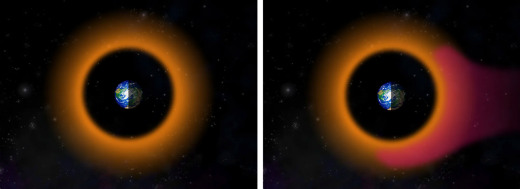
An artist's concept of Earth's ring current, quiet (left) and active (right) [more]
On Jan. 1st, the ring current was pumped up by hours of intense geomagnetic storming, with energy dissipating downward into SAR arcs. Photographers caught their pure red glow from many locations in both Europe and North America.
Observing tip: The red color of SAR arcs is *so* pure, that many people cannot see it. The human eye is not very sensitive to its 630 nm wavelength. Cameras don't have the same problem, though. During the next strong geomagnetic storm, point your camera (even your phone's camera) at the sky and 'click.' You might catch an SAR arc.
more SAR images: from Martin McKenna of Lough Fea, N. Ireland; from Jay Shaffer of Taos County, New Mexico USA; from Alessandro Carrozzi of Casalgrande, Emilia-Romagna, Italy; from Aaron Watson of Paonia, Colorado; from Adrián Ramírez of Mexicali, Baja California, Mexico
Realtime Aurora Photo Gallery
Free: Spaceweather.com Newsletter
GIFTS FROM THE EDGE OF SPACE: A New Year of balloon launches is about to begin, and we need to buy helium! You can help by puchasing a gift from the Earth to Sky Store. It's filled with unique items that have flown to the edge of space onboard cosmic ray research balloons.

These unique gifts have flown above 99.7% of Earth's atmosphere, experiencing space-like blasts of cosmic rays, extreme cold, and a wild ride parachuting back to Earth after the balloon explodes. Even Amazon doesn't carry items this far out.
Don't forget to enter coupon code "SOLARMAX2025" at checkout for a 15% holiday discount. All profits support STEM space weather research.
Far Out Gifts: Earth to Sky Store
All sales support hands-on STEM education
Realtime Comet Photo Gallery
Free: Spaceweather.com Newsletter
Realtime Space Weather Photo Gallery
Free: Spaceweather.com Newsletter