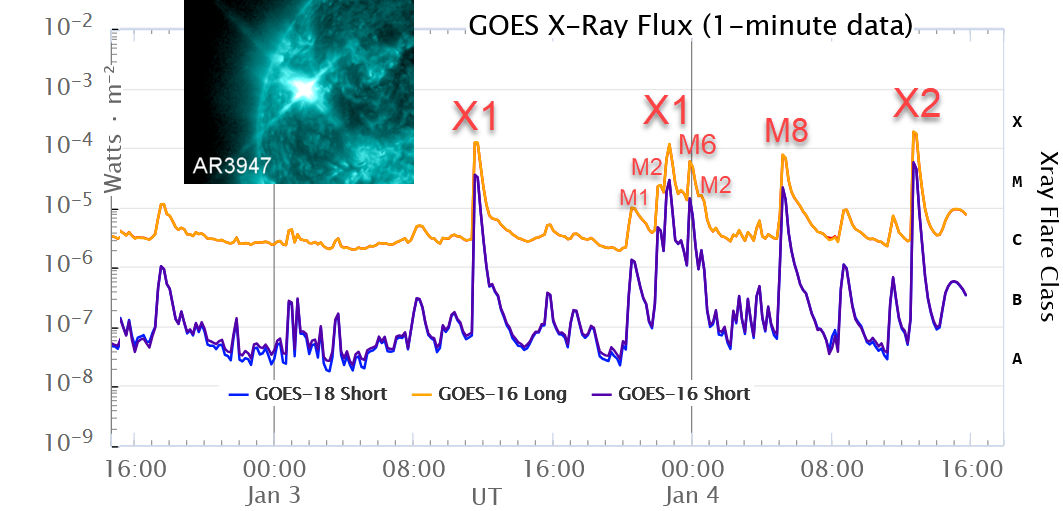
QUIET WITH A CHANCE OF FLARES: After firing off a series of X-class solar flares on Jan. 3-4, active sunspot AR3947 has gone quiet. However, the threat of strong flares is not over. The sunspot still has an unstable 'beta-gamma-delta' magnetic field that could explode at any moment. NOAA forecasters estimate a 25% chance of another X-flare on Jan. 8th. Solar flare alerts: SMS Text.
THE EVENING PLANET SHOW: When the sun goes down tonight, step out out and look ... in any direction. There are bright planets all across the sky. Alan Dyer captured the display in this Jan. 6th photo from rural Alberta, Canada:
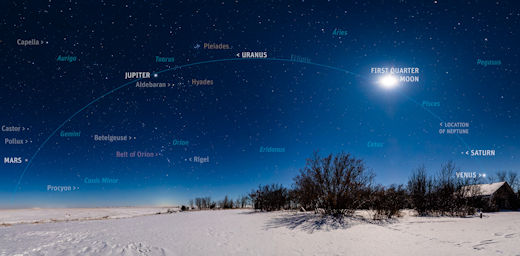
"This month there has been a lot of media hype about a 'planet alignment' — well, here it is," says Dyer. "Four of the naked eye planets are above the horizon at once. Only Mercury is missing."
Venus, Jupiter and Mars, in particular, are *really* bright--all brighter than the brightest star in the night sky, Sirius, which is also visible. It's quite a show.
The Moon is moving among the planets. On Jan. 3rd there was a conjunction with Venus, followed on Jan. 4th by an occultation of Saturn. Next, on Jan. 9th, Jupiter will have a close encounter with the Moon. The best event of all will be next Monday's occultation of Mars.
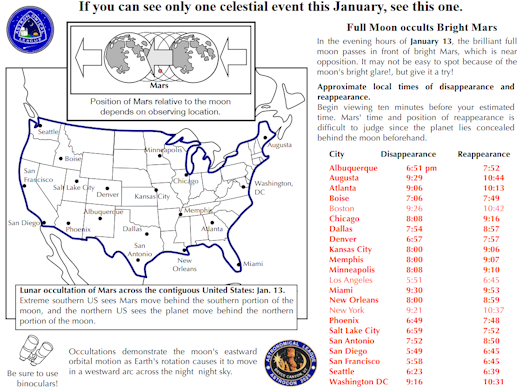
On Jan. 13th, the Moon will occult (cover) Mars. This infographic from the Astronomical League shows the times and circumstances. The red planet's vanishing will be visible to most everyone in North America around dinnertime. Binoculars are recommended to see Mars near the glaring-bright edge of the Full Moon. As you look through the optics, be sure to appreciate the rusty-orange color of Mars; there's no other planet like it.
Realtime Space Weather Photo Gallery
Free: Spaceweather.com Newsletter
A BRIGHT COMET IS FALLING TOWARD THE SUN: Next week, Comet ATLAS (C/2024 G3) could outshine the planet Venus. It's falling toward the sun for a very close encounter (0.09 AU) on Jan. 13th. "If, by some miracle, the comet survives the intense thermal stress, it could become visible to the naked eye for observers in the southern hemisphere," says Lionel Majzik, who sends this picture from Chile:
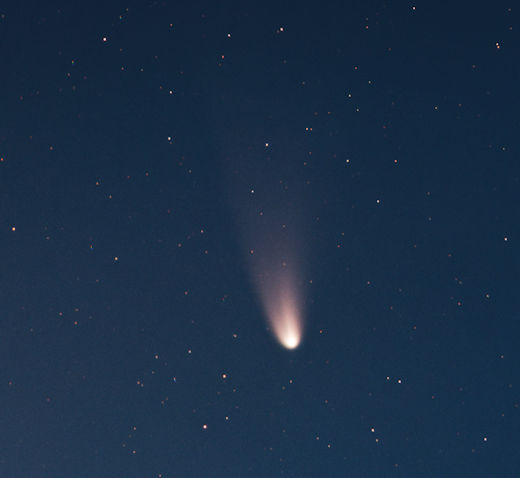
"I photographed the comet at sunrise on Dec. 31st," says Majzik. "It was only about 6 degrees above the horizon. A fan-shaped prominent dust tail could be seen in the waxing glow of the rising sun."
Three days after Majzik's photo, Comet ATLAS experienced an outburst, abruptly brightening by +2 magnitudes. Many astronomers feared it might be breaking apart. However, Nick James of the British Astronomical Association thinks it might be okay.
"The sudden jump in brightness on Jan. 2nd, first reported by Terry Lovejoy, was significant," says James. "This could have been an early sign of disintegration, but since then the comet has continued to brighten. It looks as if this outburst has not been fatal."
Indeed, James himself photographed the comet apparently intact on Jan 4th:
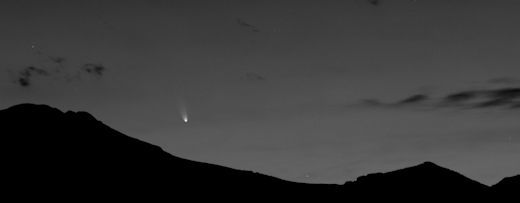
"This is a dawn photo from Rio Hurtado, Chile," says James. "The comet was only 16 degrees from the sun, easy to photograph despite being very low in the morning sky"
The big day is Jan. 13th, when the comet swoops only 0.09 AU from the sun. If current trends hold, its magnitude should increase to around -5 (twice as bright as Venus). "It might even be visible in the daytime sky, but the sun will be only 5 degrees away," notes James. "Observing with the sun so nearby is dangerous and should only be attempted with great care."
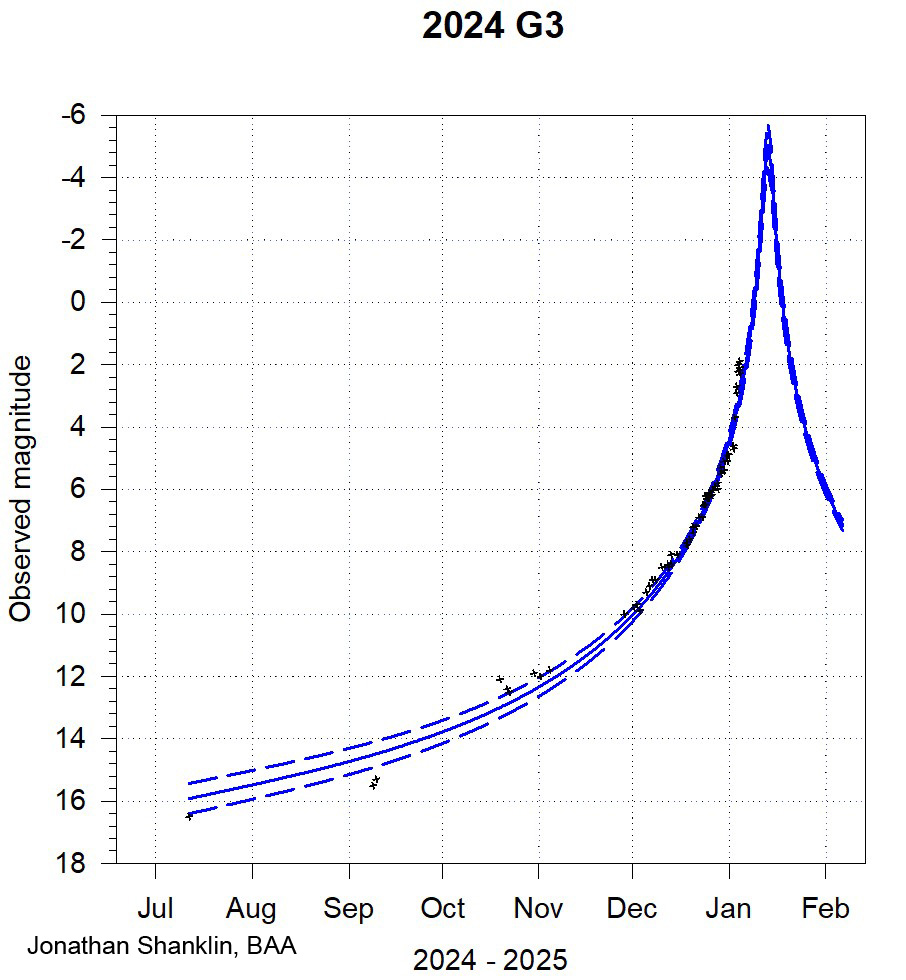
SOHO coronagraphs will pick up the comet starting Jan. 11th. That will give us a preview of what to expect two days later. Until then, read "Prospects for C/2024 G3 (ATLAS)" by Nick James for observing tips--and stay tuned!
more images: from Michael Mattiazzo of Swan Hill, Australia; from Alan C Tough using a remote telescope in Rio Hurtado Valley, Chile
Realtime Comet Photo Gallery
Free: Spaceweather.com Newsletter
PLANET CAT IS BACK: There's a story behind this cat. Keep reading for the full story. The Planet Cat Pendant is a far-out gift for the cat-lover in your life: The sterling silver jewelry touched space on Nov. 17, 2022, when it hitched a ride onboard an Earth to Sky Calculus cosmic ray research balloon.
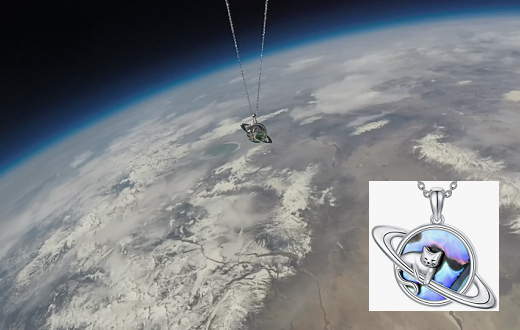
You can have it for $199.95. The students of Earth to Sky Calculus are selling space pendants to support their cosmic ray ballooning program. Each one comes with a greeting card showing the pendant in flight and telling the story of its journey to the stratosphere and back again.
And now for the story: We launched this balloon on Nov. 17, 2022, more than two years ago. When the payload parachuted back to Earth, it veered off course, landing unexpectedly on Saline Peak, a rugged mountain in Death Valley National Park. The payload remained in that spot for 2 winters and 2 summers, subjected to episodes of deep snow, hurricane-force winds, and scorching 100+ degree F temperatures. Severe weather and technical terrain prevented us from recovering the payload until Jan. 5, 2024. Astonishingly, the payload and parachute were severely bleached by the Death Valley sun, but the instrumentation is completely intact. All the radiation sensors and cameras still work--and the Planet Cat Pendent, which was shadowed by the payload, looks awesome.
Far Out Gifts: Earth to Sky Store
All sales support hands-on STEM education
Realtime Aurora Photo Gallery
Free: Spaceweather.com Newsletter