SOHO CAN SEE THE COMET NOW: Sungrazing Comet ATLAS (C/2024 G3) has just entered the field of view of SOHO's C3 coronagraph. Check it out. The comet will remain visible to the spacecraft throughout the comet's Jan. 13th close encounter with the sun, allowing us to monitor its health as it endures fierce solar heat. Stay tuned! Solar flare alerts: SMS Text.
SUNGRAZING COMET AT DAWN: Comet ATLAS (C/2024 G3) is brightening rapidly as it falls toward the sun for a Monday close encounter. This morning before sunrise, Petr Horálek saw it with his naked eyes over the hills of Spisske Podrhadie, Slovakia:
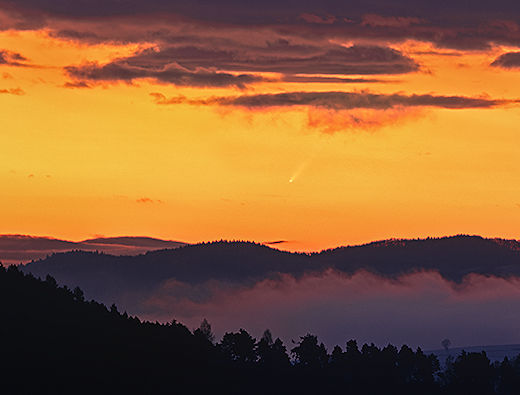
"I was truly surprised," says Horálek. "While Mercury was difficult to find, the comet was an easy target. Thanks to finding it in the camera's viewfinder, I could see it immediately with my eyes too (the structures in the clouds in its vicinity helped)."
Meanwhile in England, Nick James of the British Astronomical Association photographed the sungrazer in broad daylight. His image, captured while the afternoon sun was hidden behind a tree, is inset in this up-to-date light curve from the Comet Observation Database:
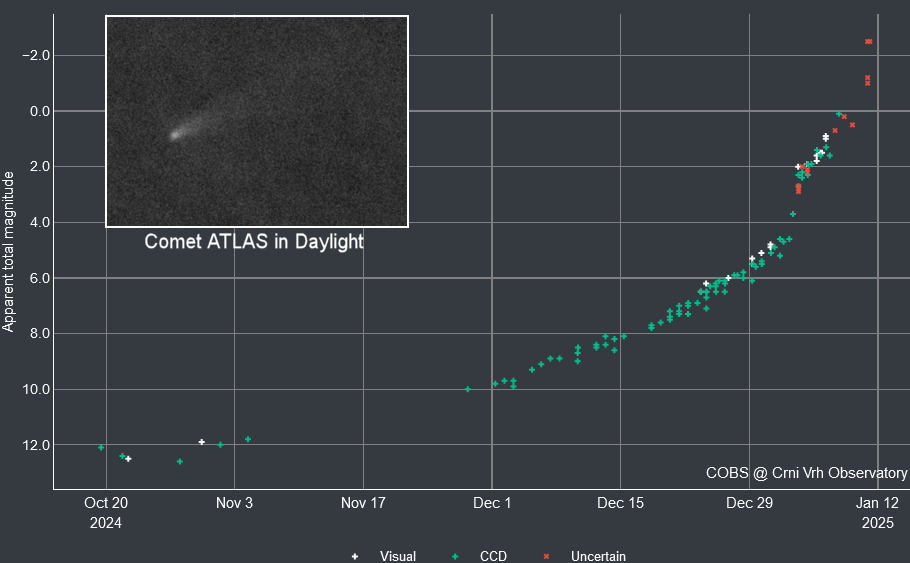
"I was surprised to get such a strong image," says James. "The comet must be pretty bright."
James compared the comet to Venus, which was even higher in the afternoon sky, and was able to make an estimate of the comet's brightness: "It's magnitude was about -0.8. That doesn't really seem bright enough given how prominent the comet is on the image, but that is what I get!"
If current trends hold, Comet ATLAS could brighten another 2 to 4 magnitudes by Jan. 13th when the comet swoops only 0.09 AU from the sun. Although it will likely be brighter than Venus, only the most experienced observers should attempt to photograph the comet so close to the blinding sun.
If Comet ATLAS survives the heat, it could become a nice object in the evening sky next week. Southern hemisphere observers are favored, but many northerners will be able to see it, too. Read "Prospects for C/2024 G3 (ATLAS)" by Nick James for observing tips.
more images: from Gorazd Bizjan of Medvode, Slovenia; from Chris Schur of Payson, Arizona; from Lionel Majzik of Tápióbicske, Pest, Hungary
Realtime Space Weather Photo Gallery
Free: Spaceweather.com Newsletter
"ALWAYS AND FOREVER" RUBY HEART PENDANT: Are you looking for a far out Valentine's Day gift? Consider the Always and Forever Space Pendent. The students of Earth to Sky Calculus launched it to the stratosphere onboard a cosmic ray research balloon:
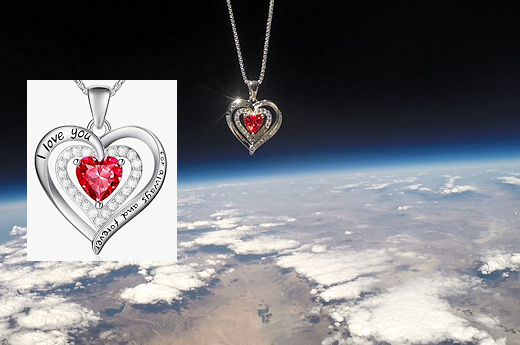
You can have it for $219.95. Engraved with the words "I love you always and forever", this sterling silver pendant has a heart-shaped ruby crystal in the middle surrouunded by a ring of glittering 5A cubic zirconia nuggets. It is a visually striking necklace perfect for Valentine's Day, anniversaries, or romantic birthdays.
The students are selling space pendants to pay the helium bill for their cosmic ray ballooning program. Each one comes with a greeting card showing the jewelry in flight and telling the story of its trip to the stratosphere and back again.
Far Out Gifts: Earth to Sky Store
All sales support hands-on STEM education
Realtime Aurora Photo Gallery
Free: Spaceweather.com Newsletter
Realtime Comet Photo Gallery
Free: Spaceweather.com Newsletter