SUNGRAZING COMET UPDATE: Comet ATLAS (C/2024 G3) is still alive and brightening as it falls toward the sun for a close encounter on Monday, Jan. 13th. Unlike yesterday, however, astronomers are having trouble seeing it.
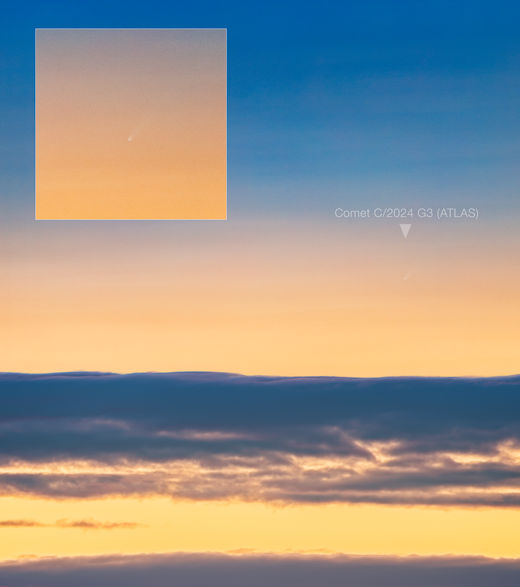
"The dawn is too bright!" explains Petr Horálek, who tried to photograph the comet this morning from Gemer, Slovakia. "I pointed my camera where the comet was supposed to be. What a surprise: When I processed the data on the computer, the comet was actually there in the shining sky."
This situation calls for an eclipse! The Solar and Heliospheric Observatory (SOHO) can provide one. SOHO has an occulting disk that blocks the sun, allowing it to monitor developments. Current coronagraph images show a healthy comet, flamboyantly brightening as it plunges toward the sun.
Hours after Horálek photographed the comet at dawn, Italian photographer Alessandro Carrozzi managed the same trick in broad dayight:
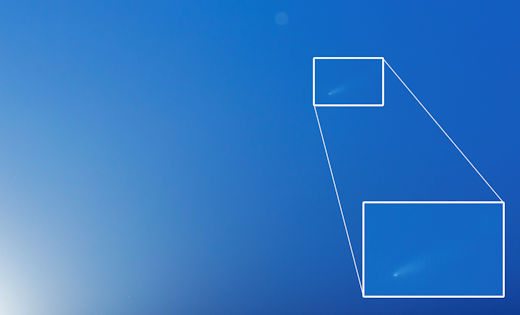
"The photograph, made possible thanks to a clear day and excellent atmospheric transparency, is the result of a complex daytime imaging technique," says Carrozzi. "I carefully obscured the sun behind a building, and took 165 frames of 1/1000 second each. The comet was not visible to the naked eye nor in individual frames. It was revealed through extreme processing of the stacked images."
"This type of capture is dangerous and should only be attempted by experienced observers," warns Carrozzi. "It is essential to protect both the camera sensor and the observer's eyesight with appropriate solar filters during the set up phase."
After Comet ATLAS passes the sun on Monday, it could become a nice, potentially naked-eye object in the evening sky next week. Southern hemisphere observers are favored, but many northerners will be able to see it, too. Read "Prospects for C/2024 G3 (ATLAS)" by Nick James for observing tips.
more images: from Scott Tucker of Tucson, Arizona; from Paul Robinson of Longmont, CO USA; from Paolo Bardelli of Sumirago (Varese), Italy; from Gorazd Bizjan of Medvode, Slovenia; from Chris Schur of Payson, Arizona; from Lionel Majzik of Tápióbicske, Pest, Hungary;
Realtime Space Weather Photo Gallery
Free: Spaceweather.com Newsletter
"ALWAYS AND FOREVER" RUBY HEART PENDANT: Are you looking for a far out Valentine's Day gift? Consider the Always and Forever Space Pendent. The students of Earth to Sky Calculus launched it to the stratosphere onboard a cosmic ray research balloon:
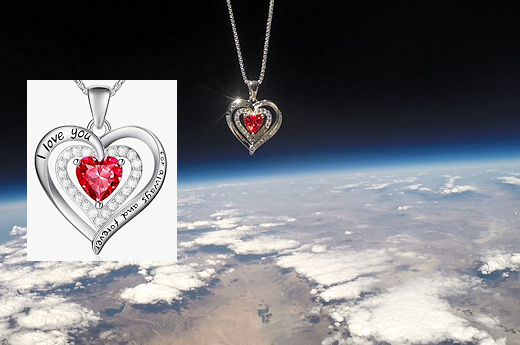
You can have it for $219.95. Engraved with the words "I love you always and forever", this sterling silver pendant has a heart-shaped ruby crystal in the middle surrouunded by a ring of glittering 5A cubic zirconia nuggets. It is a visually striking necklace perfect for Valentine's Day, anniversaries, or romantic birthdays.
The students are selling space pendants to pay the helium bill for their cosmic ray ballooning program. Each one comes with a greeting card showing the jewelry in flight and telling the story of its trip to the stratosphere and back again.
Far Out Gifts: Earth to Sky Store
All sales support hands-on STEM education
Realtime Aurora Photo Gallery
Free: Spaceweather.com Newsletter
Realtime Comet Photo Gallery
Free: Spaceweather.com Newsletter