LUNAR OCCULTATION OF MARS--TONIGHT: It's the must-see backyard astronomy event of 2025 (so far). On Monday night, Jan. 13th, the full Moon will pass directly in front of Mars for a lunar occultation visible across North America. Check this infographic from the Astronomical League for observing times and tips. And submit your photos here!
COMET ATLAS IS BUZZING THE SUN: Sungrazing Comet ATLAS (C/2024 G3) is making its closest approach to the sun today. Coronagraphs onboard the Solar and Heliospheric Observatory (SOHO) are recording the encounter. So far, the comet looks big, healthy and intact:
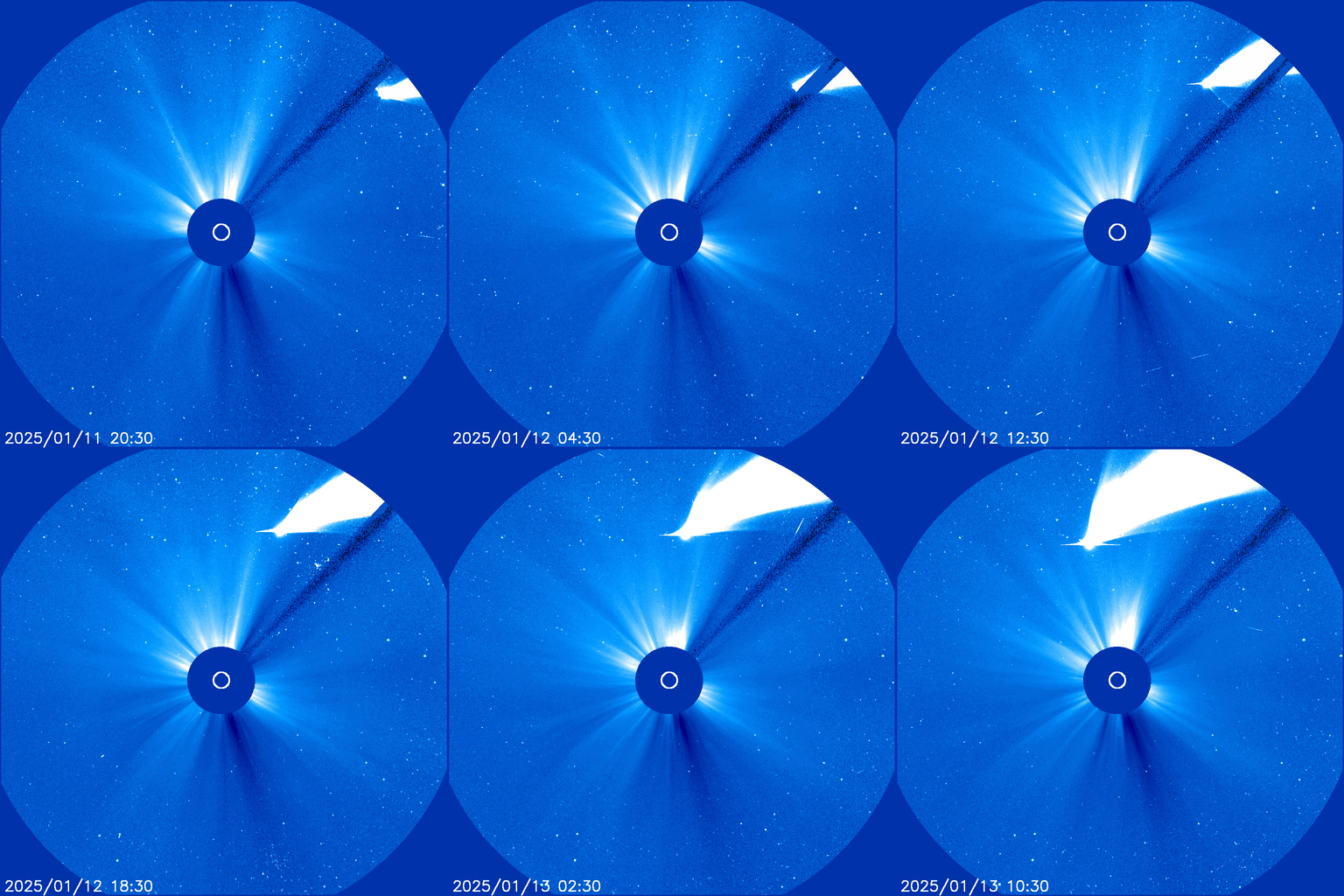
Right now the comet is only 0.09 AU from the sun. If it survives the heat, Comet ATLAS will emerge from the glare later this week as a potentially naked-eye object in the evening sky. Southern hemisphere observers are favored, but many northerners will be able to see it, too. Read "Prospects for C/2024 G3 (ATLAS)" by Nick James for observing tips.
Realtime Comet Photo Gallery
Free: Spaceweather.com Newsletter
A COMET IN BROAD DAYLIGHT: You don't see this very often. "Here is the comet at 11am in the morning only 5 degrees from the sun," says Chris Schur, who sends this picture from Payson, Arizona:
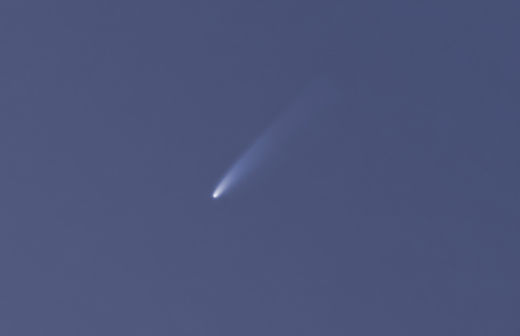
This is Comet ATLAS (C/2024 G3), plunging toward the sun for a very close encounter on Monday, Jan. 13th. It is currently ten times closer to the sun than Earth, and deep inside the orbit of Mercury.
"I used a special baffle tube to block sunlight from entering the tube of my 10-inch telescope," says Schur. "Observing a comet this close to the sun is dangerous, and should only be attempted by experienced observers."
Lorenzo Comolli photographed the comet at midday from Tradate, Italy:
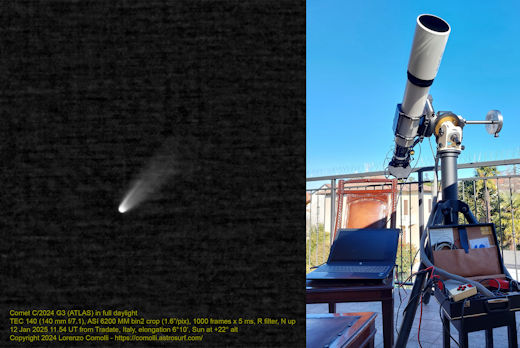
"I pointed the telescope to the sun using an Astrosolar filter," says Comolli . "After synching the mount, I shifted to the comet's coordinates 6° from the sun, removed the solar filter and--WOW--the comet was visible with a small tail right in the field center!"
Realtime Space Weather Photo Gallery
Free: Spaceweather.com Newsletter
"ALWAYS AND FOREVER" RUBY HEART PENDANT: Are you looking for a far out Valentine's Day gift? Consider the Always and Forever Space Pendent. The students of Earth to Sky Calculus launched it to the stratosphere onboard a cosmic ray research balloon:
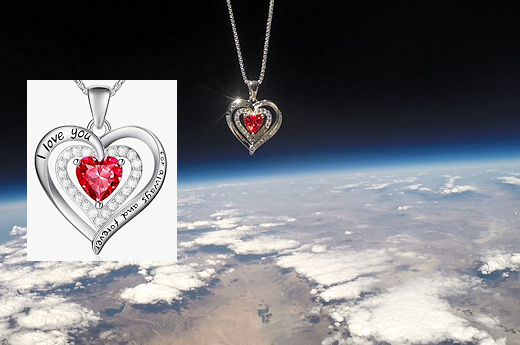
You can have it for $219.95. Engraved with the words "I love you always and forever", this sterling silver pendant has a heart-shaped ruby crystal in the middle surrouunded by a ring of glittering 5A cubic zirconia nuggets. It is a visually striking necklace perfect for Valentine's Day, anniversaries, or romantic birthdays.
The students are selling space pendants to pay the helium bill for their cosmic ray ballooning program. Each one comes with a greeting card showing the jewelry in flight and telling the story of its trip to the stratosphere and back again.
Far Out Gifts: Earth to Sky Store
All sales support hands-on STEM education
Realtime Aurora Photo Gallery
Free: Spaceweather.com Newsletter
Realtime Comet Photo Gallery
Free: Spaceweather.com Newsletter