SOLAR ACTIVITY IS LOW: It's probably temporary, but the sun has become quiet this week with only a smattering of C-class solar flares. The quiet is likely to continue. All of the sunspots currently facing Earth have stable magnetic fields unlikely to explode. Solar flare alerts: SMS Text.
SUNSET COMET ALERT: We know three things about Comet ATLAS (C/2024 G3). It survived yesterday's close encounter with the sun. It brightened to magnitude -2.5. And it is now a photo-op in the sunset sky. "I was truly surprised to see it," says Erik Norlund of Alberone di Cento, Italy, who photographed the comet about 7 minutes after sunset on Jan. 14th:
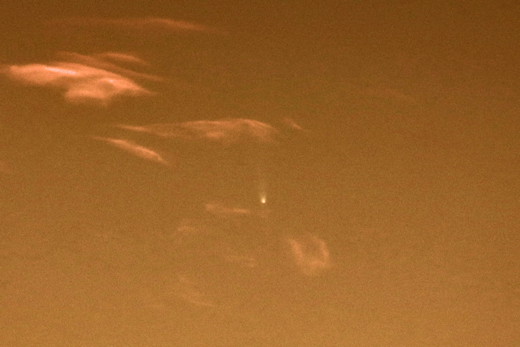
"The comet looked very nice with my 200mm Newtonian telescope, with a small tail and a bright nucleus," adds Norlund. "Then I also saw it with a small binocular."
What will happen next? Nick James of the British Astronomical Association speculates: "If it follows predictions, the comet's magnitude will drop from around -2.5 now to possibly +3 or fainter in a week's time. It is quite difficult to predict how the comet will behave after its near-death encounter with the sun, so it may be a lot brighter or fainter than our predictions. We also don't really know how the currently spectacular tail will perform. The only way to find out is by observing it. That is what makes comets so much fun."
Many observers are now submitting photos of Comet ATLAS in the sunset sky. Browse the links below for photo settings and anecdotes.
more images: from Petr Horálek of Tiszacsermely, Hungary; from Mike Androsch of Oberneukirchen, Upper Austria, Europe; from Sven Melchert of Stuttgart, Germany; from Karl Kaiser of Aigen-Schlägl, Bohemian Forest, Upper Austria; from Andreas Walker of Zetzwil, Switzerland, Europe;
Realtime Comet Photo Gallery
Free: Spaceweather.com Newsletter
LUNAR OCCULTATION OF MARS: Last night, Jan. 13th, the Full Moon passed directly in front of Mars. Selín Alejandro Gonzalez caught the Red Planet half-in and half-out over Toluca, Mexico:
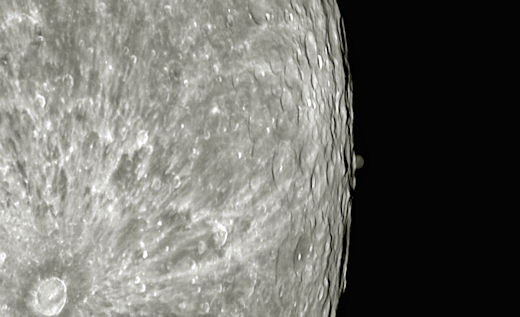
"Mars was partially hidden and then emerged in a very spectacular way," says Gonzalez. "Even though some clouds were passing over, the excitement of witnessing this astronomical event was at its best. In the photo, we can see clearly the contrast between the glowing lunar surface and the faint reddish disk of Mars."
The occultation was widely visible across North America, and many photographers are submitting images. See them all in the Realtime Lunar Occultation Photo Gallery:
Realtime Lunar Occultation Photo Gallery
Free: Spaceweather.com Newsletter
"ALWAYS AND FOREVER" RUBY HEART PENDANT: Are you looking for a far out Valentine's Day gift? Consider the Always and Forever Space Pendent. The students of Earth to Sky Calculus launched it to the stratosphere onboard a cosmic ray research balloon:
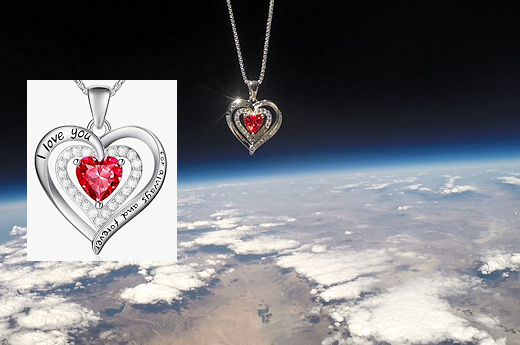
You can have it for $219.95. Engraved with the words "I love you always and forever", this sterling silver pendant has a heart-shaped ruby crystal in the middle surrouunded by a ring of glittering 5A cubic zirconia nuggets. It is a visually striking necklace perfect for Valentine's Day, anniversaries, or romantic birthdays.
The students are selling space pendants to pay the helium bill for their cosmic ray ballooning program. Each one comes with a greeting card showing the jewelry in flight and telling the story of its trip to the stratosphere and back again.
Far Out Gifts: Earth to Sky Store
All sales support hands-on STEM education
A COMET IN BROAD DAYLIGHT: Astronomer Petr Horálek was crouching behind his car yesterday when he took this picture. It shows Comet ATLAS (C/2024 G3) high above the clouds of Pribylina, Slovakia, shining brightly enough to photograph in broad daylight:
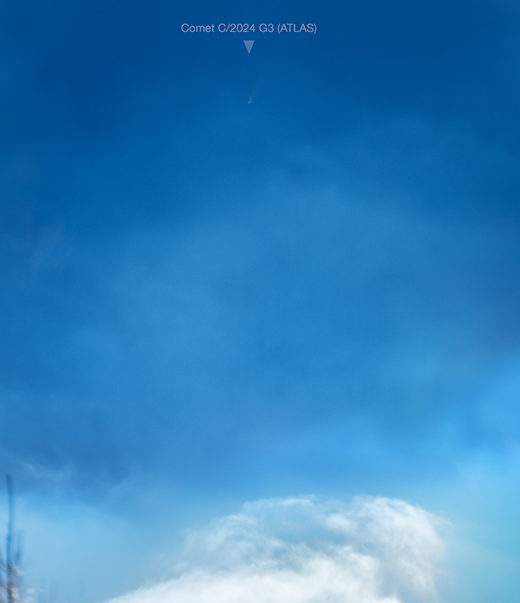
"I drove 300 km to find a place with clear skies," says Horálek. "By the time I parked at 1 pm, the sun and the comet were high in the sky. I hid my camera, its mount, and myself in the shadow of my car so the sun was not shining into the optics. Then I took 72 single short exposures, which I stacked into one image and processed. Voilà--the comet popped out!"
At the time of Horálek's photo, Comet ATLAS was making a close approach to the sun (0.09 AU) deep inside the orbit of Mercury. It survived the heat of the sun at point-blank range, setting the stage for a lot of rare blue-sky images.
more images: from Chris Schur of Payson, Arizona; from Greg Hogan of Georgia, USA; from Marko Posavec of Koprivnica, Croatia; from Richard Nugent of Framingham, Massachusetts, USA; from Shahrin Ahmad of Kuala Lumpur, Malaysia;
Realtime Comet Photo Gallery
Free: Spaceweather.com Newsletter
Realtime Aurora Photo Gallery
Free: Spaceweather.com Newsletter
Realtime Space Weather Photo Gallery
Free: Spaceweather.com Newsletter