SOLAR ACTIVITY IS LOW: It's probably temporary, but the sun has become quiet this week with only a smattering of C-class solar flares. The quiet is likely to continue. All of the sunspots currently facing Earth have stable magnetic fields unlikely to explode. Solar flare alerts: SMS Text.
THE SUNSET COMET SHOW: Comet ATLAS (C/2024 G3) survived its close encounter with the sun on Monday. Now it is emerging into the sunset sky. Mike Olason watched it follow the sun into the western horizon last night from Tucson, Arizona:
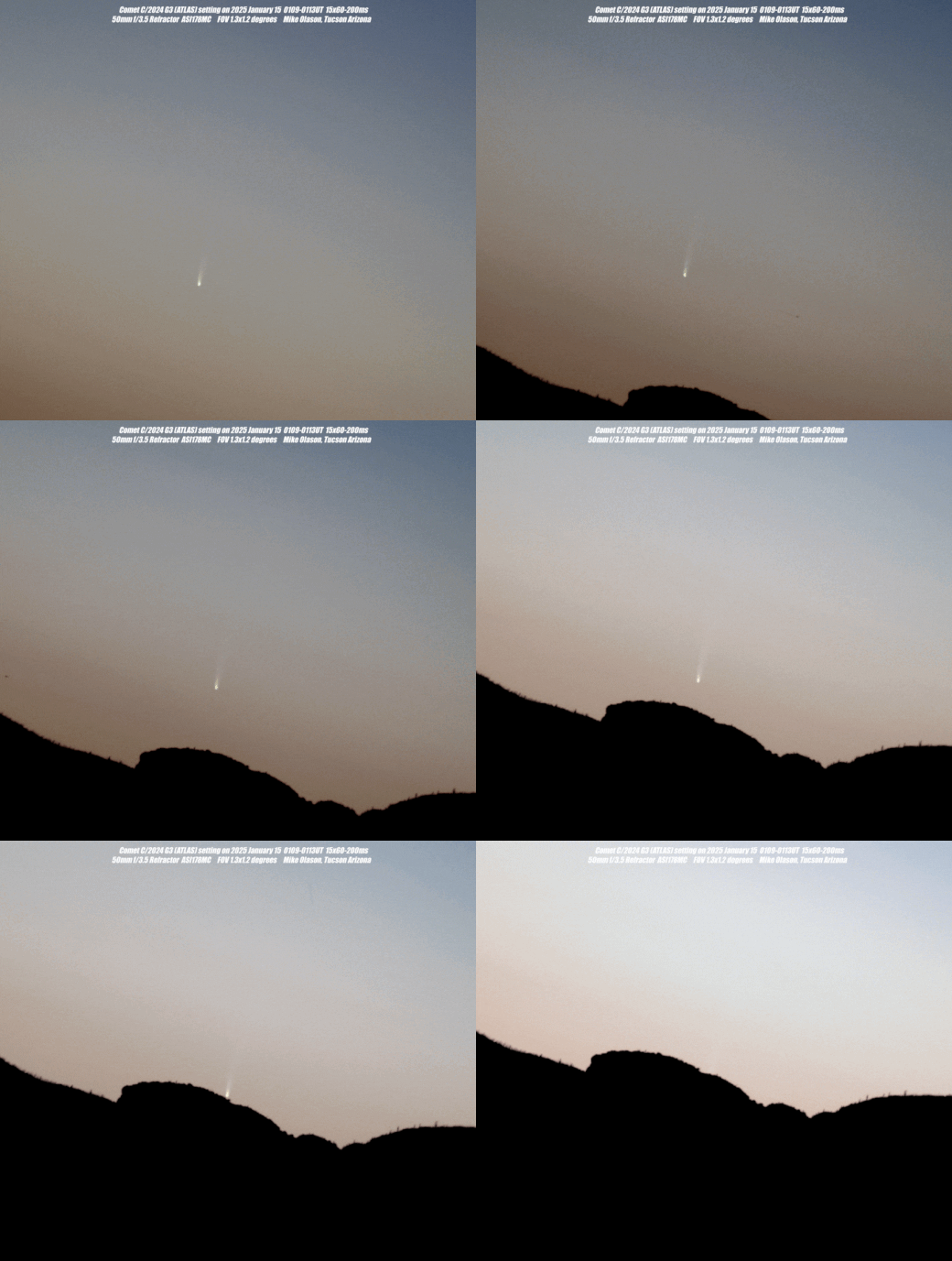
"The comet was very easy to see with my 50mm f/3.5 refracting telescope as soon as the sun dipped below the horizon," says Olason. "15 minutes after sunset one could easily see the comet with 8x21 binoculars, a bright starlike coma and a nice tail in a rich orange twilight sky. Several times I caught glimpses of the comet with the naked eye, aided by knowing exactly where to look."
What will happen next? Nick James of the British Astronomical Association speculates: "If it follows predictions, the comet's magnitude will drop from around -2.5 now to possibly +3 or fainter in a week's time. It is quite difficult to predict how the comet will behave after its near-death encounter with the sun, so it may be a lot brighter or fainter than our predictions. We also don't really know how the currently spectacular tail will perform. The only way to find out is by observing it. That is what makes comets so much fun."
Realtime Comet Photo Gallery
Free: Spaceweather.com Newsletter
THE EVOLVING TAIL OF COMET ATLAS: French astronomer Nicolas Lefaudeux has simulated the evolving tail of Comet ATLAS (C/2024 G3), and he has a prediction. "Despite unfavorable viewing circumstances, it seems that Comet ATLAS has the potential to show an extended low-brightness dust tail between Jan. 19th and 26th while the comet's head remains hidden in the sun's glare," he explains.
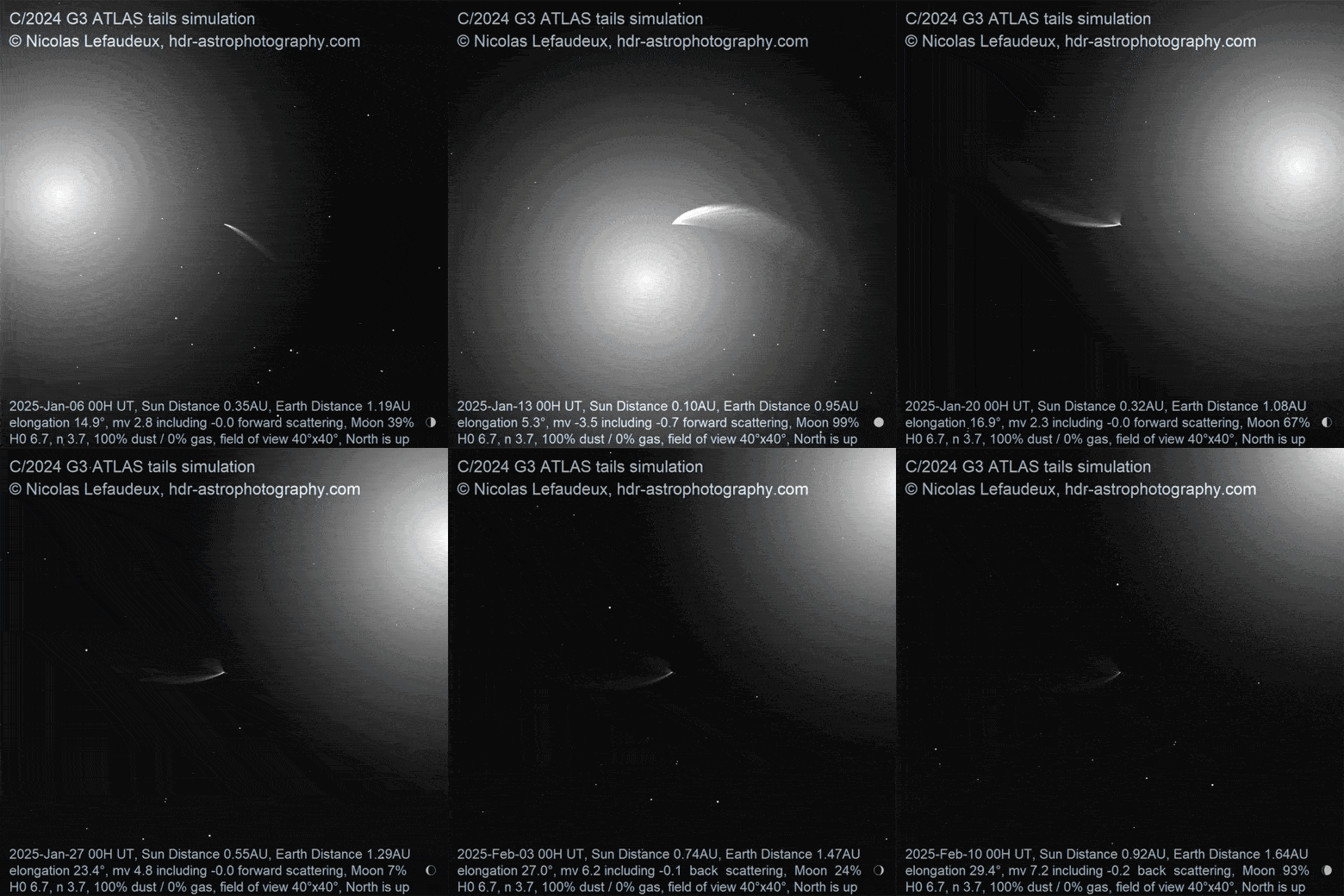
"Observers located near the equator and in the southern hemisphere will be best placed to observe this tail. Because it is so big, however, the curved dust tail may be detectable photographically even from the northern hemisphere, especially between Jan. 18th and 22nd. It would be located mostly in the constellation of Aquarius, and be overlapped with the zodiacal light," Lefaudeux continues.
Lefaudeux says the tail of Comet ATLAS reminds him of the tail of Comet McNaught (C/2006 P1) in 2007, which was visible in the evening sky after that comet also flew very close to the sun. Here are some examples from Spaceweather.com's 2007 archives: Jan. 20, Jan. 22, Jan. 23, Jan. 24. The tail of Comet ATLAS will be fainter, though.
If you photograph the tail of Comet ATLAS, please submit your images here!
Realtime Space Weather Photo Gallery
Free: Spaceweather.com Newsletter
"ALWAYS AND FOREVER" RUBY HEART PENDANT: Are you looking for a far out Valentine's Day gift? Consider the Always and Forever Space Pendent. The students of Earth to Sky Calculus launched it to the stratosphere onboard a cosmic ray research balloon:
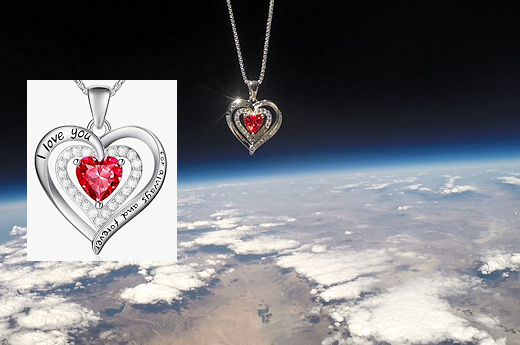
You can have it for $219.95. Engraved with the words "I love you always and forever", this sterling silver pendant has a heart-shaped ruby crystal in the middle surrouunded by a ring of glittering 5A cubic zirconia nuggets. It is a visually striking necklace perfect for Valentine's Day, anniversaries, or romantic birthdays.
The students are selling space pendants to pay the helium bill for their cosmic ray ballooning program. Each one comes with a greeting card showing the jewelry in flight and telling the story of its trip to the stratosphere and back again.
Far Out Gifts: Earth to Sky Store
All sales support hands-on STEM education
Realtime Aurora Photo Gallery
Free: Spaceweather.com Newsletter
Realtime Space Weather Photo Gallery
Free: Spaceweather.com Newsletter