INCREASING CHANCE OF FLARES: The sun has been quiet for more than a week. That's about to change. Two new sunspots (3959 and 3962) have unstable delta-class magnetic fields that harbor energy for X-class solar flares. Don't be surprised if one of them explodes before the end of the week. Solar flare alerts: SMS Text.
SUNSET COMET ATLAS: Three days after it dive-bombed the sun, Comet ATLAS (C/2024 G3) is still putting on a good show. Dirk Ewers photographed it shining through yesterday's sunset from the Canary Islands:
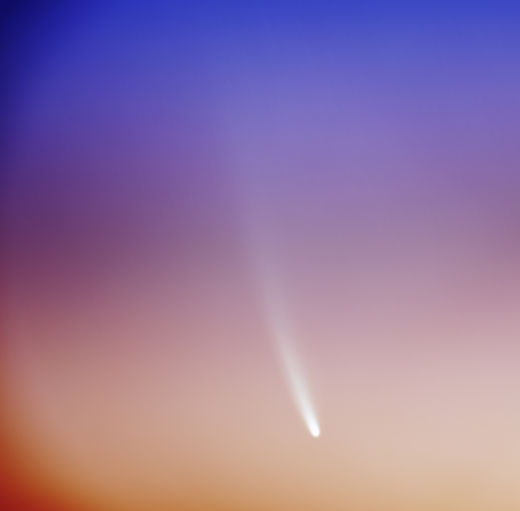
"At an altitude of 1350m in La Palma, the comet offered great views in binoculars and scopes," says Ewers. "The tail shows a nice curve with some detail and was clearly more visible than the day before. Beautiful sunset colors accompanied the event."
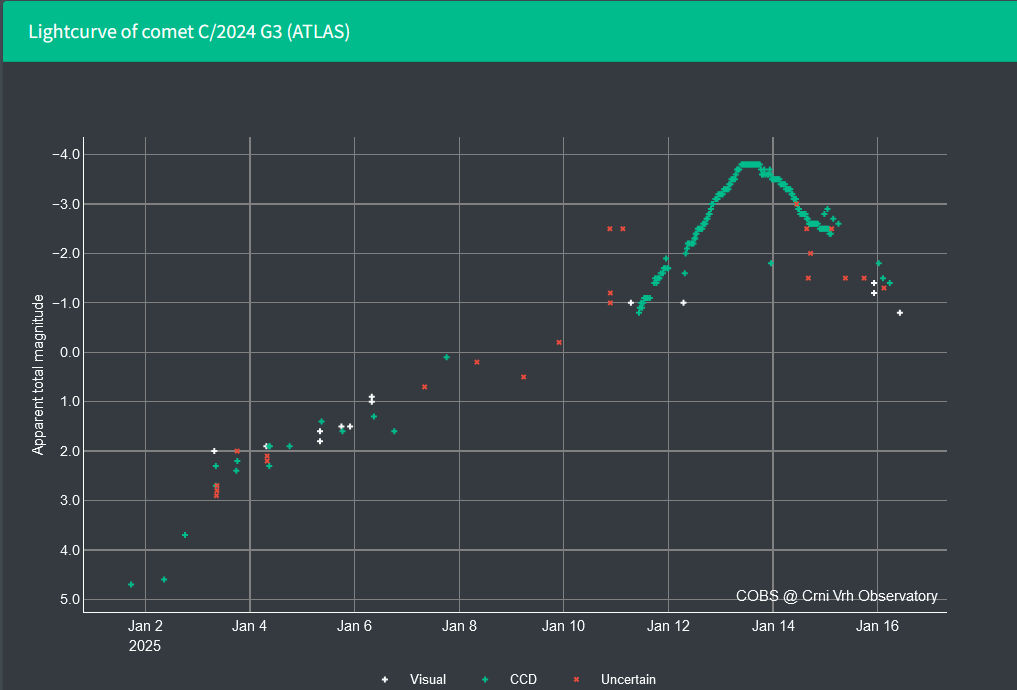
According to observers reporting to the Comet Observation Database, the comet's magnitude is now near -1, much dimmer than it was a few days ago, but still bright enough to photograph in twilight and even blue sky daylight.
Realtime Comet Photo Gallery
Free: Spaceweather.com Newsletter
THINGS YOU SEE WHILE LOOKING FOR A COMET: Comet ATLAS (C/2024 G3) was plunging toward the sun on Jan. 12th when Todd Bush walked outside at dawn. "I was hoping to catch a glimpse of the comet," he says. "I got skunked on that. But the sun sure looked wild doing this sunrise happy dance."
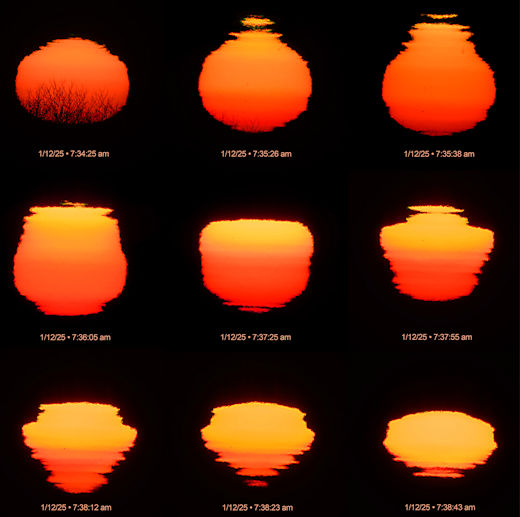
Instead of a comet, Bush witnessed a mirage. It was caused by temperature inversions in the atmosphere. When a layer of warm air sits on top of colder air, the sun can be split in two. Looking across the Appalachians from Banner Elk, NC, Bush viewed the rising sun through multiple such layers--cold, warm, cold, warm, cold--splitting the sun into a whole stack of shape-shifting pancakes. Rays of light trapped between some layers (in tunnels called "ducts") produced bright horizontal stripes.
Meanwhile, others did see the comet. Browse the Comet ATLAS gallery for their photos.
Realtime Space Weather Photo Gallery
Free: Spaceweather.com Newsletter
THE EVOLVING TAIL OF COMET ATLAS: French astronomer Nicolas Lefaudeux has simulated the evolving tail of Comet ATLAS (C/2024 G3), and he has a prediction. "Comet ATLAS has the potential to show an extended low-brightness dust tail between Jan. 19th and 26th even when the comet's head is below the horizon," he says. This would make it a sort of "headless comet."
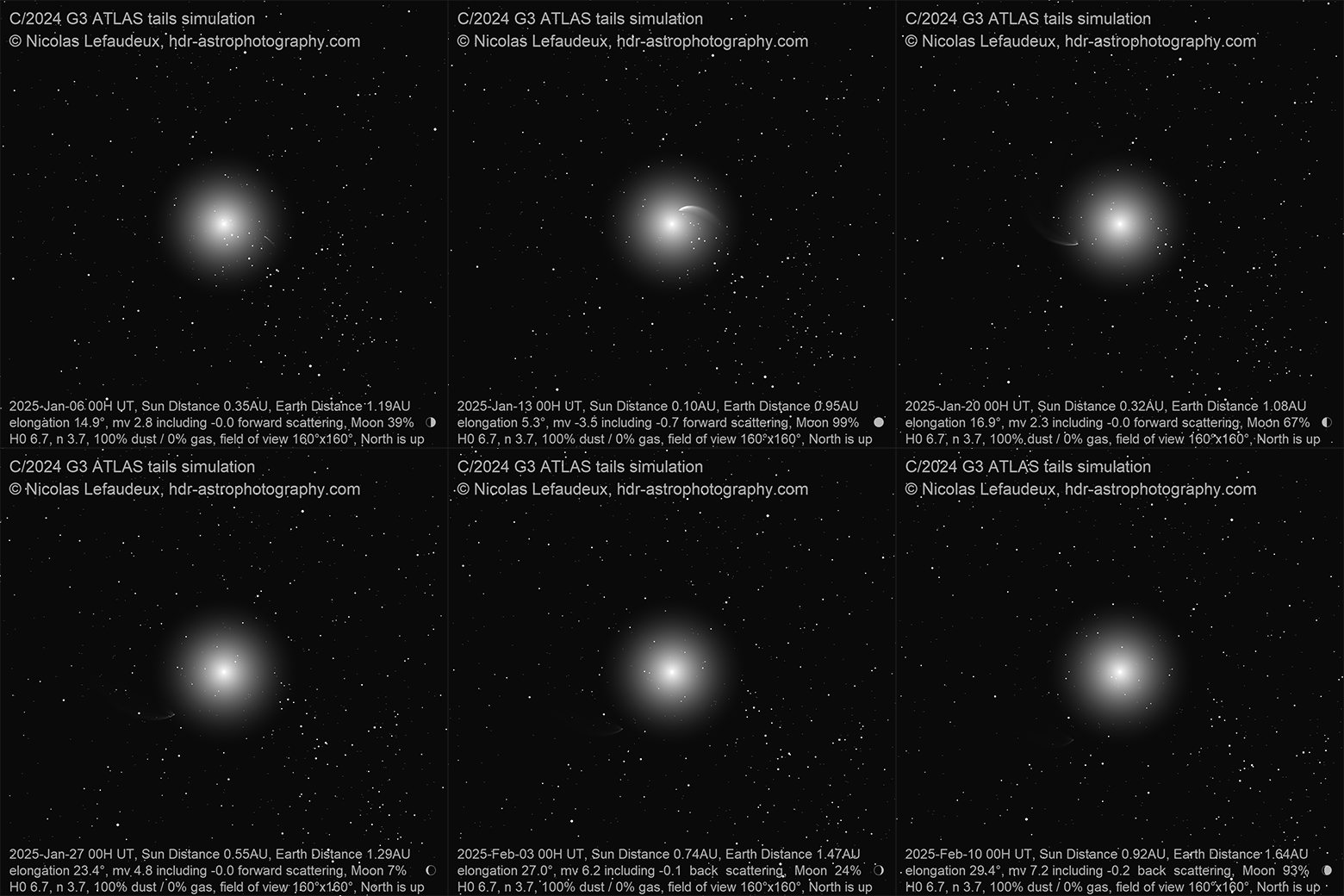
"Observers located near the equator and in the southern hemisphere will be best placed to observe this tail. Because it is so big, however, the curved dust tail may be detectable photographically even from the northern hemisphere, especially between Jan. 18th and 22nd. It would be located mostly in the constellation of Aquarius, and overlap the zodiacal light," Lefaudeux continues.
Lefaudeux says the tail of Comet ATLAS reminds him of the tail of Comet McNaught (C/2006 P1) in 2007, which was visible in the evening sky after that comet also flew very close to the sun. Here are some examples from Spaceweather.com's 2007 archives: Jan. 20, Jan. 22, Jan. 23, Jan. 24. The tail of Comet ATLAS will be fainter, though.
If you photograph the tail of Comet ATLAS, please submit your images here!
Realtime Comet Photo Gallery
Free: Spaceweather.com Newsletter
"ALWAYS AND FOREVER" RUBY HEART PENDANT: Are you looking for a far out Valentine's Day gift? Consider the Always and Forever Space Pendent. The students of Earth to Sky Calculus launched it to the stratosphere onboard a cosmic ray research balloon:
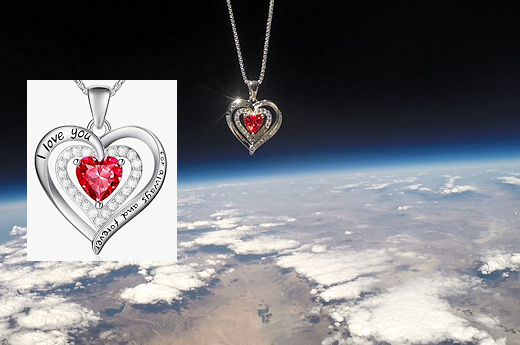
You can have it for $219.95. Engraved with the words "I love you always and forever", this sterling silver pendant has a heart-shaped ruby crystal in the middle surrouunded by a ring of glittering 5A cubic zirconia nuggets. It is a visually striking necklace perfect for Valentine's Day, anniversaries, or romantic birthdays.
The students are selling space pendants to pay the helium bill for their cosmic ray ballooning program. Each one comes with a greeting card showing the jewelry in flight and telling the story of its trip to the stratosphere and back again.
Far Out Gifts: Earth to Sky Store
All sales support hands-on STEM education
Realtime Aurora Photo Gallery
Free: Spaceweather.com Newsletter
Realtime Space Weather Photo Gallery
Free: Spaceweather.com Newsletter