A BIG SUNSPOT IS FACING EARTH: Sunspot 3961 is one of the largest sunspots of Solar Cycle 25. After days of impressive growth, it is now directly facing Earth with a 'beta-gamma-delta' magnetic field that harbors energy for X-class solar flares. A geoeffective explosion may be in the offing. Solar flare alerts: SMS Text.

GOOD NEWS AND BAD NEWS ABOUT COMET ATLAS: First, the good news: Comet ATLAS (C/2024 G3) has just emerged into the evening sky of the southern hemisphere--and it is a beauty. "I do not think I have seen a comet as beautiful as this one since Hale-Bopp in 1997," says Daniel Mello, who sends this Jan. 19th selfie from Rio de Janeiro, Brazil:
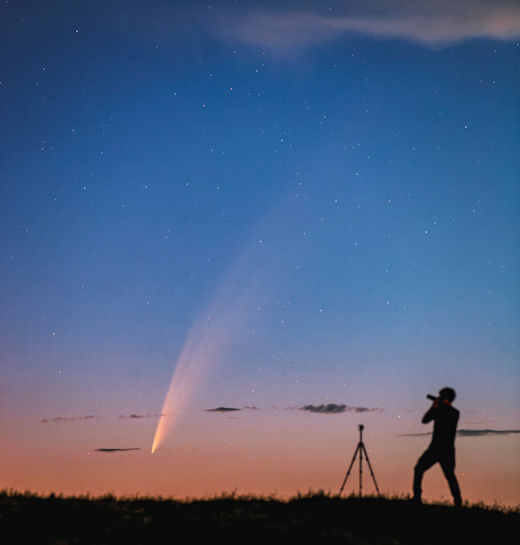
"Comet ATLAS is surprising everyone in the southern hemisphere," says Mello.
Indeed, beautiful photos are pouring in from many countries south of the equator. "We were not expecting that!" marvels Noeleen Lowndes, who experienced the surprise of seeing the comet's tail naked-eye from Mt Tamborine, Australia. "It is was clearly visible to the naked eye," says Andres Molina of Bogota, Colombia. "This is one of the most incredible photos I have ever taken!" adds Gabriel Zaparolli of Jaquirana, Brazil.
Now for the bad news: The comet may be disintegrating. This sequence of photos from Hungarian astronomer Lionel Majzik, using a telescope in Chile, shows a troubling change. A bright streamer has appeared inside the comet's atmosphere, and the head is no longer the brightest object in the photo:
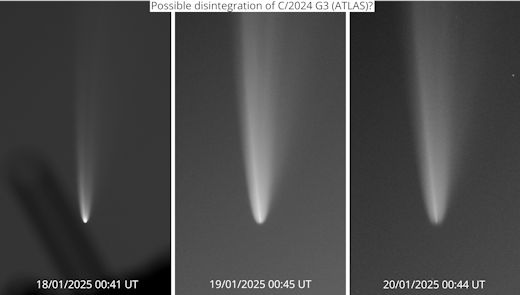
Only one week ago, Comet ATLAS passed very close to the sun (0.09 AU), deep inside the orbit of Mercury. The thermal stress may have been too much. Famously, a similar disintegration happened to Comet Lovejoy (C/2011 W3) after its close approach to the sun in mid-Dec. 2011. Comet Lovejoy appeared to lose its nucleus ("the head") while still maintaining a visible tail.
But who needs a head? Comet Lovejoy went on to become a "headless wonder" visible throughout the southern hemisphere. Check out these photos from the Spaceweather.com archive: Dec, 20, 21, 22, 2011. The same thing could happen to Comet ATLAS. Stay tuned!
Realtime Comet ATLAS Photo Gallery
Free: Spaceweather.com Newsletter
"I LOVE YOU MORE" MOONSTONE PENDANT: Valentine's Day is coming! Nothing says "I love you" like a moonstone from space. This one hitched a ride on an Earth to Sky Calculus cosmic ray research balloon, floating 112,201 feet above the Sierra Nevada mountains of central California:
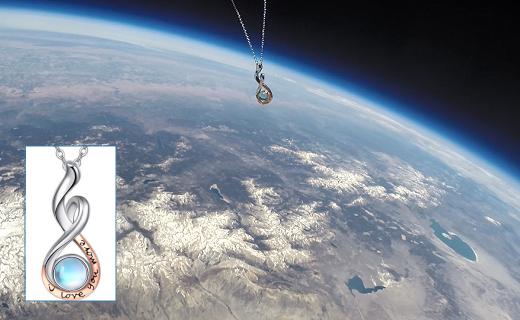
You can have it for $162.95. The students are selling these sterling silver infinity-wrapped moonstone pendants to support their ballooning program. Engraved with "I Love You More," it makes a romantic Valentine's gift. Each one comes with a greeting card showing the moonstone in flight and telling the story of its trip to the stratosphere and back again.
Far Out Gifts: Earth to Sky Store
All sales support hands-on STEM education
Realtime Aurora Photo Gallery
Free: Spaceweather.com Newsletter
Realtime Space Weather Photo Gallery
Free: Spaceweather.com Newsletter