GEOMAGNETIC STORM WATCH: A new NOAA model suggests that two CMEs could graze Earth's magnetic field this weekend--the first on Jan. 24th and the second on Jan 25th. If both CMEs land a blow, their combined result could be a G1 (Minor) to G2 (Moderate) geomagnetic storm. This is a low-confidence forecast, but if it comes true, high-latitude sky watchers could see some beautiful auroras. CME impact alerts: SMS Text.


THE DISINTEGRATION OF COMET ATLAS: Some comets like it hot. Comet ATLAS (C/2024 G3) is not one of them. After it flew past the sun on Jan. 13th, Comet ATLAS's overheated core began to dissolve. Using a remote-controlled telescope in Río Hurtado, Chile, astronomer Lionel Majzik recorded the disintegration:
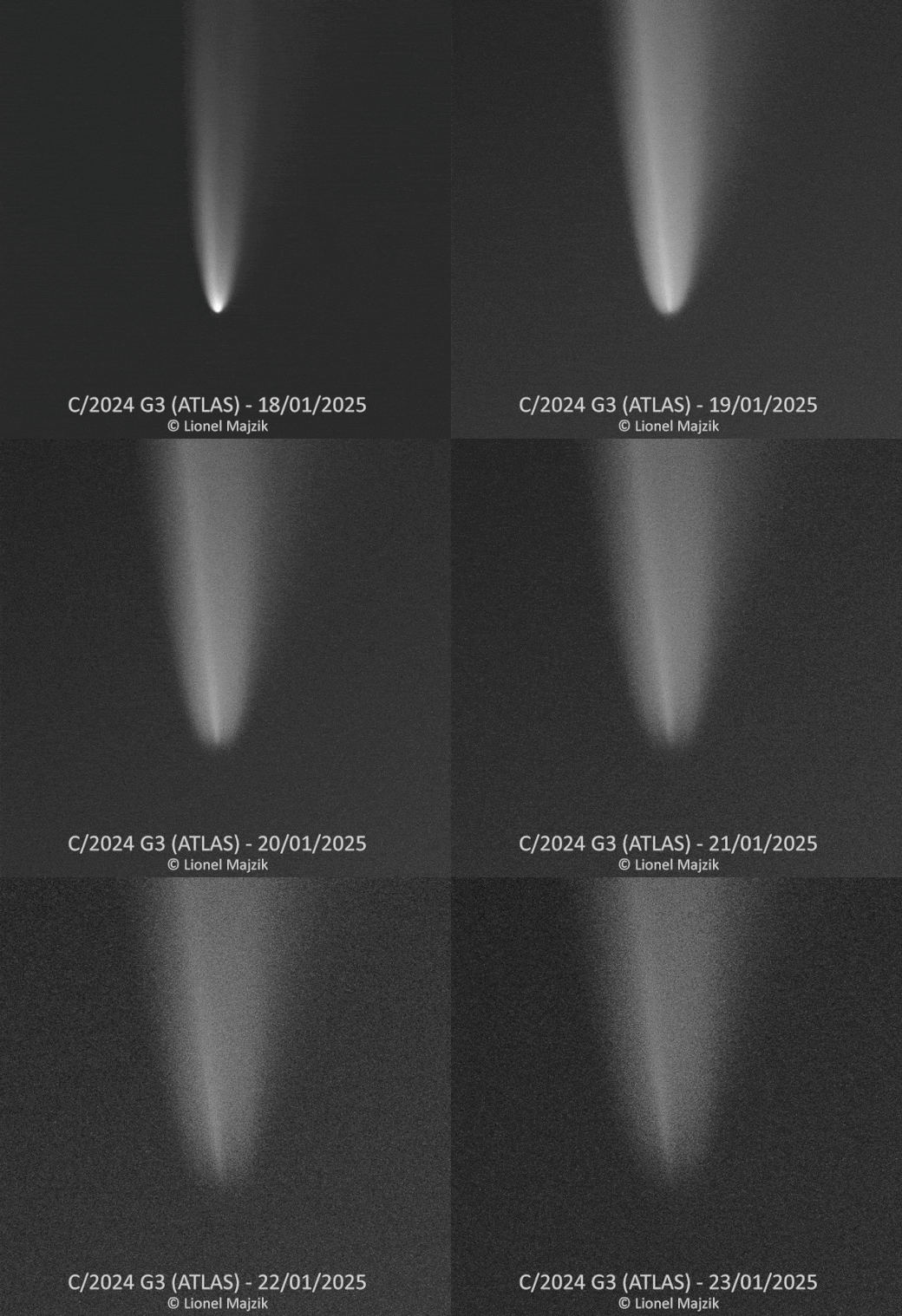
His movie, which highlights the comet's nucleus (or "head"), tracks the breakup over a 6-day period. This may sound like bad news for comet observers, but there's an upside. All of the ice and dust formerly contained in the frozen head has billowed back into the tail. Indeed, now Comet ATLAS is a "headless wonder" visible to the naked eye in the southern hemisphere. Browse the Comet ATLAS photo gallery for the latest images.
Realtime Comet ATLAS Photo Gallery
Free: Spaceweather.com Newsletter
THE EVENING PLANET SHOW: Last night in Arizona, Jeremy Perez went outside to look for the tail of Comet ATLAS. Instead, "a planet lineup said, hey, how about us?" says Perez. "Because of how spread out the planets were, I made my first attempt at capturing a 180° overhead, horizon-to-horizon strip panorama." Here it is:
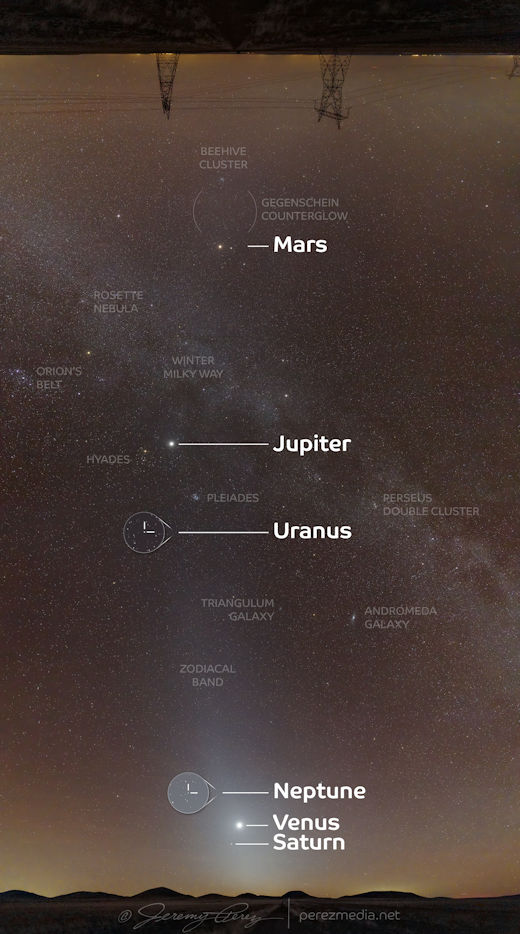
"They're pretty spread out, but worth a look — Saturn & Venus in the west after sundown, Jupiter roughly overhead, and Mars rising bright in the east. Neptune & Uranus are hiding in there too, but some star charts may be needed to pull them up in binoculars," says Perez.
"That Zodiacal Light was a strong visual feature from astronomical twilight onward," notes Perez. "There was also lots of red air glow compared to the greens I typically see."
The planet lineup is visible from both hemispheres. Enjoy the show!
Realtime Space Weather Photo Gallery
Free: Spaceweather.com Newsletter
18K GOLD TOTAL ECLIPSE LOCKET: Valentine's Day is coming! If you need a romantic gift, consider the 18K Gold Total Eclipse Locket. The students of Earth to Sky Calculus launched it to the stratosphere during a total eclipse of the sun on April 8, 2024. Floating more than 118,110 feet above Texas onboard a cosmic ray research balloon, the locket spent 3 minutes and 45 seconds wrapped in the Moon's shadow:
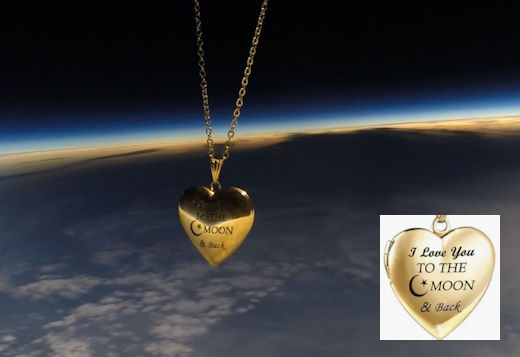
You can have it for $199.95. The 18K gold-plated locket is inscribed with the words "I love you to the Moon and back," and opens to hold a personal photo or other small item. It comes with a greeting card showing the locket in flight and telling the story of its journey to the edge of space during the total eclipse.
Far Out Gifts: Earth to Sky Store
All sales support hands-on STEM education
Realtime Aurora Photo Gallery
Free: Spaceweather.com Newsletter
Realtime Space Weather Photo Gallery
Free: Spaceweather.com Newsletter