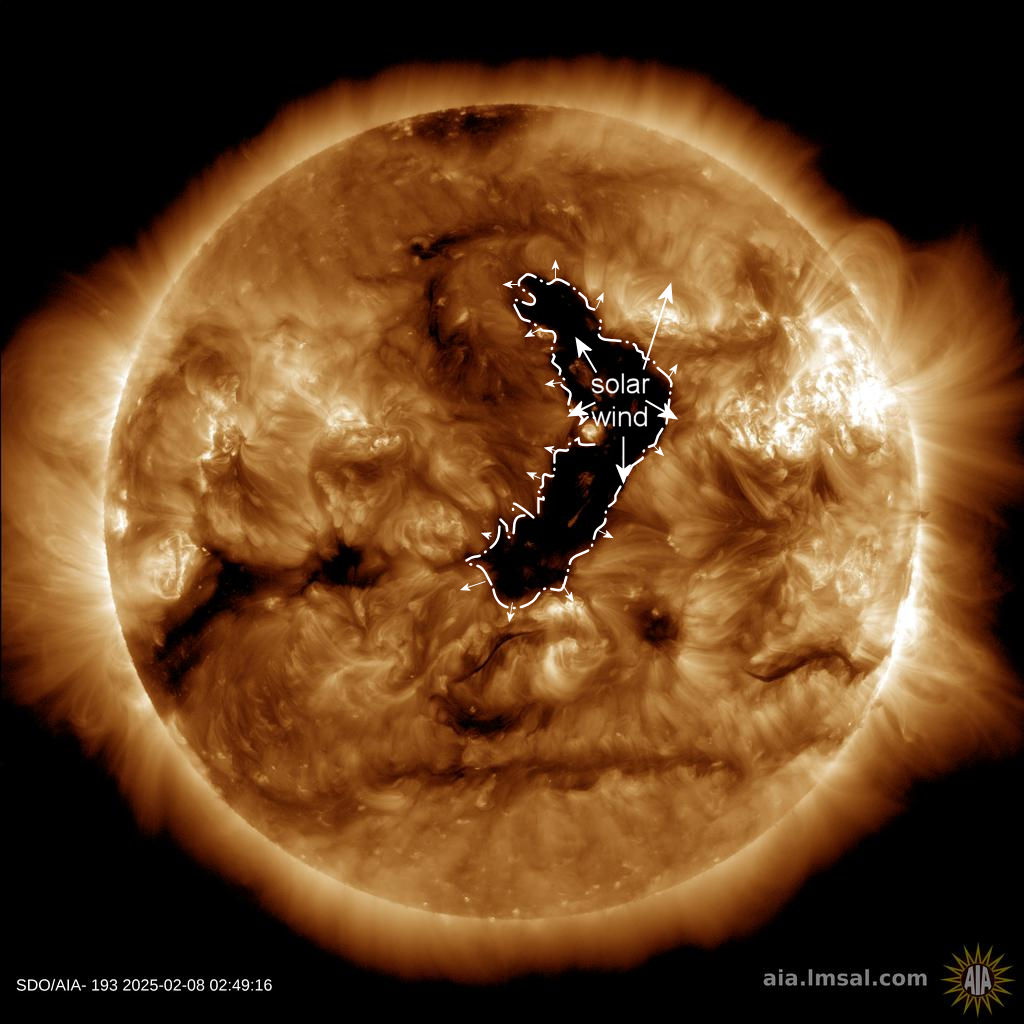
THE SOLAR WIND HAS ARRIVED: Earth has entered a stream of solar wind flowing from a crescent-shaped hole in the sun's atmosphere. It has already caused one minor G1-class geomagnetic storm, and more are possible as Earth moves deeper into the stream. Arctic auroras are likely on Feb. 10th and 11th. Aurora alerts: SMS Text.

REINDEER AND AURORAL SPIKES: Solar wind is blowing around Earth faster than 550 km/s. Petr Horálek saw the resulting glow along with a herd of reindeer from Kilpisjärvi, Finland:
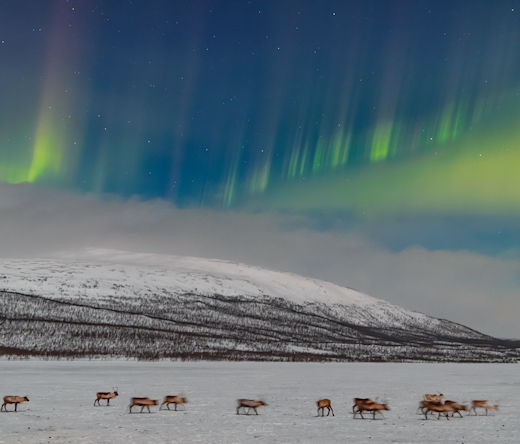
"On Jan. 9th, my friends and I drove 4 hours from cloudy Tromso to clear skies in Finland," says Horálek. "We were well rewarded. The aurora was truly brilliant while a giant herd of reindeer crossed a frozen lake where we stopped. The aurora created an incredible view with its 'spikes' structure; I had never seen anything like it."
more images: from Ivar Hamberg of Umeå, Sweden; from Yrjö Benson of Ylläsjärvi, Lapland, Finland
Realtime Aurora Photo Gallery
Free: Spaceweather.com Newsletter
SUPERIOR CONJUNCTION OF MERCURY: NOAA's new coronagraph for space weather forecasting can do astronomy, too. Yesterday, it recorded a superior conjunction of Mercury only a few degrees from the sun:

This is CCOR-1, a coronagraph onboard NOAA's GOES-19 satellite. Using an occulting disk to block the glare, CCOR-1 delivers uninterrupted monitoring of CMEs, stars, planets and comets near the sun. In the short animation, above, Mercury is the bright star-like object directly below the artificially-eclipsed sun.
There's nothing special about a solar conjunction of Mercury. They happen every two months, more or less. However, observing this event confirms that CCOR-1 is operating as expected with impressive sensitivity. The two objects to the left of Mercury are delta Capricornus (magnitude +2.9) and gamma Capricornus (+3.7), two faint stars impossible to see from Earth when they are so close to the sun. CCOR-1 picked them up with ease.
On April 4th, GOES-19 will be fully operational, and NOAA will begin using CCOR-1 for regular space weather forecasts.
Realtime Space Weather Photo Gallery
Free: Spaceweather.com Newsletter
VALENTINE'S GIFTS FROM THE EDGE OF SPACE: Does your sweetheart love space? Shop the Earth to Sky Store for their perfect Valentine's gift. All items have flown to the stratosphere on board cosmic ray research balloons--and from now until Feb. 14th, everything is 10% off:
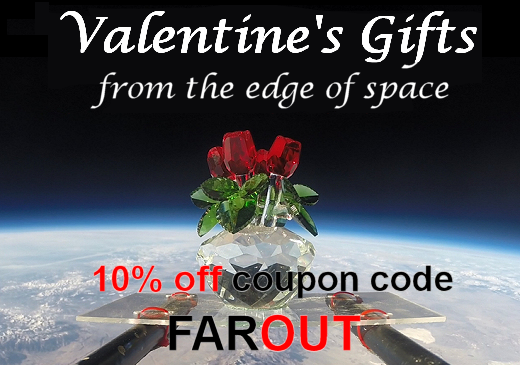
Each purchase comes with a greeting card showing the item in flight and telling the story of its journey to the stratosphere and back again. Don't forget to enter the coupon code "FAROUT" for your Valentine's discount!
Far Out Gifts: Earth to Sky Store
All sales support hands-on STEM education
Realtime Aurora Photo Gallery
Free: Spaceweather.com Newsletter
Realtime Comet ATLAS Photo Gallery
Free: Spaceweather.com Newsletter