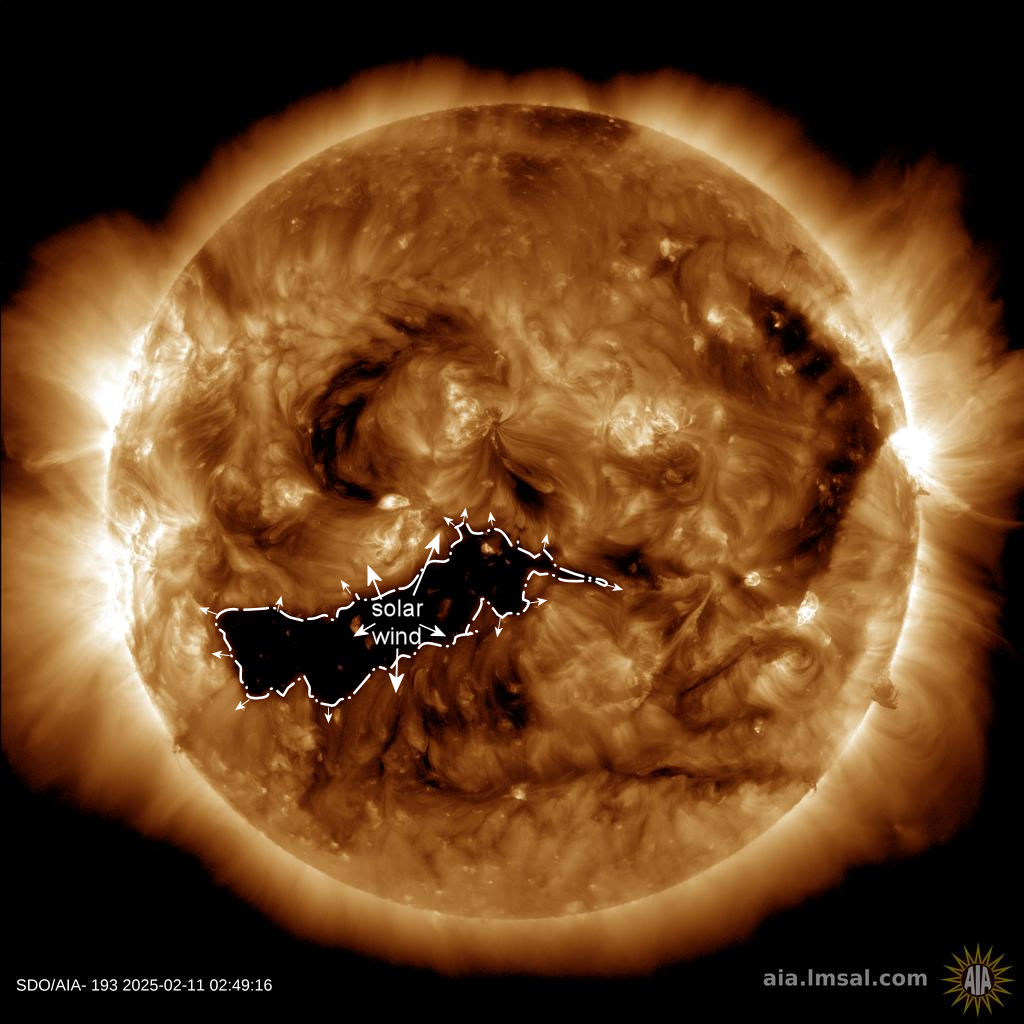
MINOR GEOMAGNETIC STORM WATCH: Another solar wind stream is heading for Earth. It is flowing from a canyon-like hole in the sun's atmosphere. First contact with the stream on Feb. 14th could cause a minor G1-class geomagnetic storm with Arctic auroras for Valentine's Day. Aurora alerts: SMS Text.

POLAR STRATOSPHERIC CLOUDS AT NIGHT: Unusual weather in the stratosphere has set the stage for a rare nighttime apparition of polar stratospheric clouds (PSCs). Marianne Bergli photographed the display last night in Kilpisjervi, Finland:
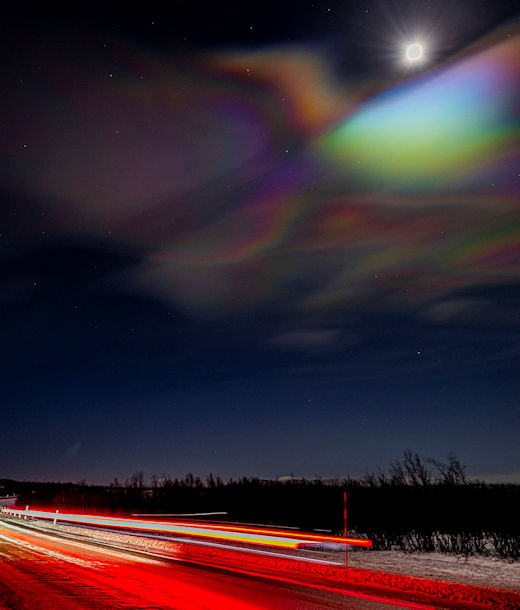
"The PSCs were even more colorful than auroras," says Bergli. "The full Moon lit them beautifully."
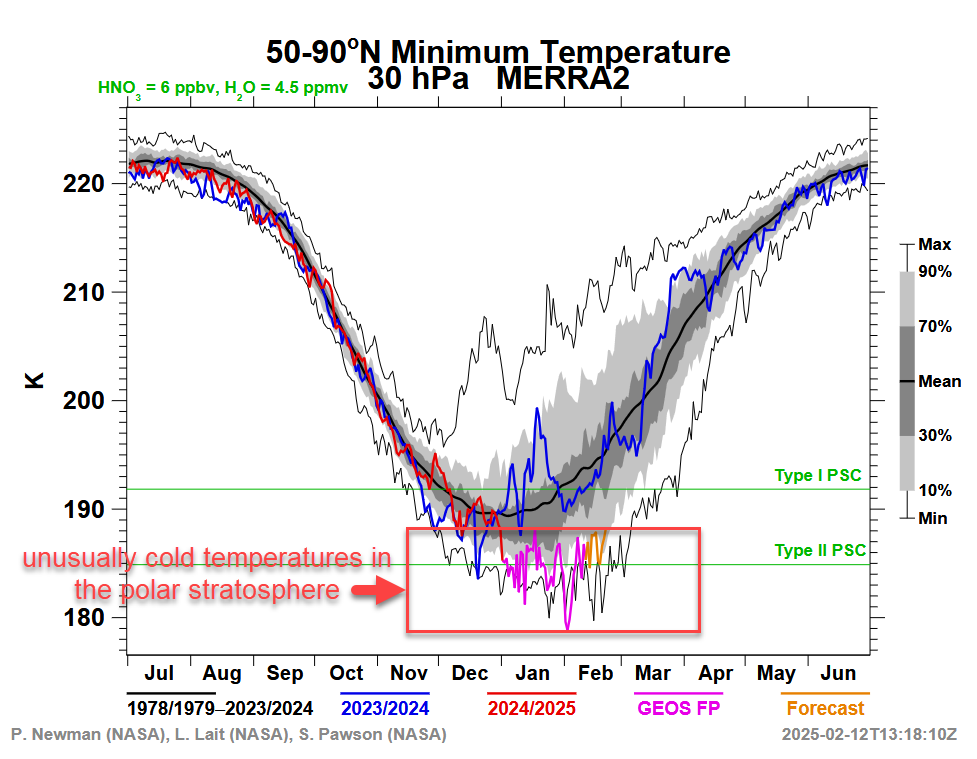
This is rare. Normally, Earth's stratosphere has no clouds at all. Only when the temperature drops to a staggeringly-low -85 C can widely-spaced water molecules assemble into icy Type II PSCs. During a typical polar winter, sky watchers might see them no more than once or twice, almost always during the day when bright sunlight causes their colors to blossom.
Nighttime displays are doubly rare because the clouds must coincide with a bright Moon to make them visible in full color. Tonight is such a night!
"I have seen more PSCs this winter than I have seen before in all my life," says Fredrik Broms of Kvaløya, Norway, a well-known aurora photographer who has been carefully watching the Arctic sky for decades. This is what he saw on Feb. 11th:
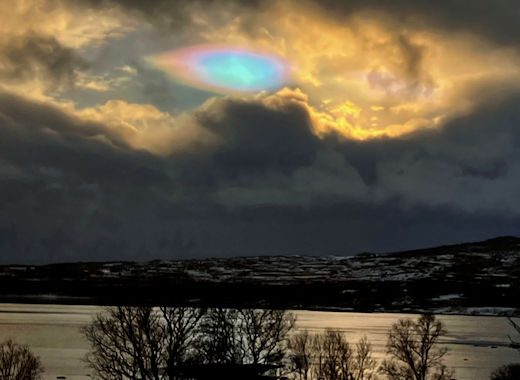
"The PSCs were truly amazing," he says. "Since mid-January 2025, I have seen these colorful clouds weekly or every second week."
According to NASA's MERRA2 climate model, the polar stratosphere has been exceptionally cold this winter with temperatures dropping to near 45-year lows. The reason might be the stratospheric polar vortex. This winter's vortex has been strong, keeping cold air bottled up over the Arctic Circle.
Springtime dynamics could soon upset that cold air mass. Until then, Arctic sky watchers should remain alert for PSCs--even at night. They're the most beautiful clouds on Earth.
Realtime Space Weather Photo Gallery
Free: Spaceweather.com Newsletter
VALENTINE'S GIFTS FROM THE EDGE OF SPACE: Does your sweetheart love space? Shop the Earth to Sky Store for their perfect Valentine's gift. All items have flown to the stratosphere on board cosmic ray research balloons--and from now until Feb. 14th, everything is 10% off:
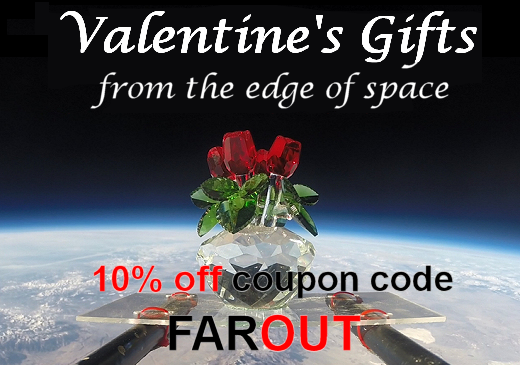
Each purchase comes with a greeting card showing the item in flight and telling the story of its journey to the stratosphere and back again. Don't forget to enter the coupon code "FAROUT" for your Valentine's discount!
Far Out Gifts: Earth to Sky Store
All sales support hands-on STEM education
MOON RINGS -- 'AUREOLES' VS. 'CORONAS': Sometimes the best thing about a bright full Moon is what goes on around it. Last night in Pennsylvania, Dave Mitsky photographed this beautiful moon-ring:
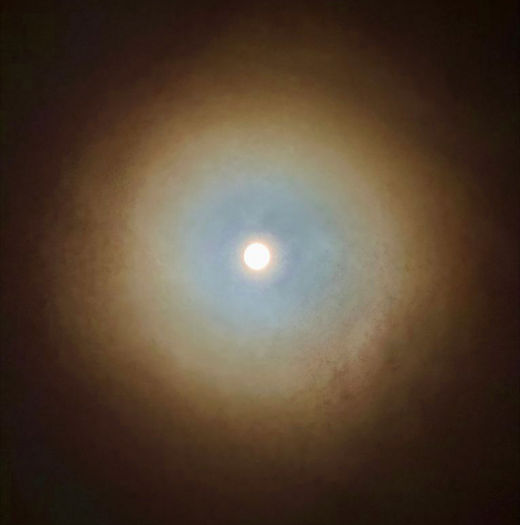
The correct name is "lunar aureole," cousin to the better-known lunar corona. Aureoles and coronas are caused by water droplets in clouds. When the droplets are a jumble of different sizes, they produce a straw-colored ring--an aureole. When the droplets are all of the same size they produce a rainbow-colored ring--a corona. Look for both tonight.
more images: from Heiko Ulbricht of Freital, Saxony, Germany
Realtime Space Weather Photo Gallery
Free: Spaceweather.com Newsletter
Realtime Aurora Photo Gallery
Free: Spaceweather.com Newsletter
Realtime Comet ATLAS Photo Gallery
Free: Spaceweather.com Newsletter