EXTREME COMPRESSION OF EARTH'S MAGNETOSPHERE: During last May's solar superstorm, Earth's magnetic field was extremely compressed. According to new study in the research journal Space Weather, the dayside magnetopause was so squashed that geosynchronous satellites were outside the magnetosphere's protective cocoon for 6 hours. Remarkably, no satellites were lost, although data transmission from some weather satellites was degraded. Read the original research here.
SOLAR MAX -- IS A SECOND PEAK COMING? Last October, NOAA and NASA announced that Solar Max has arrived. Only half the sun got the memo. The majority of solar activity has been happening in just one of the sun's hemispheres--the south. The solar superstorm of May 10, 2024, for instance, was caused by a monster southern sunspot.
It makes you wonder, is the other half of Solar Max still coming? This plot of hemispheric sunspot numbers from SILSO provides some context:
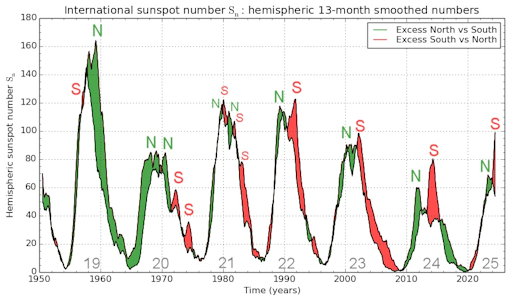
Here we see all seven solar cycles of the Space Age, punctuated by current Solar Cycle 25 on the far right. The most recent cycles are double peaked, with northern sunspots (green) and southern sunspots (red) reaching their own Solar Max ~two years apart. This isn't big news. Researchers have long known that the two hemispheres of the sun are slightly out of sync. The north vs. south delay is called the "Gnevyshev gap."
This composite image of last year's sunspots shows how dominant the southern hemisphere has been:
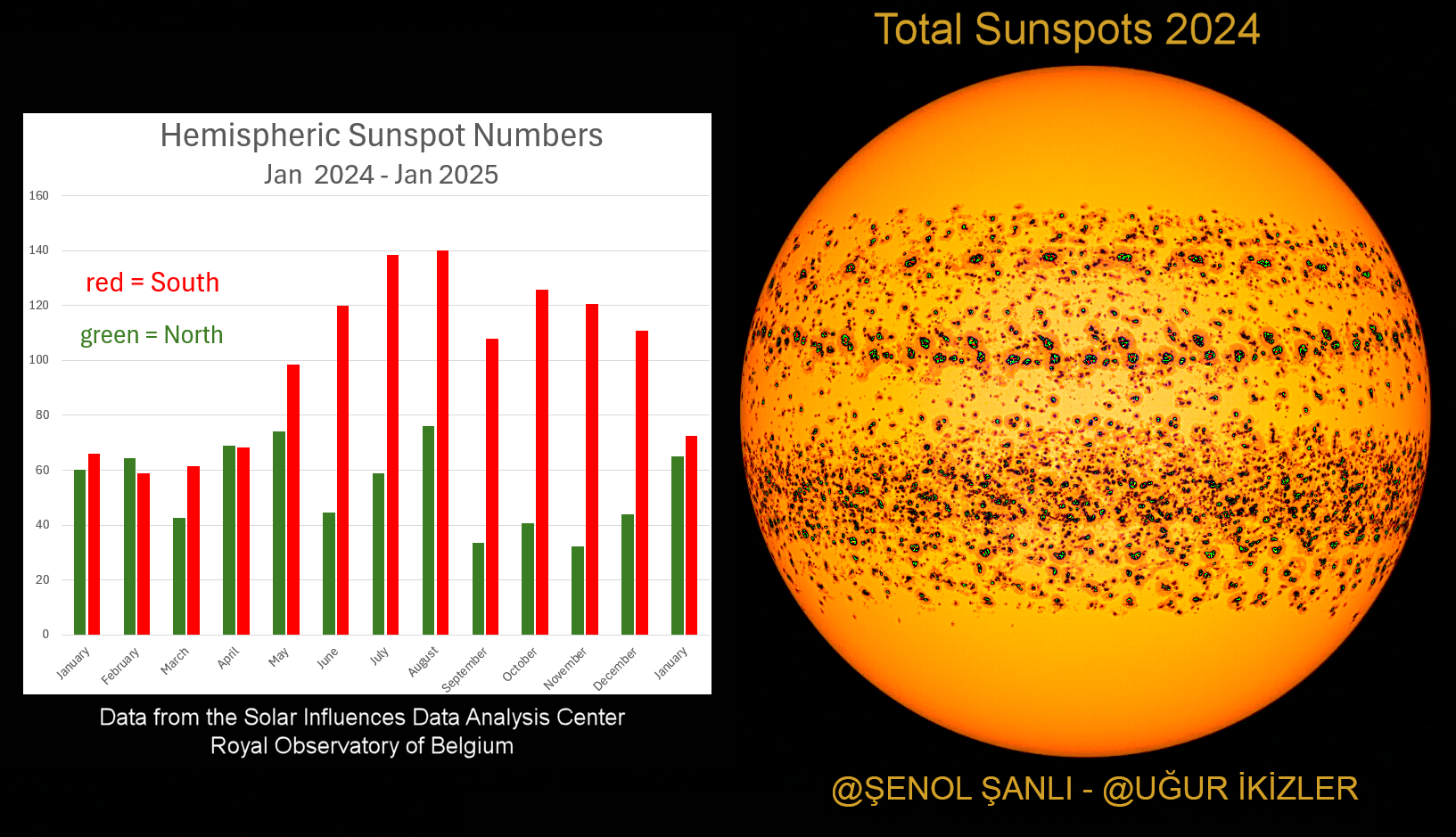
For forecasters of the solar cycle, this raises an interesting possibility: Maybe the northern peak is still coming. Indeed, there are signs in February 2025 that the pendulum is swinging. This month's sunspots have been more evenly distributed between the two hemispheres, a sign that activity may be shifting north.
On the other hand, the northern peak might have already occured. Take another look at the first plot. There is a puny northern peak near the beginning of Solar Cycle 25. Perhaps that was it.
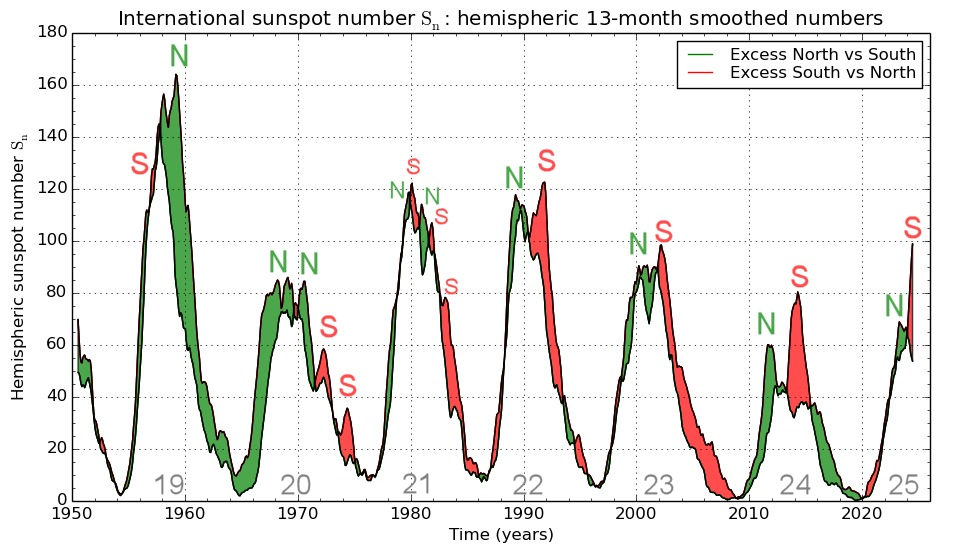
This discussion focuses attention on the north-south balance of sunspots. A northern shift in the months ahead could herald a second peak and another year or two of excellent auroras before Solar Cycle 25 finally peters out. Stay tuned!
Realtime Aurora Photo Gallery
Free: Spaceweather.com Newsletter
THE MILKY WAY IN A CRYSTAL BALL: Are you looking for a big gift? How about the entire Milky Way? The students of Earth to Sky Calculus have launched our own galaxy to the stratosphere onboard a cosmic ray research balloon. Here it is 113,517 feet above the Sierra Nevada mountains of central California:
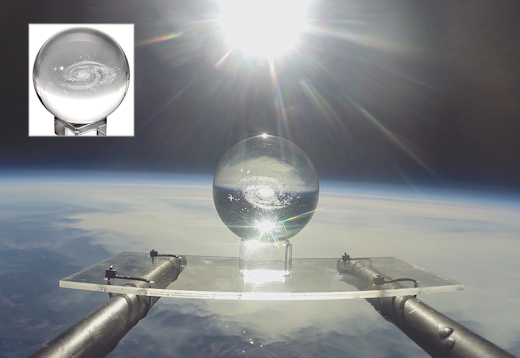
You can have it for $119.95. The galaxy is laser etched inside a 60 mm crystal sphere. You can turn it in your hands, inspecting the spiral star system from any angle. The gift-boxed sphere comes with a greeting card showing the item in flight and telling the story of its journey to the edge of space.
Far Out Gifts: Earth to Sky Store
All sales support hands-on STEM education
FALCON 9 RE-ENTRY OVER EUROPE: The upper stage of a SpaceX Falcon 9 rocket plunged into Earth's atmosphere on Feb. 19th (0345 UTC) producing a spectacular light show over Europe. A meteor camera operated by André Knoeffel in Brandenburg, Germany, recorded the disintegrating debris:
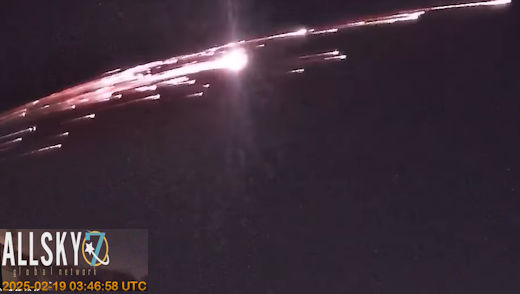
Early risers in the Netherlands, UK, Germany and Denmark saw the fragmenting rocket body glide slowly across the sky as more than 3,900 kilograms (8,598 pounds) of metal and plastic disintegrated.
The rocket should have reentered almost 3 weeks ago, just after Feb. 1st when it propelled 22 internet satellites (Starlink group 11-4) into Earth orbit. It failed to deorbit, however, instead coming down yesterday in an uncontrolled blaze.
This event adds to the already unprecedented number of Starlink satellites and SpaceX debris reentering Earth's atmosphere in early 2025. We'll be posting an update about that early next week. Stay tuned!
Realtime Space Weather Photo Gallery
Free: Spaceweather.com Newsletter
Realtime Aurora Photo Gallery
Free: Spaceweather.com Newsletter