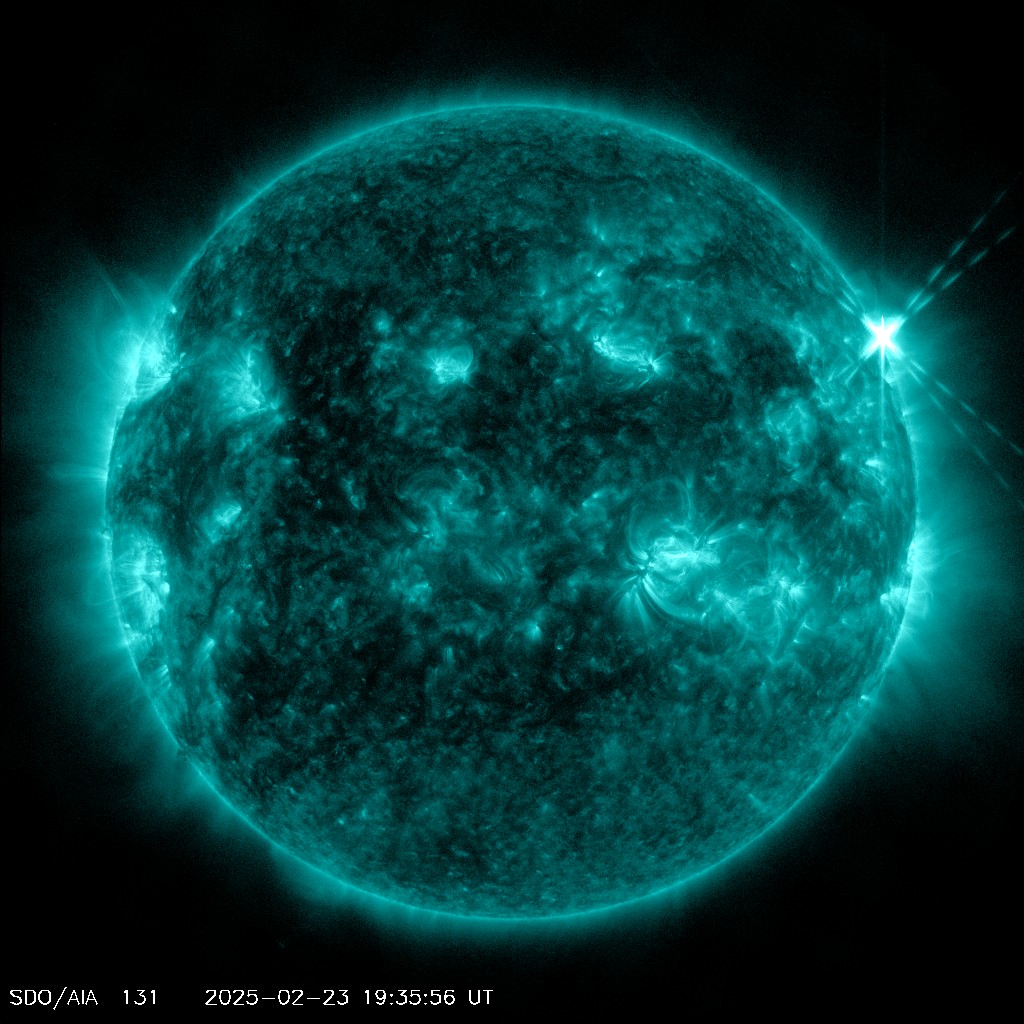
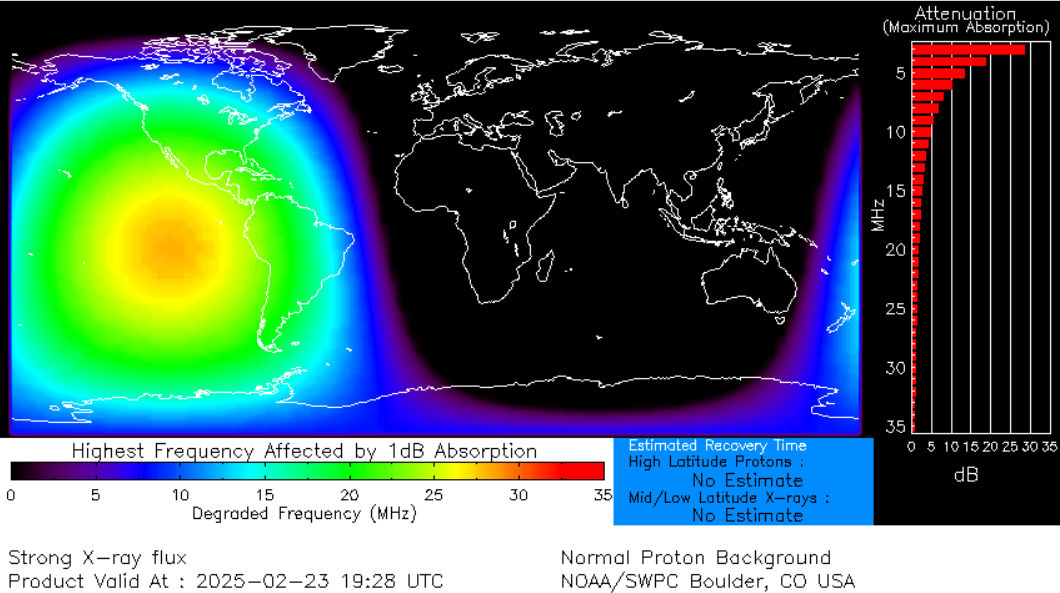
X-CLASS SOLAR FLARE: Earth-orbiting satellites detected an X2-class solar flare on Feb. 23rd (1927 UTC). The source was just behind the sun's northwestern limb--a location that will not allow it to send a CME toward Earth. However, a pulse of extreme UV radiation did cause a shortwave radio blackout over the equatorial Pacific Ocean. Solar flare alerts: SMS Text.
GRAVITATIONAL LENS STEREOSCOPY: In recent years, some astronomers have wondered if images of gravitationally lensed galaxies could be combined as stereo pairs, allowing a 3D view of star systems billions of light years away. The technique is called "gravitational lens stereoscopy." German stereoscopist Hanno Falk just tried it with JWST images of the famous question mark galaxy in Eridanus, and here is the result:
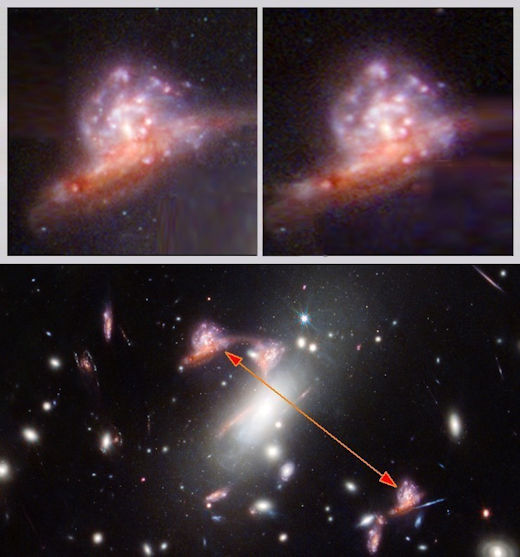
"I combined two lensed images of the same galaxy to create a pair of 3D-cross-eyed pictures," explains Falk.
To make this work, click on the full-sized image. Stare at the two side-by-side frames, slowly crossing your eyes until they merge. The shape of the galaxy should pop out of the screen.

For readers whose eyes won't cross, Falk created this blink comparison that captures some of the same effect:
An anaglyph is also available if you have red-blue glasses: Take a look.
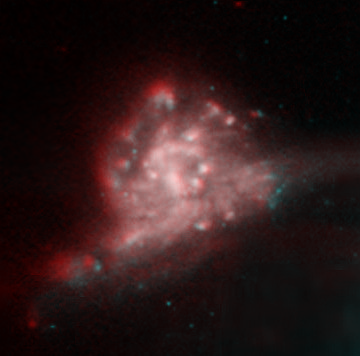
This galaxy went viral in 2023 when Hubble images captured what appeared to be a cosmic question mark. A closer look by the JWST revealed it to be a pair of interacting galaxies--one stripping plumes of gas and stars from the other. In addition, these galaxies are lensed by an intervening cluster of galaxies, MACS-J0417.5-1154, which acts like a magnifying glass because the cluster is so massive it warps the fabric of space-time. JWST has detected at least 4 copies of the question mark scattered around the lensing cluster. Falk combined the two most prominent copies to create the stereo pair.
Gravitational lenses aren't perfect for stereoscopy. A normal stereoscopic image is produced by taking two photographs of the same scene from slightly different angles, essentially mimicking how our own eyes see the world from slightly different perspectives. However, the angles involved in gravitational lensing are typically very small--no more than a few arcseconds. Moreover, lensed images are distorted. These factors may combine to produce false features in lensed stereographs. But it's fun and it's new, so congratulations Hanno!
Realtime Space Weather Photo Gallery
Free: Spaceweather.com Newsletter
THE INFINITE RAINBOW PENDANT: Nothing says "I Love You" like an Infinite Rainbow Pendant from the edge of space. It's an authentic Swarovski crystal wrapped in a sterling silver infinity loop, which flew 113,209 feet above the Sierras on an Earth to Sky cosmic ray research balloon:
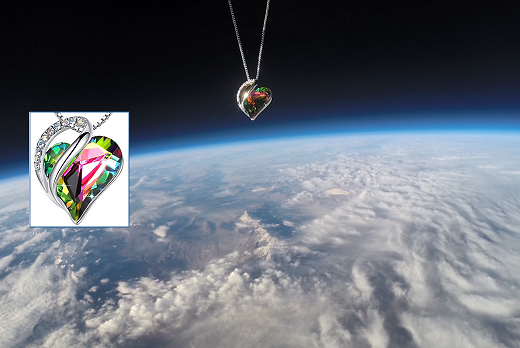
You can have it for $162.95. The crystal glitters with all the colors of a rainbow. It is suspoended from a matching 18-inch silver-embossed chain with a 2-inch extender. The pendant comes with a romantic card showing the jewelry in flight and telling the story of its journey to the edge of space and back again.
Far Out Gifts: Earth to Sky Store
All sales support hands-on STEM education
Realtime Space Weather Photo Gallery
Free: Spaceweather.com Newsletter
Realtime Aurora Photo Gallery
Free: Spaceweather.com Newsletter