ASTEROID 2024 YR4 IS NO LONGER A THREAT: Christmas 2032 might be Merry, after all. New observations of "city-killer" asteroid 2024 YR4 have ruled out an impact with Earth on Dec. 22, 2032. According to JPL, the odds of a strike have plummeted to a miniscule 0.002%--safer than crossing the street or driving a car.
A MILLION ASTEROIDS FROM ALPHA CENTAURI: If you want to travel to Alpha Centauri, it'll take thousands of years using current technology. It might be easier to wait. Astronomers have long known that the triple star system is approaching Earth for a close encounter 28,000 years from now. Indeed, a new study contends that asteroids from alpha Centauri are already here.
"We estimate that a million asteroid-sized objects from the alpha Centauri system could be in the Solar System right now," says Cole Gregg, a PhD student at the University of Western Ontario (UWO) and co-author of the study just accepted by the Planetary Science Journal. This simulation from the study shows asteroids entering the Solar System as alpha Centauri passes by:
Interest in alien asteroids spiked in 2017 when 'Oumuamua raced through the solar system. Prof. Avi Loeb from Harvard argued that the cigar-shaped object might be an alien spacecraft, but most astronomers went with Occam's Razor. It was more likely a natural body from another star system, they argued.
To investigate the likelihood of such bodies, Gregg and co-author Paul Wiegert (also of UWO) decided to do a case study of Alpha Centauri, the closest star system to Earth. Within Alpha Centauri, three stars and an unknown number of planets are constantly using their gravity to scatter objects out into space. Dust, comets, asteroids, ancient planetesimals--they're all flying out of the Alpha Centauri system in a cloud like Pigpen's from the Peanut comics. Running a simulation that spanned more than 100 million years, Gregg and Wiegert showed that a significant number of these objects could reach us.
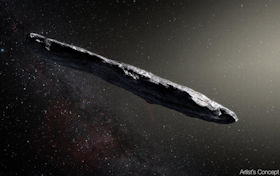 Right: The first known interstellar object to visit our solar system, 'Oumuamua
Alpha Centauri isn't the only star system potentially sending asteroids our way. "Quite a few have had (or will have) close encounters with the Solar System," notes Gregg. "An example of a past approach is Scholz's star, which likely passed through the Oort Cloud around 70,000 years ago. An example of a future approach is Gilese 710, which is estimated to pass by 1.3 million years from now also within the Oort Cloud."
So alien asteroids are *not* unusual. Can we now go out and find some?
It's harder than it sounds. The Solar System is a big place and even with a million Alpha Centauroids "the observable fraction of such objects remains low as there is only a probability of 10-6 that one of them is within 10 AU of the sun," write Gregg and Wiegert. A better bet is to look for meteors. Their analysis suggests that the Solar System may be littered with dust from Alpha Centauri. In the night skies of Earth, as many as 10 meteors per year may come from that distant star system.
It's something to think about the next time you see a shooting star...
Read the original research here: https://arxiv.org/abs/2502.03224
Realtime Space Weather Photo Gallery
Free: Spaceweather.com Newsletter
GLOW-IN-THE-DARK AURORA PENDANT: Are you looking for a far-out gift? Consider the Glow-in-the-Dark Aurora Pendant. On July 8, 2024, it flew to the stratosphere onboard an Earth to Sky Calculus cosmic ray research balloon:
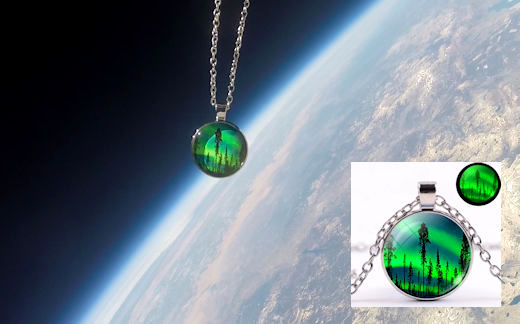
You can have it for $99.95. For 3 hours, the necklace floated 106,444 feet above the Sierra Nevada mountains of central California while radiation sensors inside the balloon's payload gathered data for the students' cosmic ray monitoring project. It comes with a greeting card showing the pendant in flight and explaining the Earth to Sky Calculus radiation experiment.
The students of Earth to Sky Calculus are selling space jewelry to support their cosmic ray ballooning program. Get yours now!
Far Out Gifts: Earth to Sky Store
All sales support hands-on STEM education
Realtime Space Weather Photo Gallery
Free: Spaceweather.com Newsletter
Realtime Aurora Photo Gallery
Free: Spaceweather.com Newsletter